
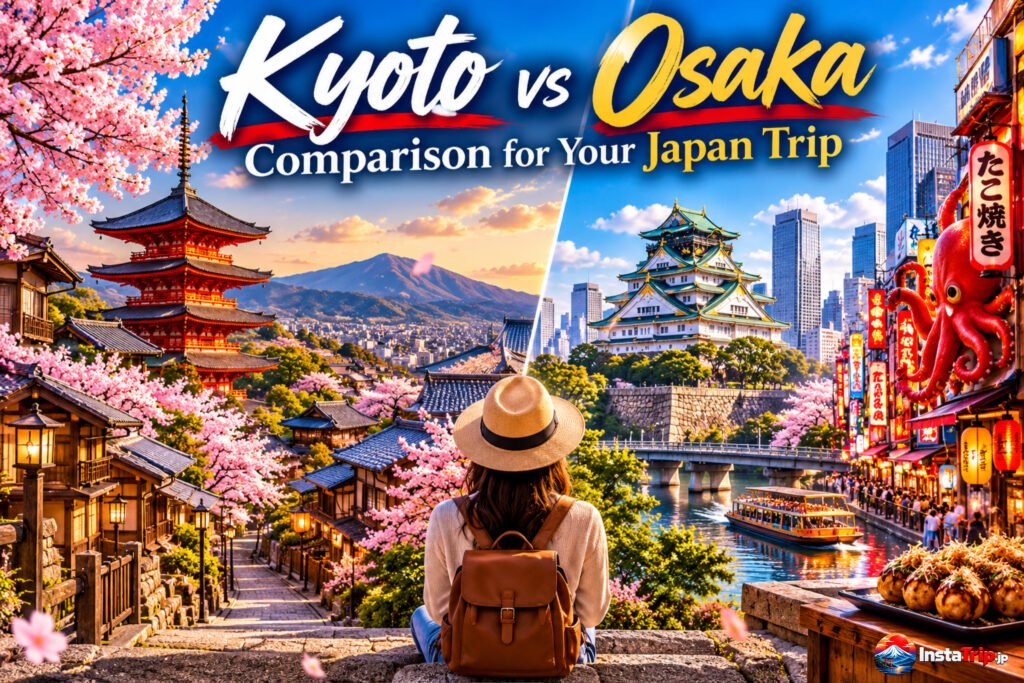
Kyoto and Osaka sit less than an hour apart, yet they create entirely different memories. A Kyoto Osaka comparison is not really about choosing the “better” city. It is about deciding whether your Japan journey calls for temple bells, moss gardens, and centuries of craft, or glowing signboards, sizzling street food, and a city that feels wonderfully awake after dark.
For many travelers, the answer is both. But time is precious, and each city deserves to be experienced on its own terms. Kyoto rewards patience and early mornings. Osaka invites spontaneity, appetite, and a willingness to follow the brightest street into the next neighborhood.
Kyoto Osaka Comparison: Two Different Rhythms
Kyoto is Japan’s former imperial capital, a city where the past remains visible in the grain of wooden townhouses, the geometry of dry gardens, and the rituals of seasonal festivals. Its most celebrated sights can be crowded, especially around Higashiyama, Arashiyama, and Fushimi Inari Taisha. Yet Kyoto is not a museum. It is a living city shaped by university life, independent coffee shops, contemporary art, neighborhood sento bathhouses, and culinary traditions refined over generations.
Osaka is more direct and dynamic. It is Japan’s great merchant city, historically powered by trade, theater, industry, and an enduring love of good food. Its personality is most vivid in places such as Dotonbori, Shinsekai, Umeda, and Nakazakicho, where retro alleys, futuristic towers, casual bars, and tiny specialist restaurants can exist blocks apart. Osaka feels less formal than Kyoto, though it has its own profound history, from Osaka Castle to Shitennoji, one of Japan’s oldest Buddhist temple complexes.

The contrast is not simply old versus new. Kyoto has striking modern architecture and a lively creative scene. Osaka has sacred spaces, traditional performing arts, and deeply rooted local customs. The real difference is tempo. Kyoto often asks you to slow down and notice. Osaka encourages you to join in.
Choose Kyoto for Timeless Atmosphere and Cultural Depth
Kyoto is a remarkable choice for travelers drawn to Japanese architecture, spirituality, gardens, tea culture, and the changing colors of the seasons. Walking through Gion in the early morning, before the day’s crowds arrive, reveals lattice-fronted machiya townhouses and narrow stone lanes that still carry the atmosphere of an old capital. Near the Philosopher’s Path, the pace becomes quieter still, with canals, small temples, and hillside neighborhoods inviting an unhurried wander.
The city’s major landmarks are magnificent for good reason. Kiyomizu-dera rises above eastern Kyoto with expansive wooden terraces and views across the basin. Kinkaku-ji’s gold-covered pavilion reflects in a pond with theatrical precision. Ryoan-ji’s rock garden turns simplicity into a lasting question: what do you see when there is almost nothing to distract you?
Kyoto’s deepest pleasures often appear beyond the headline sights. A morning visit to a smaller Zen temple can feel more intimate than a famous attraction at midday. Nishijin’s textile heritage, Kyoto-style confectionery, ceramics, incense, and kaiseki cuisine reveal how the city has preserved and reinvented its artistic traditions. Even a simple meal can carry a strong sense of place, whether it is yudofu near Nanzen-ji or a seasonal wagashi served with matcha.

There are trade-offs. Kyoto’s bus network can be slow during peak sightseeing hours, and popular areas become congested in spring and autumn. Travelers who want a late-night city energy may find central Kyoto comparatively restrained. The city is most rewarding when you build in breathing room rather than trying to collect temples from morning to evening.
Kyoto is especially suited to…
Kyoto fits travelers who want to photograph historic streets, learn about Buddhist and Shinto traditions with care, explore gardens and craftsmanship, or spend time in a quieter visual world. It also works beautifully for couples, culture-focused first-time visitors, and repeat travelers ready to look beyond the most famous landmarks.
Choose Osaka for Food, Nightlife, and Urban Energy
Osaka is often described through its food, and that reputation is richly deserved. The city’s casual culinary culture is immediate and joyful: takoyaki served hot from the griddle, okonomiyaki cooked before you, kushikatsu enjoyed in a lively local restaurant, and bowls of ramen or udon that feel like a complete evening plan. The phrase kuidaore, often understood as eating oneself into ruin, is associated with Osaka’s exuberant appetite, though the city offers far more than indulgence.
Dotonbori is the dazzling first impression, with canal-side crowds, illuminated signs, and the famous Glico running man. It is energetic, theatrical, and undeniably touristy. For a broader view of Osaka, spend time in Umeda, where elevated walkways and department store basements form a polished urban labyrinth, or in Nakazakicho, where converted houses hold small galleries, cafes, and vintage shops. Amerikamura brings youth culture and street fashion, while Tenma offers a more local-feeling maze of eateries and drinking spots.
Osaka also has exceptional cultural experiences. Bunraku puppet theater, recognized for its intricate puppetry, music, and storytelling, has a historic home here. Osaka Museum of History offers a compelling perspective on the city’s evolution, while the grounds around Osaka Castle make room for a slower afternoon, particularly during cherry blossom season.
The trade-off is that Osaka can feel visually intense and noisier than Kyoto, particularly around Namba and Dotonbori. Travelers seeking hushed lanes and contemplative scenery may need to choose their neighborhoods carefully. Osaka’s best rhythm is often found by balancing its high-energy centers with places such as Nakanoshima, a riverside district of museums, architecture, and green space.
Osaka is especially suited to…
Osaka is ideal for travelers who want evenings full of choice, approachable local food, shopping, contemporary city life, and a more casual social atmosphere. It is particularly appealing for friends, solo travelers, families with older children, and anyone who believes a memorable meal can be as meaningful as a famous landmark.
Kyoto or Osaka for a Short Trip?
If you have only one full day in Kansai, choose according to the experience you want to remember. Pick Kyoto if a sunrise walk through torii gates, a temple garden, or a traditional neighborhood would make the trip feel complete. Pick Osaka if you want a city that delivers food, entertainment, and urban spectacle from afternoon into late evening.
With two or three days, staying in one city and taking a day trip to the other is entirely practical. Fast rail connections place central Osaka and Kyoto within easy reach, although stations, local transfers, and the distance between attractions still take time. Do not mistake a short train ride for a short day. Kyoto’s key sights are spread across the city, while Osaka’s vast station areas can require plenty of walking.
For a first visit, Kyoto often benefits from an overnight stay because its most magical hours arrive before day-trippers and after they leave. Osaka, meanwhile, is especially compelling at night, when restaurant curtains lift, neon reflects on wet pavement, and an ordinary side street can lead to an excellent dinner.
Where You Stay Changes the Experience
In Kyoto, Gion and Higashiyama place you close to historic scenery but can be busy and expensive. Downtown Kyoto, around Kawaramachi and Karasuma, offers easier dining and transit while remaining close to cultural areas. Arashiyama is scenic but less convenient for a citywide itinerary.
In Osaka, Namba suits travelers who want Dotonbori, markets, and nightlife nearby. Umeda is excellent for rail access, shopping, and a more polished metropolitan feel. Tennoji can offer strong transport connections and access to parks, museums, and Shinsekai’s retro character. Neighborhood choice matters because each city is large enough to shape your daily energy.
Kyoto vs Osaka at a Glance
| Your priority | Kyoto | Osaka |
|---|---|---|
| Typical sightseeing | Temples, gardens, shrines and traditional streets | Food districts, urban attractions and lively evening streets |
| Evenings | A quieter atmosphere in many historic areas | A natural fit for food and nightlife itineraries |
| Where to stay | Kyoto Station for rail access; downtown for central walks | Umeda for rail connections; Namba for southern downtown |
| Budget decision | Compare actual hotels, travel dates and daily transport costs | |
How to Travel Between Kyoto and Osaka
Choose the railway by your destination, not just the city name. JR’s Special Rapid service takes roughly 30 minutes between Osaka Station and Kyoto Station. Hankyu links Osaka-umeda with Kyoto-Kawaramachi in about 45 minutes; Keihan’s Limited Express connects Yodoyabashi with downtown Kyoto stations such as Gion-Shijo and Sanjo in roughly 48 minutes.
These are approximate train times, not door-to-door journeys. Add the walk to your station, waiting time and local transfers. For most central Kyoto–Osaka sightseeing trips, conventional trains are sufficient; the Shinkansen serves a different station pair. Check the official Kyoto access guide and your route on the day.
A Flexible Four-Day Kyoto and Osaka Plan
Spend two days in Kyoto, grouping one day around eastern districts and another around a smaller selection of temples or gardens. Then spend two days in Osaka, leaving room for a food-focused evening and attractions near your accommodation. This is a planning example: opening days, crowd levels and your interests should determine the final order.
One hotel base can save a move, while two bases can reduce repeated commuting. Compare the entire stay: room prices, luggage storage, transfers and the cost of returning after dinner. Neither city is automatically cheaper for every travel date.
Watch: An Evening Walk Through Kyoto’s Gion
This VIRTUAL KYOTO walking tour follows the streets around Yasaka Shrine, Hanamikoji and Gion Shirakawa. It gives you a sense of Kyoto’s evening atmosphere as you compare it with Osaka’s urban energy.
Watch this walking tour on YouTube.
Useful Japanese Words for Your Route
京都 (Kyōto) and 大阪 (Ōsaka) are the city names. 新快速 (shinkaisoku) means Special Rapid on JR services. 京都駅 (Kyōto-eki) is Kyoto Station: it is not the same location as Kyoto-Kawaramachi, so double-check which station is closest to your hotel.
Kyoto or Osaka: Frequently Asked Questions
Can I visit Kyoto as a day trip from Osaka?
Yes. Select one area or a short list of sights, and include local travel within Kyoto in your schedule. Trying to cover both sides of the city can turn a simple day trip into hours of transport.
Should I change hotels between the cities?
Change hotels when it helps your itinerary or evenings. Keep one base when avoiding luggage transfers matters more; calculate the actual commute from that hotel.
Which city is better for a first trip?
Choose Kyoto for a temple-and-garden focus, Osaka for food and city evenings, or divide your stay if both matter to you.
Build your Kyoto shortlist with our Kyoto temples guide and guide to geisha performances. For a wider city decision, read the Tokyo and Osaka comparison.
Useful travel items (paid links): Japanese travel phrasebooks and compact travel daypacks.
The Best Answer May Be Both
Kyoto and Osaka are not rivals so much as complementary expressions of Kansai. One reveals Japan through ritual, restraint, artistry, and the quiet persistence of history. The other reveals it through flavor, humor, commerce, performance, and the electric pleasure of city life.
Give Kyoto an early morning and give Osaka an evening. Let the first teach you to look closely, then let the second remind you to follow your appetite. That combination can turn a Kansai itinerary into something far more lasting than a checklist.