

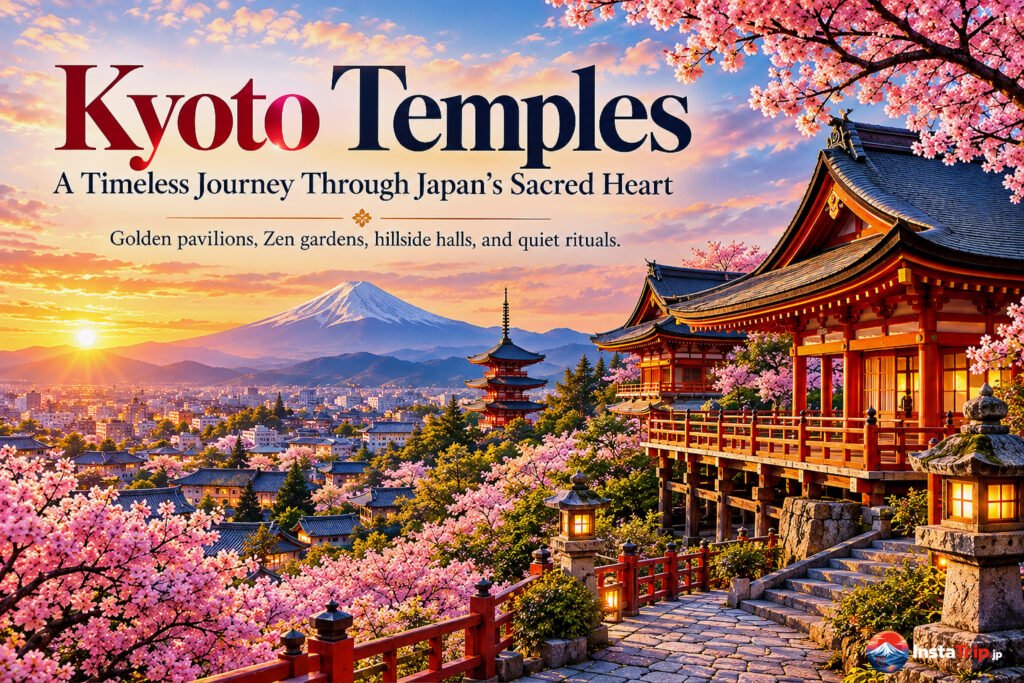
Kyoto is one of the best places in Japan to understand Buddhism through architecture, gardens, sculpture, ritual, and everyday practice. Its famous temples range from the dramatic wooden stage of 清水寺 (Kiyomizu-dera) to the gold-covered pavilion of 金閣寺 (Kinkaku-ji), the rock garden of 龍安寺 (Ryōan-ji), and the thousand Kannon statues of 三十三間堂 (Sanjūsangen-dō).
For first-time visitors, the challenge is not finding a temple — it is choosing which ones deserve your limited time. This Kyoto temples guide focuses on the best temples for different experiences, practical neighborhood routes, Buddhist etiquette, seasonal planning, and how to avoid turning Kyoto into a rushed checklist.
Kyoto Temples at a Glance
| Temple | Japanese | Best for | Area |
|---|---|---|---|
| Kiyomizu-dera | 清水寺 | City views, historic approach, first visit | Higashiyama |
| Kinkaku-ji | 金閣寺 | Iconic architecture and reflection | Northwest Kyoto |
| Ginkaku-ji | 銀閣寺 | Gardens, Higashiyama aesthetics | Eastern Kyoto |
| Ryōan-ji | 龍安寺 | Zen rock garden | Northwest Kyoto |
| Nanzen-ji | 南禅寺 | Zen, gardens, aqueduct, spacious grounds | Eastern Kyoto |
| Sanjūsangen-dō | 三十三間堂 | Buddhist sculpture | Higashiyama / Shichijō |
| Tō-ji | 東寺 | Five-story pagoda, Shingon Buddhism | Kyoto Station area |
Best first-time combination: choose two or three temples from the same area rather than crossing the city repeatedly. Kyoto’s buses and streets can become crowded, especially during cherry blossom and autumn foliage seasons.
寺 (Tera) or 神社 (Jinja)? Know the Difference
A Buddhist temple is generally called 寺 (tera / ji), while a Shinto shrine is 神社 (jinja). Kyoto has extraordinary examples of both, but their rituals differ. Temple names often end in -ji, -dera, or -in.

One common mistake is calling Fushimi Inari a temple. 伏見稲荷大社 (Fushimi Inari Taisha) is a Shinto shrine, not a Buddhist temple. For a clearer comparison, see our temples vs shrines in Japan guide.
1. 清水寺 (Kiyomizu-dera): Best for a First Visit
Kiyomizu-dera is one of Kyoto’s most recognizable Buddhist sites. Its wooden veranda projects from the Higashiyama hillside on tall timber supports and opens toward the city below. The official Kyoto guide highlights the main hall, its Kannon image, mountain setting, and broad city views. Kyoto Travel’s official Kiyomizu-dera guide is a useful source for current access information.
The approach is part of the experience. 二年坂 (Ninenzaka) and 三年坂 (Sannenzaka) climb through historic streets lined with shops, cafés, crafts, and traditional architecture. Arrive early if you want a quieter atmosphere; by late morning this can be one of Kyoto’s busiest areas.
Kiyomizu-dera is especially beautiful during spring blossoms and 紅葉 (autumn foliage), when seasonal night openings may also be scheduled.

2. 金閣寺 (Kinkaku-ji): Kyoto’s Golden Icon
金閣寺 (Kinkaku-ji), formally Rokuon-ji, is famous for the gold-covered pavilion reflected in 鏡湖池 (Kyōko-chi / Mirror Pond). Kyoto’s official travel guide notes that the building first served as a retirement villa for shogun Ashikaga Yoshimitsu before becoming a Zen temple after his death. The current pavilion was rebuilt in 1955 after the 1950 fire.
The visit follows a fairly structured one-way route, so Kinkaku-ji is less about wandering than seeing one of Japan’s most carefully framed architectural landscapes. Early opening time is usually the best strategy if photography matters to you.
3. 銀閣寺 (Ginkaku-ji): Subtle Beauty and Higashiyama Culture
銀閣寺 (Ginkaku-ji), formally Jishō-ji, is the quieter counterpart to the Golden Pavilion. Despite the name, it was never covered in silver. Its restrained architecture, sand garden, moss, pond, and wooded path embody the refined culture associated with shogun Ashikaga Yoshimasa. Kyoto’s official guide describes its grounds as an outstanding example of Japanese landscape design.
Ginkaku-ji also anchors one end of the 哲学の道 (Philosopher’s Path), making it easy to combine with smaller temples and eventually Nanzen-ji.
4. 龍安寺 (Ryōan-ji): Kyoto’s Most Famous Zen Rock Garden
Ryōan-ji is famous for its 枯山水 (karesansui) garden: fifteen stones arranged within raked white gravel and enclosed by an earthen wall. Kyoto’s official tourism site notes that from any single viewpoint, at least one of the fifteen stones remains hidden.
Do not treat it as a five-minute photograph. Sit on the veranda, let the crowd move, and look at the garden long enough for the spacing, wall, shadows, and empty areas to become part of the composition.
Ryōan-ji pairs naturally with Kinkaku-ji and Ninna-ji in northwest Kyoto.
5. 南禅寺 (Nanzen-ji): Zen, Gardens and the Suirokaku Aqueduct
南禅寺 (Nanzen-ji) is the head temple of the Rinzai Nanzen-ji school and one of Kyoto’s strongest choices if you want space, Zen architecture, gardens, and less of a single “must-photograph” focal point. Its enormous Sanmon gate, dry landscape garden, subtemples, and brick 水路閣 (Suirokaku) aqueduct create an unusual blend of medieval Zen and Meiji-period engineering.
Current note: Nanzen-in, one of the subtemples within the wider complex, is closed for roof renovation until around spring 2027 according to Kyoto City tourism information. The main Nanzen-ji complex remains a separate visit.
6. 三十三間堂 (Sanjūsangen-dō): Best for Buddhist Sculpture
Sanjūsangen-dō offers a completely different experience. Its long hall contains a central seated Kannon and 1,000 standing statues of 千手観音 (Senju Kannon), along with guardian deities. Kyoto’s official tourism guide describes the ensemble as one of the city’s most extraordinary collections of Buddhist sculpture.
Photography inside the hall is prohibited, which is part of what makes the visit memorable. Instead of looking through a phone, you face rows of carved figures and details directly.
7. 東寺 (Tō-ji): Pagoda, Esoteric Buddhism and a Famous Market
東寺 (Tō-ji) sits close to Kyoto Station and is especially useful when you have limited time. Its five-story pagoda rises about 55 meters and has long been one of Kyoto’s defining silhouettes. The temple was transferred to Kūkai in 823 and became an important center of Shingon Buddhism.
On the 21st of each month, the temple hosts the large Kōbō-san flea market, bringing antiques, ceramics, textiles, plants, food, and everyday local energy into the grounds.
Best Kyoto Temple Routes by Neighborhood
Higashiyama: Kiyomizu-dera + Sanjūsangen-dō
Start early at Kiyomizu-dera, walk down through Sannenzaka and Ninenzaka, then continue through eastern Kyoto. Sanjūsangen-dō works well later in the day if Buddhist sculpture interests you.
Philosopher’s Path: Ginkaku-ji + Nanzen-ji
This is one of Kyoto’s most satisfying slow routes. Begin at Ginkaku-ji, follow the Philosopher’s Path, stop at smaller temples as time allows, and finish around Nanzen-ji.
Northwest Kyoto: Kinkaku-ji + Ryōan-ji
These two famous temples are close enough to combine without wasting much of the day in transit. Add Ninna-ji only if you genuinely have time rather than rushing all three.
Kyoto Station Area: Tō-ji
Tō-ji is one of the easiest major temples to work into an arrival or departure day because of its proximity to Kyoto Station.
Kyoto Temple Etiquette: What Visitors Should Know
Buddhist temples are active religious places, even when they are also major tourist attractions. Basic etiquette is straightforward:
- Speak quietly inside worship halls.
- Follow all photography signs; many interiors prohibit photos.
- Remove shoes when requested.
- Do not cross ropes, barriers, or enter private monastic areas.
- Do not touch statues, paintings, moss, or garden elements.
- At a Buddhist temple, do not clap as you would at many Shinto shrines.
- A small bow and quiet prayer are appropriate; you do not need to imitate unfamiliar rituals.
If you also plan to visit shrines, our Japanese shrine etiquette guide (神社参拝) explains why the worship sequence is different.
御朱印 (Goshuin): Temple Calligraphy and Seals
Many Kyoto temples offer 御朱印 (goshuin), calligraphic records and seals traditionally associated with visiting a sacred site. They are collected in a dedicated 御朱印帳 (goshuinchō).
Treat goshuin as part of the religious visit rather than as a tourist stamp hunt. Procedures vary: some are written directly into your book, while others are provided on prepared paper, especially during busy periods.
Best Time to Visit Kyoto Temples
Spring: cherry blossoms add extraordinary beauty but also major crowds.
Summer: temple gardens become intensely green; expect heat and humidity.
Autumn: 紅葉 (kōyō) brings some of Kyoto’s most dramatic scenes and seasonal illuminations. See our Kyoto autumn illuminations guide.
Winter: fewer visitors, bare garden structure, cold air, and occasional snow can make famous temples feel completely different.
For major temples, opening time on a weekday is usually the strongest strategy. Kyoto’s most famous sites can change character dramatically once tour groups arrive.
How Many Kyoto Temples Should You Visit in One Day?
For most travelers, two to four temples in a day is enough, depending on how close they are. Seeing six famous temples across opposite sides of Kyoto may look efficient on a map but usually means buses, queues, and very little time actually experiencing the places.
Build days around neighborhoods. The less time you spend crossing Kyoto, the more time you have for gardens, temple halls, tea, small streets, and unexpected discoveries.
Useful Gear for a Kyoto Temple Day
(paid links)
- Comfortable travel walking shoes on Amazon — Kyoto temple days often involve many kilometers of stone paths, slopes, and neighborhood streets.
- Compact lightweight travel umbrellas on Amazon — easy to carry when Kyoto weather changes between temple stops.
Watch: 京都・祇園から清水寺 — 4K ASMR Walk
This 4K walk from the Japanese channel VIRTUAL KYOTO goes from Gion through Ninenzaka and Sannenzaka to Kiyomizu-dera. There is no presenter talking over the journey — the streets, temple approach, and Kyoto atmosphere remain the focus.
Kyoto Temples FAQ
Which Kyoto temple is best for first-time visitors?
Kiyomizu-dera is one of the strongest first choices because it combines major Buddhist heritage, architecture, city views, and the historic Higashiyama approach. Kinkaku-ji is the other obvious icon if the Golden Pavilion is high on your list.
Is Fushimi Inari a temple?
No. Fushimi Inari Taisha is a Shinto shrine. Kyoto has both Buddhist temples and Shinto shrines, and their worship customs differ.
Do you clap at Buddhist temples in Kyoto?
No. Clapping is associated with worship at many Shinto shrines. At a Buddhist temple, a quiet bow and prayer are more appropriate.
Are Kyoto temples free?
Some temple grounds are free while specific halls, gardens, or famous complexes charge admission. Fees and opening hours vary, so check the official temple or Kyoto tourism page before visiting.
How many temples should I visit in Kyoto?
Two to four in one day is a comfortable range for most visitors. Group temples by neighborhood instead of trying to cross the city repeatedly.
What is the best season for Kyoto temples?
There is no single best season. Spring and autumn are visually spectacular but busiest; winter is quieter; summer offers lush gardens but intense heat and humidity.
Can I collect goshuin at Kyoto temples?
Many temples offer 御朱印, but availability and procedure vary. Bring a proper goshuinchō and follow each temple’s instructions.
Kyoto Is Better When You Stop Counting Temples
The memorable part of Kyoto is rarely the final number of temples you managed to visit. It is the sound of a bell in a wooden hall, raked gravel after morning rain, incense drifting across a courtyard, or the moment a crowded path unexpectedly becomes quiet.
Choose a few temples with different characters, give each enough time, and let the neighborhoods between them become part of the experience. That is when Kyoto stops feeling like a list of monuments and starts feeling like a living sacred landscape.