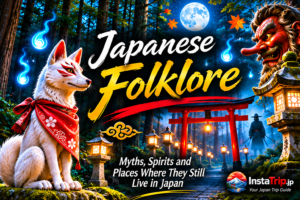

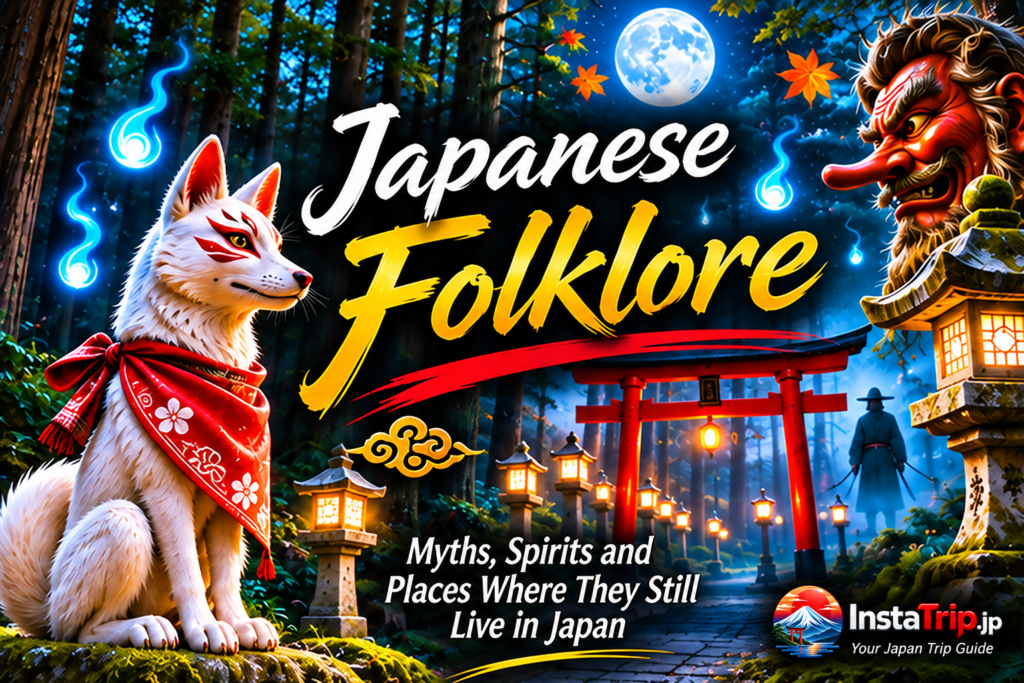
A vermilion torii standing at the edge of a cedar forest, a stone fox watching over a shrine path, the hush of a mountain village after rain: Japanese folklore is not confined to old storybooks. Its characters and ideas still shape the atmosphere of temples, festivals, theater, art, and ordinary landscapes across Japan.
For travelers, folklore offers a more meaningful way to look at what is already in front of them. A dragon painted on a temple ceiling may signal a local legend. A row of small statues in a quiet lane may carry prayers for children and travelers. Even the playful creatures seen in modern animation often have roots in stories that have moved through Japan for centuries.
Japanese Folklore (日本の民間伝承): Places, Video and Map
To explore 日本の民間伝承 (Japanese folklore), notice the difference between 妖怪 (yōkai, strange beings), 幽霊 (yūrei, ghosts), 神 (kami, sacred presences) and 狐 (kitsune, foxes). At 伏見稲荷大社 (Fushimi Inari Taisha) in Kyoto, fox figures symbolize messengers of Inari rather than foxes being worshipped as gods themselves.
See the torii paths and fox sculptures in this real 4K walk through Fushimi Inari:

Watch this video on YouTube (if the embedded player is unavailable).
Map: Fushimi Inari Taisha (伏見稲荷大社)
Useful reading: Japanese folklore and yōkai books on Amazon and illustrated Japanese mythology books.
Japanese Folklore at a Glance
What to look for: kami are sacred presences associated with Shinto traditions; yōkai are extraordinary beings in storytelling; and yūrei are ghosts, often connected with unfinished emotions or unresolved stories. These categories overlap in popular culture but are not interchangeable.
Best way to explore: choose a shrine, a local history museum or a regional festival, read the information provided on site and remember that a living place of worship is not a supernatural attraction. For related background, see our guide to Japanese mythology.

What Japanese Folklore Really Holds
Japanese folklore is a vast, evolving body of regional tales, beliefs, customs, and supernatural imagery. It includes ancient narratives recorded in texts such as the Kojiki and Nihon Shoki, Buddhist-influenced legends, village ghost stories, seasonal rituals, and tales shared between families and neighbors. There is no single canon that neatly contains it all.
That variety matters. A spirit or legend may be understood differently in Kyoto, coastal Kanagawa, snowy Tohoku, or Okinawa, where the Ryukyuan cultural tradition has its own distinctive spiritual world. Folklore is shaped by local geography: stormy seas, volcanic mountains, rice fields, deep forests, and the changing moods of the seasons.
It also resists a simple division between the sacred and the entertaining. A frightening tale can carry a warning about dangerous water or a remote road. A festival mask may be joyful and theatrical while drawing on beliefs about protection, harvests, and the unseen. The most captivating stories are rarely just about monsters. They are about how people have made sense of uncertainty, loss, nature, and community.
Kami, Yōkai, and Yūrei: Three Worlds of Wonder
Visitors often encounter these terms together, but they describe different ideas. Understanding the distinction adds depth to a visit without requiring anyone to become an expert overnight.
Kami and the presence of place
In Shinto, kami are sacred presences associated with natural forces, places, ancestors, and more. They should not be treated as a direct equivalent of gods in every other religious tradition. A waterfall, an ancient tree, a mountain, or a shrine may be connected with a kami, inviting reverence rather than spectacle.
This sense of presence helps explain why Japan’s shrines can feel so closely tied to their surroundings. At Meiji Jingu in Tokyo, the broad forest approach creates a pause within one of the world’s most dynamic cities. At Itsukushima Shrine in Hiroshima Prefecture, the famous torii appears to float on the sea, binding architecture, tide, and sacred landscape into one magnificent view.
Yōkai and the mischievous unknown
Yōkai are supernatural beings of extraordinary range. Some are dangerous, some amusing, some protective, and some simply strange. Their forms include animals, household objects, humanlike figures, and creatures that seem to emerge from a landscape’s particular mood.
The kappa, often depicted as a water-dwelling creature with a dish-like hollow on its head, is one of the best known. Folklore about kappa has been interpreted as a caution around rivers and ponds, especially for children, though local stories vary. Kitsune, or foxes, are another familiar presence. Associated especially with Inari worship, foxes can appear as shrine messengers and as clever shapeshifters in popular tales.
Yōkai became especially visible through illustrated scrolls, woodblock prints, and Edo-period popular culture. Today they remain vibrant in manga, games, film, and character design. That continuity is fascinating, but it is worth remembering that a cheerful souvenir version is only one chapter in a much older cultural history.
Yūrei and stories of lingering emotion
Yūrei are ghosts, often portrayed in white burial garments with long dark hair. In classic tales, they may be bound to this world by grief, betrayal, love, or an unresolved promise. Their imagery has influenced kabuki, ukiyo-e prints, and Japanese horror cinema.
These stories are not simply designed for a fright. They frequently explore responsibility, mourning, injustice, and the consequences of broken social bonds. The famous tale of Okiku, associated with Himeji Castle, has many versions, yet its emotional force remains immediate: a wronged servant’s voice continues to be heard after death.
Folklore You Can Encounter While Traveling
Japan’s folklore becomes most vivid when it is connected to a real setting. Some places are internationally known, while others reveal themselves in a small museum, a temple noticeboard, or a local festival program.
In Kyoto, the elegant Gion district carries associations with traditional arts and old urban legends, while temples and lanes throughout the city preserve an atmosphere where history feels close at hand. At Kiyomizu-dera, visitors may notice the shrine spaces and devotional practices that exist alongside the temple’s celebrated wooden stage. Japan’s religious landscape has long been shaped by interaction between Shinto and Buddhism, even when their institutions and practices are distinct.
In Tottori Prefecture, Mizuki Shigeru Road in Sakaiminato celebrates the yōkai universe popularized by manga artist Shigeru Mizuki. It is playful, highly visual, and accessible for families, but it also points visitors toward the broader legacy of yōkai illustration and storytelling.
Farther north, Aomori’s Nebuta Matsuri fills summer nights with enormous illuminated floats, bold color, drums, and movement. The festival’s imagery is drawn largely from historical and literary figures rather than one single folktale, yet its dramatic visual language shows how old narratives can become a living public celebration.
Mountain landscapes hold their own powerful traditions. Mount Fuji has inspired pilgrimage, artistic devotion, and stories of sacred power for centuries. In Nikko, ornate shrines set among towering cedars and rushing water reveal a landscape shaped by spiritual practice as much as by architecture. Here, folklore is not a separate attraction. It is part of the way a place has been seen and respected over generations.
How to Experience Japanese Folklore Respectfully
Curiosity is welcome, but the setting matters. A shrine or temple is an active religious site, not a themed backdrop. Follow posted guidance, keep voices low where appropriate, and observe how people approach purification fountains, prayer spaces, and sacred objects. Photography rules can differ sharply from one site to another.
It is also useful to let local context lead. A fox statue at an Inari shrine is not proof that every fox image tells the same story, and a demon mask is not automatically a sign of something evil. In many festivals, oni figures can be frightening, comic, protective, or cleansing. Meaning depends on the tradition, season, and community.
Museums, local cultural centers, and thoughtfully presented historic sites can offer valuable interpretation, especially when a story is unfamiliar. Travelers who enjoy folklore in translation may also find that seeing a landscape first changes the way a tale reads later. A river no longer feels abstract after you have stood beside it in evening mist.
Why These Stories Still Matter
Japanese folklore endures because it is wonderfully adaptable. It can appear in a centuries-old kagura performance, a child’s festival costume, a contemporary artwork, or a Tokyo storefront filled with yōkai imagery. It can be solemn, funny, unsettling, and beautiful within the same cultural moment.
More deeply, these stories encourage attention. They ask people to notice the threshold between town and forest, the character of a river, the vulnerability of a traveler, and the emotional weight that may remain in a familiar room. That attentiveness feels especially powerful in Japan, where a futuristic skyline and a quiet shrine grove can stand only minutes apart.
When you encounter a legend on your travels, linger with the place that gave it shape. Read the plaque, listen for the local version, and look beyond the creature or ghost at the landscape, ritual, or human feeling beneath the story. Japanese folklore becomes most memorable not when it is explained away, but when it makes the world around you feel a little more alive.