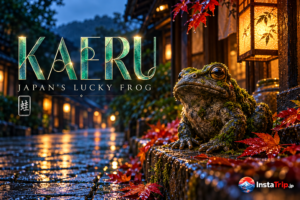

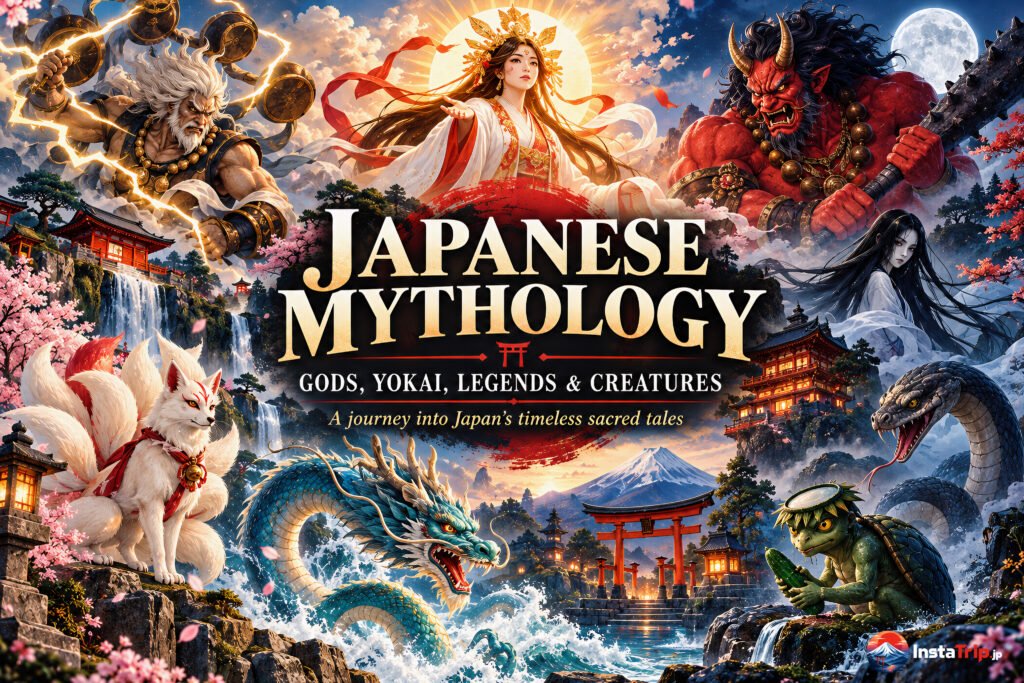
A vermilion torii gate rising from morning mist, a fox statue holding a key in its mouth, a mountain trail that suddenly feels hushed and watchful – Japanese mythology is never far from the landscape. Japanese mythology: gods, yokai, legends and creatures of Japan is not simply a collection of old stories. It is a living cultural world that still shapes shrines, festivals, theater, art, seasonal customs, and the atmosphere of places from Tokyo to remote mountain villages.
For travelers, these stories offer a richer way to see Japan. A temple guardian is not just decorative. A dragon painted on a ceiling may invoke rain and protection. A row of foxes at a shrine opens a path into centuries of belief, local memory, and imagination.
Japanese Mythology: Gods, Yokai, Legends, and Creatures
Japanese mythology has no single, fixed canon in the way many people expect. Its stories grew from Shinto traditions, regional folklore, court chronicles, Buddhist influences, and oral storytelling passed between generations. The ancient texts known as the Kojiki and Nihon Shoki preserve foundational myths, but the mythology encountered across Japan is much broader, wonderfully local, and often full of contradictions.

At its center is the idea of kami. Often translated as “gods,” kami are not always gods in the Western sense. They may be associated with natural forces, ancestors, striking places, animals, or qualities that inspire awe. A waterfall, old cedar tree, mountain peak, or rice field can carry spiritual presence.
This perspective helps explain why Japan’s natural scenery can feel so culturally charged. Mount Fuji is an immense volcanic landmark, but it is also connected to devotion and the goddess Konohanasakuya-hime. The forested slopes around Nikko, the crashing coast of the Kii Peninsula, and the quiet approach to a neighborhood shrine all invite visitors to notice a relationship between place and spirit.
Amaterasu and the heavenly origins of Japan
Among the most celebrated kami is Amaterasu Omikami, the sun goddess. In one of Japan’s best-known myths, Amaterasu retreats into a cave after being offended by the reckless actions of her brother Susanoo, the storm god. With the sun hidden, the world falls into darkness.
The other kami eventually lure her out through laughter, music, and a sacred mirror. When Amaterasu steps out to see the commotion, light returns to the world. It is a vivid story of restoration, but it also carries themes of harmony, ritual, and the power of communal celebration.

Amaterasu is especially associated with Ise Grand Shrine in Mie Prefecture, one of Shinto’s most sacred sites. Visitors should approach places of worship with quiet respect: observe the purification customs if they are offered, avoid treating sacred spaces as sets for dramatic photographs, and remember that shrines are active religious sites, not relics of a vanished past.
Susanoo, dragons, and the Yamata no Orochi
Susanoo is a more unruly figure. Banished from heaven, he arrives in the earthly realm and encounters a family grieving for daughters taken by the Yamata no Orochi, an enormous eight-headed serpent. Susanoo defeats the creature with sake, then finds a powerful sword within its tail.
The tale is dramatic enough for a modern fantasy film, yet it also reflects ancient connections between storm, water, danger, and renewal. Serpents and dragons appear throughout Japanese visual culture, often as water beings connected to rivers, rainfall, and the sea. At many temples and shrines, dragon imagery signals not evil, but protection and life-giving water.
Yokai: The Uncanny Neighbors of Folklore
If kami can inspire reverence, yokai inspire fascination, caution, laughter, and sometimes all three at once. Yokai are a vast category of supernatural beings. Some are frightening, some mischievous, some protective, and some so peculiar that they seem designed to delight a storyteller around a winter fire.
They are not all monsters. The word can include shapeshifters, haunted household objects, strange animals, ghosts, and beings tied to particular roads, rivers, or mountains. Their roles vary by region and by era, which is part of their enduring appeal.
Kitsune, tanuki, and the art of transformation
The fox, or kitsune, is one of Japan’s most recognizable mythic animals. Foxes are strongly associated with Inari, a kami connected with rice, prosperity, and commerce. That is why fox statues stand watch at Inari shrines, often carrying symbols such as a key to the rice granary.
Folklore also presents kitsune as intelligent shapeshifters. They may be helpful, romantic, deceptive, or mysterious. The point is rarely that foxes are simply good or bad. Their stories ask people to be alert to appearances and respectful of the unknown.
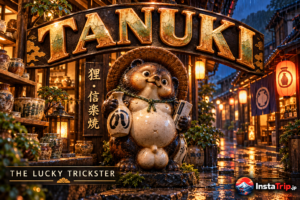
The tanuki, commonly called the Japanese raccoon dog, is another beloved trickster. Tanuki legends often celebrate playful transformation and comic mischief. In towns and outside restaurants, you may spot ceramic tanuki figures wearing wide hats and cheerful expressions. These are folk icons, not religious objects, and they reflect a more humorous side of Japan’s imaginative tradition.
Tengu and the wild mountain world
Tengu are mountain beings often depicted with wings, fierce expressions, and, in later images, long red noses. Their appearance has changed over centuries, but their connection to remote peaks, ascetic practice, and martial skill remains powerful.
Mount Kurama north of Kyoto is especially associated with tengu lore. Walking its cedar-lined paths, it is easy to understand why mountain landscapes generated tales of elusive presences. The terrain is beautiful but demanding, the forest is dense, and weather can shift quickly. Mythology here does not replace practical awareness – it deepens the mood of the journey.
Kappa and the warnings held by water
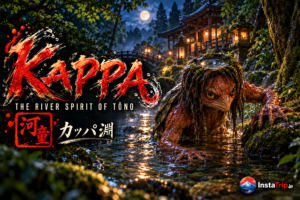
Kappa are river-dwelling yokai, usually portrayed with a turtle-like body and a dish-like depression on the head that holds water. They can be comic figures in modern culture, but traditional stories also carried a serious message: rivers and irrigation channels are dangerous, especially for children.
This is one reason Japanese folklore matters beyond entertainment. Many legends preserve a community’s relationship with its environment. A kappa story can be playful, but it can also hold a practical warning about currents, deep water, and the respect owed to places that sustain life.
Legends You Can Feel in Japan’s Cities and Landscapes
Japanese mythology is especially captivating because it is embedded in ordinary geography. In Tokyo’s Asakusa, Sensō-ji is linked to a legend of two fishermen who found a statue of Kannon in the Sumida River. The temple’s grand gates, incense-filled courtyard, and thriving surrounding streets reveal how spiritual heritage and vibrant city life can exist side by side.
In Kyoto, the annual Gion Matsuri has roots in rituals intended to appease destructive spirits during a period of epidemic. Today, its magnificent floats and intricate textiles create one of Japan’s most celebrated summer spectacles. The festival is joyful and visually dazzling, yet its history reminds visitors that ritual often emerged from communities facing uncertainty together.
On Miyajima near Hiroshima, the floating torii of Itsukushima Shrine creates one of Japan’s most iconic views. The sea, the shrine, and Mount Misen form a landscape long regarded as sacred. Visit with patience rather than a rush for the perfect image. Tides change the scene, light transforms it, and the site rewards those who pause to take in its deeper atmosphere.
How to Encounter Mythology Respectfully
You do not need to know every deity or yokai to appreciate Japanese mythology. Start by paying attention to context. At a shrine, notice the guardian animals, votive plaques, rope-bound sacred trees, and symbols on lanterns. At a museum, look for the changing ways artists have represented demons, ghosts, dragons, and heroic figures. At a festival, read the story behind the procession before assuming it is only a performance.
It also helps to resist treating these traditions as exotic curiosities. Some legends are playful; others belong to living religious practice or express deeply held local identity. Photography rules, behavior expectations, and access to sacred areas can differ from place to place. When in doubt, follow posted guidance and watch how local worshippers move through the space.
Japan’s mythology does not ask visitors to choose between history and imagination. It offers both at once: the fox at a shrine gate, the dragon over a temple hall, the mountain path alive with old stories. Let those details slow your journey down, and Japan will begin to reveal itself in far more than landmarks.
![[商品価格に関しましては、リンクが作成された時点と現時点で情報が変更されている場合がございます。]](https://hbb.afl.rakuten.co.jp/hgb/5753ff70.1b0495c6.5753ff71.e89bdead/?me_id=1278256&item_id=26789138&pc=https%3A%2F%2Fthumbnail.image.rakuten.co.jp%2F%400_mall%2Frakutenkobo-ebooks%2Fcabinet%2F7043%2F2000021547043.jpg%3F_ex%3D128x128&s=128x128&t=picttext "[商品価格に関しましては、リンクが作成された時点と現時点で情報が変更されている場合がございます。]")