
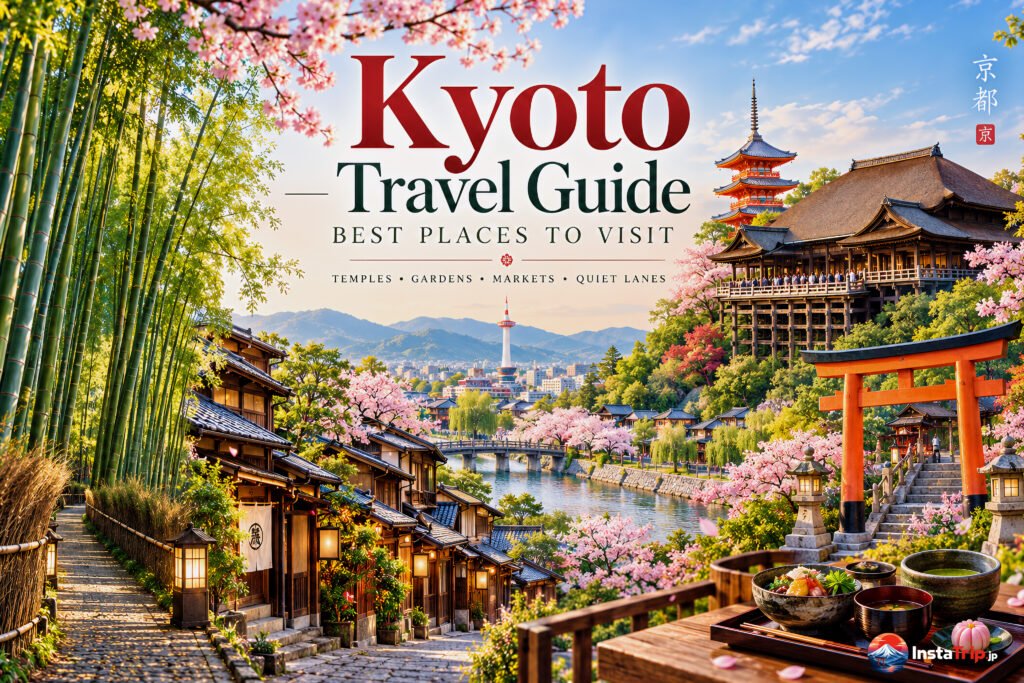
Kyoto reveals itself in layers: the quiet clap of wooden sandals on a stone lane, incense drifting from a temple hall, the sudden flash of vermilion gates climbing a wooded mountain. This Kyoto travel guide to the best places to visit is not a race through famous sights. It is an invitation to move between magnificent landmarks and smaller moments, where centuries of spiritual practice, craftsmanship, food culture, and everyday life remain vividly present.
Once Japan’s imperial capital for more than a thousand years, Kyoto is home to a remarkable concentration of temples, shrines, gardens, palaces, and traditional neighborhoods. Yet its greatest appeal lies in the contrast. A meditative moss garden can sit a short train ride from a dynamic market, while a centuries-old teahouse district may lead into a contemporary café or design shop.
Kyoto Travel Guide: Best Places to Visit for First-Time Travelers
Fushimi Inari Taisha: A path through vermilion gates
Fushimi Inari Taisha is one of Kyoto’s most unforgettable sights, known for its thousands of red-orange torii gates that form tunnels up the sacred slopes of Mount Inari. Before visiting, our Japanese shrine etiquette guide (神社参拝) explains the respectful prayer sequence. The shrine honors Inari, associated with rice, prosperity, and commerce, and fox statues appear throughout the grounds as Inari’s messengers.

The first stretch is understandably busy, especially from late morning onward. Continue uphill, however, and the experience becomes more spacious, with wooded paths, smaller shrines, and changing views over Kyoto. There is no need to complete the full mountain circuit to feel its atmosphere. An early arrival offers softer light, fewer crowds, and a more contemplative encounter with this captivating place.
Kiyomizu-dera and the lanes of Higashiyama
Perched on a hillside in eastern Kyoto, Kiyomizu-dera is celebrated for its vast wooden stage, supported by tall pillars and overlooking a sweep of trees and rooftops. The temple’s name means “pure water temple,” referring to the Otowa Waterfall below, where visitors traditionally drink from separate streams associated with health, longevity, and learning.
The temple is especially striking during cherry blossom season and autumn foliage; for classic landscape design and 紅葉, see our Japanese gardens in autumn guide, but it has a timeless presence in every season. Pair it with a slow walk through Higashiyama’s preserved streets. Ninenzaka and Sannenzaka are often crowded, yet their wooden machiya townhouses, tiled roofs, small craft stores, and tea rooms still evoke the historic Kyoto travelers imagine. Visit in the early morning if you want to photograph the lanes while they are still quiet.
Gion: Look beyond the postcard image
Gion is Kyoto’s famed geiko and maiko district, where traditional arts are sustained through demanding years of training in dance, music, etiquette, and performance. Hanamikoji Street, lined with elegant wooden buildings, is the neighborhood’s best-known scene, but Gion should be approached with care rather than treated as a costume backdrop.

If you encounter a geiko or maiko on the street, give them space and avoid following, blocking, or photographing them without permission. The most meaningful way to appreciate Gion is to notice its details: noren curtains at doorways, lantern-lit facades, narrow side streets, and the architectural language of old Kyoto. In the evening, the district feels particularly atmospheric, though visitors should remain mindful that it is also a working neighborhood.
Temples and gardens that reveal Kyoto’s quieter side
Ginkaku-ji and the Philosopher’s Path
Ginkaku-ji, often called the Silver Pavilion, was never covered in silver. Its beauty comes instead from restraint: a refined temple complex framed by pine trees, carefully raked sand, moss, and a hillside garden. The pavilion reflects the aesthetics associated with Higashiyama culture, where simplicity, impermanence, and close attention to material texture became central to Japanese artistic life.
From here, follow the Philosopher’s Path, a canal-side walk that connects several eastern Kyoto temples. It is most famous beneath spring cherry blossoms, but it is worth visiting outside peak season too. The route invites an unhurried pace, particularly when paired with nearby Honen-in or Nanzen-ji, whose expansive grounds and monumental brick aqueduct offer a fascinating meeting of religious architecture and Meiji-era engineering.
Ryoan-ji: The power of an empty space
Ryoan-ji’s dry landscape garden is among Japan’s most influential works of Zen-inspired design. Fifteen rocks sit in a field of white gravel, arranged so that no single viewpoint reveals them all at once. Its precise original meaning is unknown, which is part of the garden’s enduring pull.
Do not arrive expecting a large complex filled with obvious attractions. Ryoan-ji rewards stillness. Sit for a while, watch how other visitors respond, and let the composition shift with your own attention. It is a powerful reminder that Kyoto’s most memorable experiences are not always the loudest or most photographed.
Arashiyama beyond the bamboo grove
On Kyoto’s western edge, Arashiyama combines mountain scenery, river views, temple culture, and one of the city’s most recognizable natural landmarks. The bamboo grove near Tenryu-ji is beautiful when wind moves through the tall stalks, but its popularity makes timing essential. Early morning is the best choice for a calmer visit.
Make time for Tenryu-ji itself, whose garden is designed around a pond with the forested Arashiyama mountains as its backdrop. This is borrowed scenery at its finest, where the landscape beyond the garden becomes part of the composition. Cross Togetsukyo Bridge, wander along the Katsura River, or climb toward Okochi Sanso Garden for elevated views and a more peaceful finish to the area.
Taste Kyoto through Nishiki Market and local food culture
Nishiki Market is often called “Kyoto’s Kitchen,” a narrow covered arcade packed with vendors selling pickles, tea, tofu, fish, sweets, seasonal produce, knives, and snacks. It is an energetic introduction to the city’s culinary traditions, especially its appreciation for seasonality and exacting presentation.
Rather than trying to sample everything, choose a few items that speak to your curiosity: yuba, made from soy milk skin; Kyoto-style pickles; roasted tea; or wagashi shaped around the season. Be attentive to each shop’s rules about eating, photography, and where food should be consumed. The market can be crowded, but a respectful, observant visit turns it from a checklist stop into a window on Kyoto’s everyday food culture.
For a more traditional meal, seek out obanzai, a style of home-style Kyoto cooking built around vegetables, tofu, and carefully prepared seasonal dishes. It is not always dramatic on the plate, but its quiet balance reflects a city where cuisine has long been shaped by temple traditions, aristocratic culture, and access to exceptional local ingredients.
How to shape a Kyoto itinerary without rushing it
Kyoto is larger and more spread out than many first-time visitors expect. Group your days by area rather than zigzagging across the city. Eastern Kyoto works well for Kiyomizu-dera, Gion, and the Philosopher’s Path; western Kyoto suits Arashiyama; and central Kyoto is ideal for Nishiki Market, Nijo Castle, and downtown streets.
Buses reach many landmarks but can become slow at peak times. Trains and subways are often more efficient for longer crossings, while walking is the best way to notice Kyoto’s changing character. A compact itinerary with two major sights and room for an unscripted detour will usually feel richer than trying to visit six temples in one day.
Season also changes the city dramatically. Spring blossoms and fall colors are magnificent but busy and more expensive. Summer brings festivals, lush gardens, and intense heat and humidity. Winter is quieter, with crisp air, occasional snow, and a special stillness around temples and gardens. There is no single best time – it depends on whether you value seasonal color, calm streets, or festival energy.
At temples and shrines, follow posted guidance, dress thoughtfully, and keep voices low in worship spaces. Kyoto’s heritage is not a museum set. It is woven into active religious sites, private homes, workshops, and neighborhoods.
Leave room in your plans for the moments between destinations: a small garden glimpsed through a gate, the sound of a temple bell at dusk, a warm bowl of noodles after rain. Kyoto is most generous when you allow it to surprise you.
![[商品価格に関しましては、リンクが作成された時点と現時点で情報が変更されている場合がございます。]](https://hbb.afl.rakuten.co.jp/hgb/574e2132.47e6b7eb.574e2133.4456a8ff/?me_id=1385906&item_id=10006785&pc=https%3A%2F%2Fthumbnail.image.rakuten.co.jp%2F%400_mall%2Ff261009-kyoto%2Fcabinet%2Fr_travel_cp%2F261000_rtc016.jpg%3F_ex%3D128x128&s=128x128&t=picttext "[商品価格に関しましては、リンクが作成された時点と現時点で情報が変更されている場合がございます。]")