

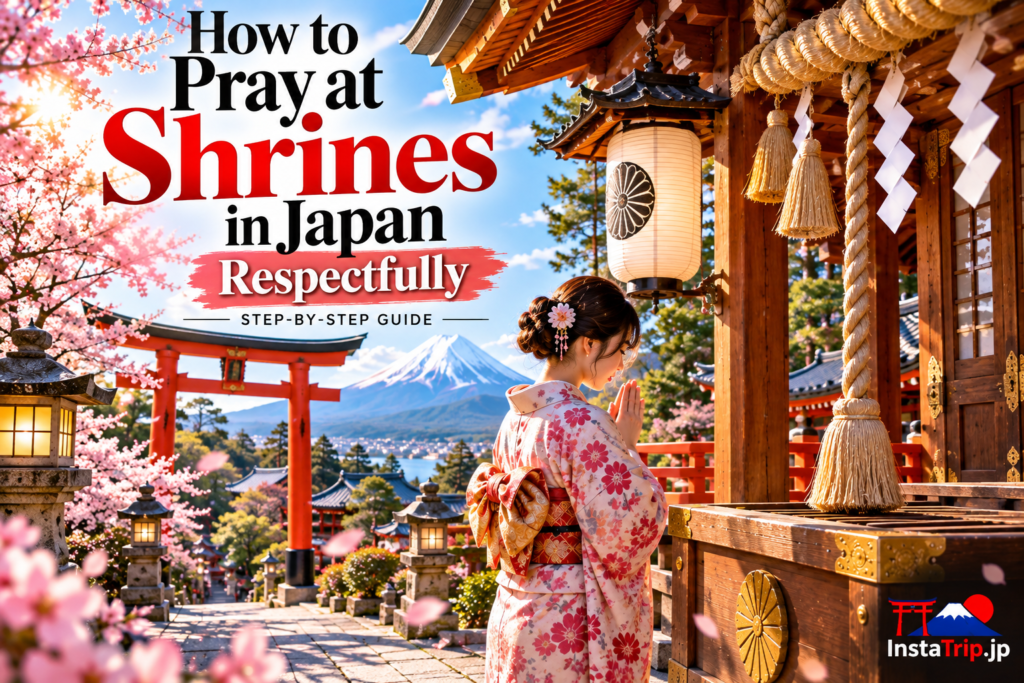
A vermilion torii gate rising between city buildings, cedar forest, or mountain mist marks a change in atmosphere. Beyond it is a 神社 (jinja), a Shinto shrine connected with 神 (kami) – sacred presences associated with nature, ancestors, places, and aspects of life. Knowing how to pray at a Japanese shrine (神社参拝) helps you enter this timeless part of Japan with confidence, humility, and genuine curiosity.
The gestures are simple, but they are not a performance. You do not need to be Shinto, speak Japanese, or ask for the perfect thing. What matters most is moving calmly, observing the space, and following the shrine’s customs with respect.
Japanese Shrine Prayer at a Glance
The standard way to pray at a Shinto shrine in Japan is 二礼二拍手一礼 (ni-rei, ni-hakushu, ichi-rei): two bows, two claps, a quiet prayer, then one final bow. Before that, enter respectfully through the torii, avoid the exact center of the approach when practical, purify your hands and mouth at the 手水舎 (temizuya) if available, and place a small offering in the 賽銭箱 (saisen-bako).
- Bow lightly at the 鳥居 (torii) before entering.
- Walk to one side of the 参道 (sandō), rather than directly down the center.
- Purify at the 手水舎 (temizuya) if it is open.
- Approach the 拝殿 (haiden), the worship hall.
- Place a coin in the 賽銭箱 (saisen-bako); there is no required amount.
- Ring the bell gently if one is provided.
- Bow twice deeply.
- Clap twice.
- Make your prayer quietly.
- Bow once more deeply before stepping away.
This is the general custom described by Jinja Honcho, the Association of Shinto Shrines, and by the Japan National Tourism Organization. Individual shrines can have their own customs, so posted instructions always take priority.

What Makes a Shrine Different From a Temple?
Japan’s spiritual landscape is shaped by both Shinto and Buddhism, and visitors often encounter shrines and temples on the same day. If you want the distinctions in one place, see our guide to temples versus shrines in Japan. A shrine is generally associated with Shinto and is often recognized by its torii gate, a symbolic threshold separating the everyday world from sacred ground. A Buddhist temple may have a large gate, incense burner, pagoda, or image of Buddha.
This difference matters because the familiar prayer sequence of bowing, clapping, and bowing is for a Shinto shrine. At a Buddhist temple, visitors usually place an offering, join their hands in silent prayer, and do not clap. Some sites blend Buddhist and Shinto history, especially in older sacred landscapes, so posted guidance always takes priority over any general rule.
Before You Enter: 鳥居 (Torii) and 参道 (Sandō) Etiquette
At the 鳥居 (torii), pause and make a small bow before passing through. If you want to understand the symbolism behind the gate itself, read our torii gate meaning guide. It is a quiet acknowledgment that you are entering a sacred space. Avoid walking directly down the center of the approach, known as the sando. Traditionally, the center is regarded as the path of the kami, so visitors walk to one side.
This is not a rule to turn into anxious choreography. On a busy approach to a major shrine, simply follow the flow while staying aware of your surroundings. At a small village shrine, where the air may hold the scent of damp earth and old wood, this small gesture can feel especially meaningful.

Keep voices low, avoid eating as you walk through the precincts, and treat photography with care. Exterior grounds are often welcoming to photographers, but some prayer halls, inner sanctuaries, and rituals prohibit photos. Signs and shrine staff should guide your decision.
Purification at the 手水舎 (Temizuya)
Near the entrance, many shrines have a water pavilion called a temizuya or chozuya. This is for symbolic purification before approaching the main hall. It is not about becoming physically clean enough to pray. Instead, it is a moment to leave behind the rush of the street and prepare yourself with intention.
Use the ladle without letting it touch your mouth or the water in the basin. The Jinja Honcho guidance on 手水 (temizu) describes the usual purification sequence. The order is straightforward:
- Hold the ladle in your right hand and rinse your left hand.
- Switch hands and rinse your right hand.
- Return the ladle to your right hand, pour a little water into your cupped left hand, and rinse your mouth discreetly. Do not drink from the ladle.
- Rinse your left hand once more, then tip the ladle upright so water runs down the handle.
If the water pavilion is closed, empty, or absent, simply proceed. Many shrines adapted their practices during public-health restrictions, and some smaller shrines may not have a temizuya. Respectful intention matters more than forcing a ritual that is not available.
How to Pray: 二礼二拍手一礼 (Two Bows, Two Claps, One Bow)
The 拝殿 (haiden), or worship hall, is where visitors usually offer their prayers. Before stepping forward, notice whether there is a line, a rope and bell, or signage describing the shrine’s particular etiquette. A bell may be rung gently before prayer, where provided.
Place a coin in the 賽銭箱 (saisen-bako), the offering box. A five-yen coin is popular because go-en can suggest a fortunate connection or relationship, but it is only a custom. Jinja Honcho states that there is no fixed amount required, so any modest offering is acceptable. Place or toss the coin gently; the offering is an expression of respect, not a fee for having a wish granted.
Then follow the standard 二礼二拍手一礼 sequence: bow twice deeply, clap twice, bring your hands together, make your prayer quietly, and finish with one deep bow. This is the general form described by both Meiji Jingu and Jinja Honcho.
The two claps announce your presence before the kami. Your prayer can be as personal or as simple as you wish. Some people express gratitude first, then ask for guidance, good health, safe travels, success in study, or the well-being of family and friends. There is no need to recite a memorized formula. A sincere, quiet moment is enough.
At especially busy shrines – such as those filled with New Year visitors – keep your prayer brief so others can approach. During a festival, formal ceremony, or wedding, do not walk into restricted areas or interrupt proceedings. Watching respectfully from a distance can be its own memorable encounter with living tradition.
Important Exception: 出雲大社 (Izumo Taisha)
The familiar 二礼二拍手一礼 pattern is not universal. At 出雲大社 (Izumo Taisha) in Shimane, visitors traditionally make two bows, four claps, and one bow. The Japan National Tourism Organization specifically notes this exception. This is a useful rule for shrine etiquette in general: learn the standard form, but always follow the instructions of the shrine you are visiting.
御神籤 (Omikuji), 絵馬 (Ema), 御守 (Omamori) and 御朱印 (Goshuin)
Prayer is only one part of a shrine visit. Many shrines offer omikuji, paper fortunes that range from excellent luck to more challenging predictions. Read yours with an open mind rather than alarm. If you receive a difficult fortune, you may tie it at the designated rack or tree, symbolically leaving misfortune behind. If it is favorable, you can tie it there or take it with you, depending on the shrine’s guidance.
You may also find ema, small wooden prayer plaques. Visitors write wishes or words of thanks on one side and leave the plaque at the shrine. Looking at the ema can be moving: prayers for exam results, recovery, new beginnings, safe journeys, and loved ones appear in many languages and handwritten styles.
Charms, called omamori, are often available for purposes such as traffic safety, health, studies, business, or easy childbirth. They are religious items, not souvenirs to handle casually. If you receive one, keep it respectfully and follow the shrine’s guidance when it is time to return it. You may also see 御朱印 (goshuin), calligraphic seals issued at many shrines and temples. A goshuin is best understood as a record of a sacred-site visit rather than a casual souvenir stamp, so present your goshuin book politely and follow the desk’s instructions.
Useful Japanese Shrine Words
| Japanese | Reading | Meaning |
|---|---|---|
| 神社 | jinja | Shinto shrine |
| 参拝 | sanpai | Worship / paying respects at a shrine |
| 鳥居 | torii | Shrine gate marking the sacred precinct |
| 参道 | sandō | Approach path to a shrine |
| 手水舎 | temizuya | Purification pavilion |
| 拝殿 | haiden | Worship hall |
| 賽銭 | saisen | Offering money |
| 賽銭箱 | saisen-bako | Offering box |
| 二礼二拍手一礼 | ni-rei ni-hakushu ichi-rei | Two bows, two claps, one bow |
| 御守 | omamori | Protective charm |
| 絵馬 | ema | Wooden prayer plaque |
| 御神籤 | omikuji | Paper fortune |
Common Shrine Etiquette Mistakes to Avoid
- Clapping at a Buddhist temple: the two-clap ritual belongs to Shinto shrine worship. At temples, join your hands quietly instead.
- Treating ¥5 as mandatory: five yen is a popular custom, not a required offering.
- Drinking directly from the ladle: pour water into your hand first when rinsing your mouth.
- Ignoring shrine-specific instructions: some important shrines use a different prayer sequence.
- Blocking the worship area for photos: step aside after praying so other visitors can approach.
- Crossing barriers or photographing restricted rituals: posted signs and shrine staff always take priority.
Small Details That Show Respect
A shrine visit does not demand flawless etiquette. It does ask visitors to be attentive. Dress neatly enough for a place of worship, particularly if you are attending a formal rite. Remove hats if it feels appropriate when praying, and do not bring pets into areas where they are restricted. Most of all, do not pose on sacred structures, cross barriers for a photo, or treat prayer spaces as backdrops.
The simplest rhythm is this: arrive quietly, bow at the gate, purify if possible, make a modest offering, pray with the two-bow, two-clap sequence, and bow once more. As you leave the precincts, a final small bow toward the torii is a graceful way to express thanks.
Useful Items for Visiting Japanese Shrines
Affiliate disclosure: As an Amazon Associate I earn from qualifying purchases.
- 御朱印帳 (goshuincho) on Amazon — a dedicated book for collecting goshuin from shrines and temples.
- Small coin purse on Amazon — useful for keeping ¥5, ¥10, and other small coins ready for 賽銭 (offerings).
Watch: 正しい神社参拝作法 (Official Shrine Prayer Etiquette)
This short official video from 神社本庁 (Jinja Honcho / Association of Shinto Shrines) demonstrates the correct shrine prayer etiquette, including the standard 二礼二拍手一礼 sequence. It is far more useful here than a presenter-led travel video.
Japanese Shrine Etiquette FAQ
Can tourists pray at Shinto shrines in Japan?
Yes. Visitors do not need to be Shinto to pay their respects at a shrine. Jinja Honcho explains that Shinto does not require conversion and that people of other religions, or no religion, are welcome to practice shrine customs respectfully.
How much money should you offer at a Japanese shrine?
There is no required amount. Five yen is popular because of the wordplay around go-en, but Jinja Honcho states that the amount of the offering is not fixed.
Do you clap at Japanese temples?
No. The familiar two bows and two claps are associated with Shinto shrines. At a Buddhist temple, visitors generally make an offering, join their hands, and pray quietly without clapping.
Do all Japanese shrines use two bows and two claps?
No. 二礼二拍手一礼 is the usual pattern, but some shrines have their own customs. At 出雲大社 (Izumo Taisha), for example, the traditional sequence includes four claps.
Do you need to say a prayer in Japanese?
No. A quiet, sincere prayer is enough. You can pray in your own language or simply express gratitude silently.
From the vibrant shrine-lined streets of Asakusa to a secluded sanctuary beneath towering cedars in Nikko, these gestures create a more intimate encounter with Japan. Pause long enough to hear the wind stir the ema, the gravel shift underfoot, or the distant ring of a bell. A shrine is not only a landmark to see, but a living space where reverence, memory, and everyday hopes quietly meet.