

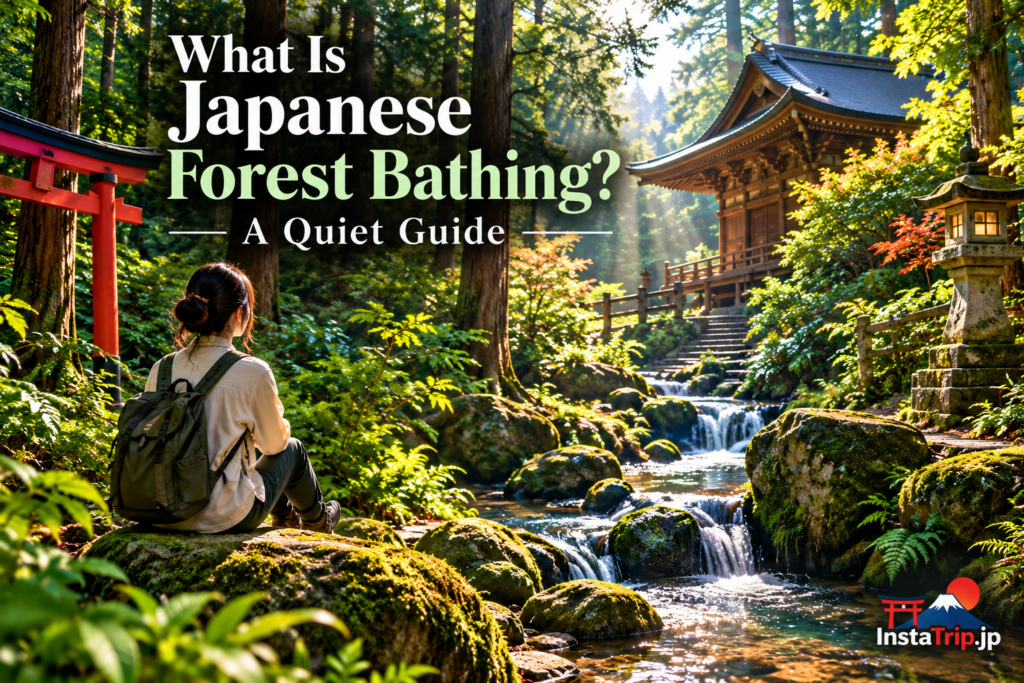
A cedar-scented path, the hush of moss underfoot, light trembling across leaves: what is Japanese forest bathing if not an invitation to notice what hurried travel can miss? Known in Japan as 森林浴 (shinrin-yoku), it is a slow, attentive way of spending time among trees. There is no water involved, no athletic target to reach, and no need to conquer a summit. The point is simply to arrive in the forest with your senses open.
For travelers drawn to Japan’s quieter dimensions, forest bathing offers a captivating counterpoint to Tokyo’s dynamic streets, Kyoto’s temple lanes, or Osaka’s vibrant nightlife. A Koyasan temple stay offers a similarly unhurried way to experience Japan’s sacred mountain landscapes. It reveals a relationship with nature that can feel both deeply personal and shaped by long cultural traditions of seasonal awareness, mountain landscapes, and reverence for place.
Japanese Forest Bathing at a Glance
- Japanese name: shinrin-yoku (森林浴), literally “forest bathing.”
- What it is: slow, sensory time in a forest rather than exercise-focused hiking.
- What you do: walk gently, pause often, listen, breathe, notice scent, light, texture, and temperature.
- How long: there is no fixed rule; even a short, unhurried session can work as a travel reset.
- Where to try it: from Tokyo’s Okutama to Nagano’s cypress forests, Yakushima, Kyoto’s northern mountains, and the sacred forests of the Kii Peninsula.
- Important: forest bathing is a wellness practice, not a substitute for medical treatment.
What Is Japanese Forest Bathing?
森林浴 (shinrin-yoku) translates literally as “forest bathing,” meaning immersion in the atmosphere of the forest. The term was introduced by Japan’s Forestry Agency in 1982, a modern wellness concept that encouraged people to spend restorative time in wooded landscapes. The Japan National Tourism Organization describes shinrin-yoku as an unhurried, sensory immersion in the forest rather than a fitness activity. It has since become one of Japan’s most widely recognized wellness concepts, though its appeal is much simpler than the terminology may suggest: walk slowly, breathe deeply, look closely, and let the forest set the pace.
A forest-bathing walk may involve pausing beside a stream, noticing the texture of tree bark, listening for birds, or sitting quietly beneath a canopy. Some guided experiences include gentle invitations to focus on one sense at a time. Others end with tea or a moment of reflection. But shinrin-yoku is not a rigid ceremony. A solitary hour on a peaceful trail can be just as meaningful as a formal guided session.

It also differs from hiking. Hiking usually has a destination, distance, or elevation in mind. Forest bathing values presence over progress. You might cover less than a mile, stop repeatedly, and never take a photograph. For a traveler accustomed to fitting major sights into every hour, that change of rhythm is part of the experience.
Forest Bathing vs. Hiking: What Is the Difference?
| Forest bathing (森林浴) | Hiking |
|---|---|
| Focuses on sensory awareness and slowing down | Usually focuses on distance, route, elevation, or destination |
| No fitness goal is required | Often involves sustained physical effort |
| Frequent pauses are part of the experience | Pauses usually support progress along the route |
| Can be practiced while sitting or walking very slowly | Usually involves continuous walking |
| The forest itself is the experience | The forest may be part of the route to a viewpoint or goal |
Why Forests Hold Such Meaning in Japan
Japan’s forests are not merely scenic backdrops. Mountains, ancient trees, waterfalls, and wooded approaches to shrines have long carried spiritual and cultural significance. In Shinto, natural features can be understood as places where kami, or sacred presences, are felt. Buddhist temples, too, are often framed by gardens, groves, and mountain settings that encourage contemplation.
This does not mean every walk in the woods is a religious act. Forest bathing is a modern practice, and participants need not follow any faith. Yet its atmosphere resonates with longstanding Japanese ways of observing nature: the first blossoms of spring, the vivid greens of early summer, the fiery maples of autumn, and the stillness of winter branches.
The Japanese aesthetic idea of living with the seasons is especially easy to feel in a forest. A trail that seems luminous in May may be cool and shadowed in July, fragrant with fallen needles in October, and almost silent after snow. Forest bathing encourages travelers to encounter that particular day rather than chase an idealized image of Japan.

What Does 森林浴 (Shinrin-Yoku) Mean?
The Japanese word 森林浴 is read shinrin-yoku. 森林 (shinrin) means “forest” or “woodland,” while 浴 (yoku) carries the idea of bathing or immersing yourself in something. The phrase is therefore less about taking a literal bath and more about letting the forest surround your senses.
You may also see 森林セラピー (shinrin therapy or forest therapy), a related term used for more structured wellness programs. Forest bathing itself can be much simpler: an unhurried walk, quiet sitting, or attentive time beneath trees.
What a Shinrin-Yoku Experience Feels Like
The first surprise is often how little you need to do. Put your phone away or switch it to silent. Let your eyes adjust to layers of green rather than searching for the next landmark. The forest becomes more detailed as you slow down: a woodpecker’s rhythm, the mineral sound of water over stones, a faint breeze moving through bamboo or cypress.
Many people find this kind of attention calming, but the experience is not identical for everyone. A dense forest can feel wonderfully protective to one visitor and disorienting to another. Weather matters, too. Mist can make a cedar grove feel magnificent and cinematic, while heavy rain may make a path slippery and less relaxing.
What Does Research Say About Forest Bathing?
Scientific interest in shinrin-yoku (森林浴) has grown well beyond tourism marketing. A 2021 umbrella review of 16 systematic reviews concluded that the strongest evidence supports forest bathing as a complementary practice for promoting psychophysical well-being, while evidence for treating specific diseases was still not strong enough for clear clinical recommendations. A newer 2026 systematic review and meta-analysis also reported short-term improvements in measures such as heart rate and some mood outcomes, while emphasizing that the evidence remains limited for disease prevention or treatment.
That distinction matters. Forest bathing may be a useful way to relax, reduce perceived stress, and spend restorative time in nature, but it should not be presented as a cure. If you are managing a medical or mental-health condition, treat 森林浴 as a complementary wellness activity and follow professional medical advice.
For readers who want to examine the evidence directly, see the umbrella review on forest bathing and well-being and the 2026 systematic review and meta-analysis.
Where to Experience Forest Bathing (森林浴) in Japan
Japan offers magnificent woodland settings across the country, from easily reached city-edge trails to remote mountain forests. The best choice depends on your itinerary, fitness, season, and desire for solitude.
Akasawa Natural Recreational Forest, Nagano
Often associated with the development of shinrin-yoku, Akasawa Natural Recreation Forest in Nagano Prefecture is celebrated for its towering Kiso cypress. The local tourism office notes that forest bathing was first proposed here in 1982. The air is aromatic, the paths are shaded, and the landscape has a timeless, almost cathedral-like grandeur. It is a particularly evocative choice for travelers who want to experience forest bathing in a place closely connected to the practice’s modern history.
Okutama, Tokyo
Beyond Tokyo’s vast urban energy, the Okutama area offers valleys, rivers, and wooded trails within the western reaches of the metropolis. It is a rewarding option for visitors based in the city who want a day of green stillness without planning a long-distance journey. Choose a route suited to your ability, especially after rain, when mountain paths can become slick.
Yakushima, Kagoshima Prefecture
Yakushima’s ancient cedar forests are among Japan’s most unforgettable natural landscapes. Moss-covered rocks, rushing water, and immense yakusugi cedars create an almost primeval setting. This is not always the easiest place for a gentle forest-bathing stroll – some routes are strenuous and weather can change quickly – but its atmosphere is extraordinary for well-prepared travelers who respect trail guidance and local conditions.
Kyoto’s Northern Mountains
Kyoto is famous for its temples and gardens, yet the quieter wooded areas north of the city offer another side of the former capital. Around villages such as Kurama and Kibune, forest paths and mountain air can bring a welcome sense of distance from the city’s more visited streets. These areas can be especially beautiful in autumn, though popularity during peak foliage season means true quiet may require an early start.
Kii Peninsula: Wakayama, Nara, and Mie
For travelers who want forest bathing with a spiritual dimension, the Kii Peninsula is especially compelling. The sacred forests around Koyasan and the Kumano region combine cedar-lined pilgrimage routes, temple landscapes, waterfalls, and mountain air. The Japan National Tourism Organization specifically highlights the Yoshino-Kumano area as a strong setting for shinrin-yoku. Pair a Koyasan temple stay with sections of the Kumano Kodo for a slower journey through Japan’s spiritual heartland.
How to Practice Shinrin-Yoku (森林浴) Step by Step
- Choose a safe, quiet forest. Pick a marked path appropriate for the weather, daylight, and your mobility.
- Put away the phone. Use it for navigation or emergencies if necessary, but avoid turning the experience into a photo checklist.
- Slow your pace. There is no target distance. Walk more slowly than you normally would and stop whenever something catches your attention.
- Use your senses. Notice birdsong, moving leaves, the smell of cedar or damp earth, changes in temperature, bark texture, and filtered light.
- Pause without doing anything. Sit beside a stream, lean against a tree where permitted, or simply stand quietly for several minutes.
- Leave the forest as you found it. Stay on marked routes, take your rubbish with you, and respect wildlife, sacred areas, and local signs.
The Japan National Tourism Organization’s forest-bathing guide emphasizes the same basic idea: 森林浴 is not about running, climbing, or achieving a hiking goal. It is about being present in the forest environment.
How to Practice Forest Bathing Respectfully
You do not need special gear, but preparation helps. Wear comfortable walking shoes, bring water, and choose a path appropriate for the time of year. In summer, humidity and insects are real considerations. In colder months, daylight fades early in mountain areas. Check conditions locally and never assume a picturesque route is suitable in every season.
Respect is equally central. Stay on marked trails, carry out any trash, and keep voices low. Do not pick plants, disturb wildlife, or enter restricted areas for a better photo. If a forest path passes a shrine, follow posted guidance and treat the setting with the same consideration you would offer any sacred site.
Try giving yourself at least an hour, though longer is not automatically better. Ten unhurried minutes beneath trees can feel more restorative than two distracted hours. Leave room in your itinerary afterward, too. Rushing straight from a quiet grove to a crowded shopping district can make the experience feel like another item checked off a list.
Useful Gear for Forest Bathing in Japan
Affiliate disclosure: As an Amazon Associate I earn from qualifying purchases.
- Lightweight trail shoes on Amazon — useful on damp cedar paths and uneven forest trails.
- Packable rain jacket on Amazon — especially useful in mountain forests where weather can change quickly.
- Portable insect repellent on Amazon — worth carrying during Japan’s warmer, more humid months.
Watch: 赤沢自然休養林 in 4K
For a visual taste of authentic 森林浴, this quiet 4K walk through Akasawa Natural Recreation Forest comes from the Agematsu Tourism Association (上松町観光協会). It focuses on the forest itself rather than a presenter, making it a natural companion to this guide.
Japanese Forest Bathing FAQ
How long should a forest-bathing session last?
There is no official minimum. A short, attentive session can still be worthwhile, while many guided experiences last one to several hours. Quality of attention matters more than distance covered.
Do you need a guide for shinrin-yoku?
No. You can practice 森林浴 independently on a safe, marked forest path. A guide can be useful if you want structured sensory exercises, local natural-history knowledge, or help choosing an accessible route.
What is the best season for forest bathing in Japan?
Japan offers forest-bathing experiences year-round. Spring brings fresh green growth, summer offers dense foliage, autumn adds vivid color, and winter can be exceptionally quiet. Trail safety, heat, snow, rain, and daylight should shape your choice more than the calendar alone.
Is forest bathing the same as meditation?
Not exactly. Both can involve mindful attention, but shinrin-yoku does not require a formal meditation technique. The emphasis is on noticing the forest through sight, sound, smell, touch, and unhurried movement.
Is shinrin-yoku a medical treatment?
No. Research suggests potential short-term benefits for relaxation and well-being, but forest bathing should be treated as a complementary wellness practice rather than a replacement for medical care.
A Different Way to Remember Japan
Forest bathing does not promise a dramatic transformation. Its beauty is quieter than that. It asks you to notice the cool air under cedar branches, the changing color of a fern, and the space between birdsong. In a country of dazzling cities, historic temples, and magnificent coastlines, Japan’s forests offer a different kind of encounter: one that stays with you precisely because it asks for nothing more than your attention.