

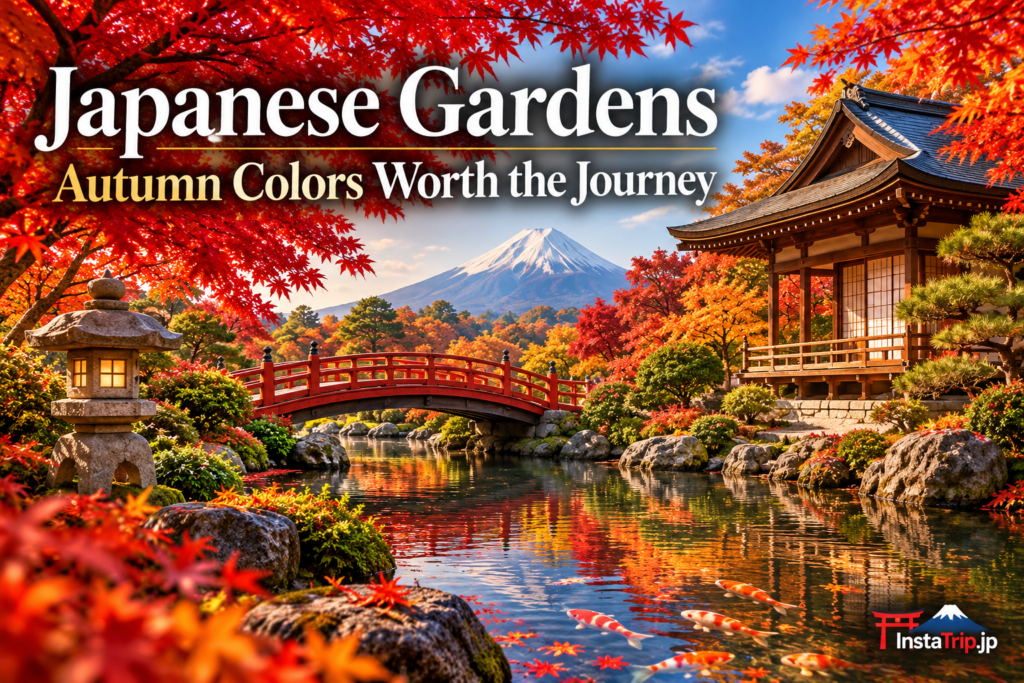
Autumn turns a Japanese garden into something more than a collection of red leaves. A single 紅葉 (kōyō) maple may frame a stone lantern, a pond may double the color in reflection, and evergreen pines make the brief reds and golds feel even more intense. For travelers searching for the best Japanese gardens in autumn, this is where landscape design and seasonality meet at their most cinematic.
In Japan, autumn-leaf viewing is often called 紅葉狩り (momijigari) — literally “hunting” for autumn colors. The experience is not only about finding the brightest tree. In a traditional 日本庭園 (nihon teien), paths, water, stone, moss, borrowed scenery, and architecture all shape how the color is revealed.
Japanese Gardens in Autumn: Quick Guide
- Japanese term for autumn foliage: 紅葉 (kōyō).
- Maple-leaf viewing: 紅葉狩り (momijigari).
- Japanese garden: 日本庭園 (nihon teien).
- Best general window: from September in northern and high-altitude regions through December in parts of central and western Japan.
- Tokyo and Kyoto: often strongest from November into early December, but timing changes each year.
- Best strategy: visit early on a weekday and check the garden’s official foliage updates before traveling.
- 2026 note: the Japan Weather Association’s October 1 forecast expects many areas nationwide to reach peak color around normal timing or later, with some eastern and western lowland areas leaning later.
For current conditions, use the Japan Weather Association’s 2026 紅葉 forecast together with each garden’s official website. Autumn color can shift quickly after warm weather, cold nights, wind, or heavy rain.
Why Japanese Gardens Transform in Autumn
Japanese gardens are designed to be experienced in motion. A strolling garden — 回遊式庭園 (kaiyū-shiki teien) — does not reveal everything from one viewpoint. A path narrows beneath maples, opens toward a pond, passes a stone lantern, and then frames a distant hill. The visitor discovers the garden scene by scene.

Autumn intensifies that design. もみじ (momiji) and other maples turn crimson, orange, and vermilion. 銀杏 (ichō), or ginkgo, adds brilliant yellow. Zelkova and other deciduous trees contribute bronze and amber, while pine, bamboo, moss, and clipped shrubs remain green.
That contrast matters. Evergreens give the garden visual stability; autumn color creates the temporary drama. Water adds another layer by reflecting leaves and sky, while fallen foliage changes the ground itself. A garden can look completely different from one week to the next.
This sensitivity to change connects naturally with mono no aware, the appreciation of beauty precisely because it is temporary. A fallen maple leaf is not something outside the composition. It becomes part of the season.
When Is the Best Time to See Autumn Gardens in Japan?
Japan’s foliage season moves broadly from north to south and from high elevations down into cities. The Japan Weather Association explains that autumn color begins around September in Hokkaido and higher areas of Honshu and can continue into December between Kanto and Kyushu.

For 2026, the latest Japan Weather Association forecast says peak timing is expected to be broadly near normal or later across much of the country, with warmer conditions likely to delay some lowland areas in eastern and western Japan. That makes live updates especially valuable this year.
| Region | Typical garden window | What to expect |
|---|---|---|
| Hokkaido / northern mountains | Late September–October | Earlier color, cooler weather, strong mountain scenery |
| Tohoku | October–early November | Gardens plus mountain and temple foliage |
| Tokyo / Kanto | Mid-November–early December | Classic strolling gardens and late urban color |
| Kyoto / Kansai | Mid-November–early December | Temple gardens, maples, moss, night illuminations |
| Kanazawa / Hokuriku | November | Large landscape gardens, water, pine, red and gold foliage |
These are planning windows, not guarantees. Elevation, temperature, rainfall, tree species, and exposure all matter. Check live updates a few days before your visit.
Best Japanese Gardens for Autumn Colors
1. 天龍寺 (Tenryū-ji), Kyoto
Tenryū-ji’s 曹源池庭園 (Sōgenchi Garden) is one of Kyoto’s most satisfying combinations of autumn color and classical garden composition. The pond reflects maples and rocks, while the hills of Arashiyama become part of the garden through 借景 (shakkei), or borrowed scenery.
Kyoto’s official tourism site notes that the Zen garden dates to the 14th century and specifically highlights the maple display in autumn. The garden is especially rewarding early in the day, before Arashiyama becomes crowded. See the official Kyoto guide to Tenryū-ji.
2. 六義園 (Rikugien), Tokyo
六義園 (Rikugien) is one of Tokyo’s great Edo-period strolling gardens. Its pond, artificial hills, bridges, maples, and carefully controlled viewpoints make it particularly strong for late-autumn photography.
For 2026, Rikugien’s official autumn night viewing is scheduled for November 25–December 6, from 18:00 to 20:30, with final entry at 19:30. The garden closes at 17:00 before reopening for the special evening session. Check the official Rikugien 2026 autumn illumination information before visiting.
3. 小石川後楽園 (Koishikawa Kōrakuen), Tokyo
Koishikawa Kōrakuen combines ponds, stone bridges, maples, and miniature landscapes inspired by famous scenery from Japan and China. It is an excellent choice if you want traditional garden design without leaving central Tokyo.
Its appeal in autumn comes from variety rather than one single viewpoint: red maples, yellow foliage, water reflections, and architectural details appear in sequence as you walk.
4. 兼六園 (Kenrokuen), Kanazawa
Kanazawa’s 兼六園 (Kenrokuen) is one of Japan’s most celebrated landscape gardens, and the city is also one of Japan’s strongest destinations for traditional craft experiences (金沢工芸), with ponds, streams, stone lanterns, bridges, tea houses, artificial hills, and sculpted pines. JNTO specifically notes the fiery Japanese maple display in fall. JNTO’s Kenrokuen guide is a useful official reference.
Kenrokuen is also notable for autumn illumination. In 2026, official Kanazawa tourism information lists evening illumination dates on November 7, 14, 15, 21, 22, 28, and 29, from 18:00 to 20:45, with closing at 21:00. The combination of illuminated foliage and 雪吊り (yukitsuri) ropes protecting the pines creates a distinctly Kanazawa scene.
5. Kyoto Temple Gardens Beyond Tenryū-ji
Kyoto has far too many autumn gardens for one list. Around Nanzen-ji, Ginkaku-ji, Tofuku-ji, Eikando, Enko-ji, Takao, and other temple areas, maples interact with moss, stone, wooden halls, and mountain backdrops. Kyoto’s official tourism information specifically identifies many of these areas as major autumn foliage destinations.
If Kyoto is central to your trip, combine this article with our Kyoto temples guide rather than trying to race through every famous garden in one day.
2026 Autumn Illuminations Worth Planning Around
Autumn light-ups can completely change the atmosphere of a garden. They are less quiet than a weekday morning, but reflections, illuminated maples, stone lanterns, and dark water can produce some of the most dramatic scenes of the season.
- 六義園 (Rikugien), Tokyo: November 25–December 6, 2026.
- 兼六園 (Kenrokuen), Kanazawa: selected evenings in November 2026, including Nov. 7, 14–15, 21–22, and 28–29.
- Kyoto: numerous temples and gardens hold seasonal evening openings; confirm each location individually because schedules and ticket systems differ.
For Kyoto, the city’s official tourism service recommends checking its autumn leaves calendar and event pages because color progression and special openings change through the season.
What to Look for Beyond Red Maples
The strongest garden experience comes from looking beyond the brightest tree. Notice how a branch reaches over water, how moss deepens after rain, how a stone path slows your pace, and how an opening between trees frames something beyond the garden.
Look for 借景 (shakkei), where distant mountains or hills are visually incorporated into the garden; 灯籠 (tōrō), stone lanterns; bridges; tea houses; islands; and carefully shaped pines. In autumn, these permanent elements make the changing leaves feel even more temporary.
Reflections are especially important. On a still morning, a pond can double the color of the canopy. After rain, wet stone and moss become darker, creating stronger contrast with red and yellow leaves.
How to Photograph Autumn Gardens Without Ruining the Experience
Arrive shortly after opening, especially in Kyoto and Tokyo. Morning usually gives softer light, fewer people, and calmer water. A cloudy day is not a failure: diffused light often keeps red leaves from becoming harsh or overexposed.
Use paths and designated viewpoints. Do not step onto moss, garden stones, roots, or private areas to improve a composition. At temples, photography may be restricted inside halls or from certain verandas, so posted instructions always take priority.
Try composing with foreground layers rather than photographing only one tree: maple leaves above, a lantern or bridge in the middle, and a pond or borrowed mountain scenery beyond. That visual layering is part of what makes Japanese garden photography distinctive.
Useful Gear for Autumn Garden Days
(paid links)
- Compact lightweight travel umbrellas on Amazon — useful for sudden autumn showers and easy to carry between gardens.
- Comfortable travel walking shoes on Amazon — helpful for long garden paths, temple grounds, and slippery stone after rain.
Watch: 京都の秋 — Japanese Gardens in 4K
This visual 4K video from the Japanese channel Yurara Sarara focuses on Kyoto’s autumn gardens themselves — red maples, light, water, moss, and designed landscapes — rather than a presenter talking to the camera.
Japanese Gardens in Autumn FAQ
What month is best for Japanese gardens in autumn?
November is the most useful single month for many famous gardens in Tokyo, Kyoto, and Kanazawa, but northern and high-altitude locations change earlier and some lowland gardens remain colorful into early December.
What does 紅葉 (kōyō) mean?
紅葉 refers to autumn foliage and the changing color of leaves. In travel contexts it is commonly used for Japan’s fall-color season.
What is 紅葉狩り (momijigari)?
紅葉狩り is the Japanese custom of going out to enjoy autumn leaves. Despite the literal “hunting” wording, it means seeking out and appreciating seasonal foliage.
When do autumn leaves peak in Kyoto?
Kyoto’s official tourism information says color typically begins around late October, reaches a broad peak around mid-November, and moves past peak toward late November, with mountain areas changing earlier. Actual timing shifts each year, so live updates are important.
When is Rikugien’s 2026 autumn illumination?
The official 2026 night viewing is scheduled for November 25 through December 6.
Is Kenrokuen worth visiting in autumn?
Yes. Its ponds, pines, maples, lanterns, and large-scale landscape design make it one of Japan’s strongest autumn garden experiences, and selected 2026 November evenings include official illumination.
Should I visit gardens in the morning or at night?
Morning is best for quieter paths and natural light. Night illuminations are more dramatic but usually busier. If your itinerary allows, they offer two completely different experiences.
A Season That Teaches You to Pause
The magic of Japanese gardens in autumn is not simply that the leaves turn red. It is that the garden gives those colors a structure: water beneath them, pine beside them, stone underfoot, and architecture framing the view.
If you want a quieter encounter with Japan’s seasonal landscapes, pair a garden visit with 森林浴 (Japanese forest bathing). The environments are different, but both reward the same thing: slowing down long enough to notice what changes from one moment to the next.