

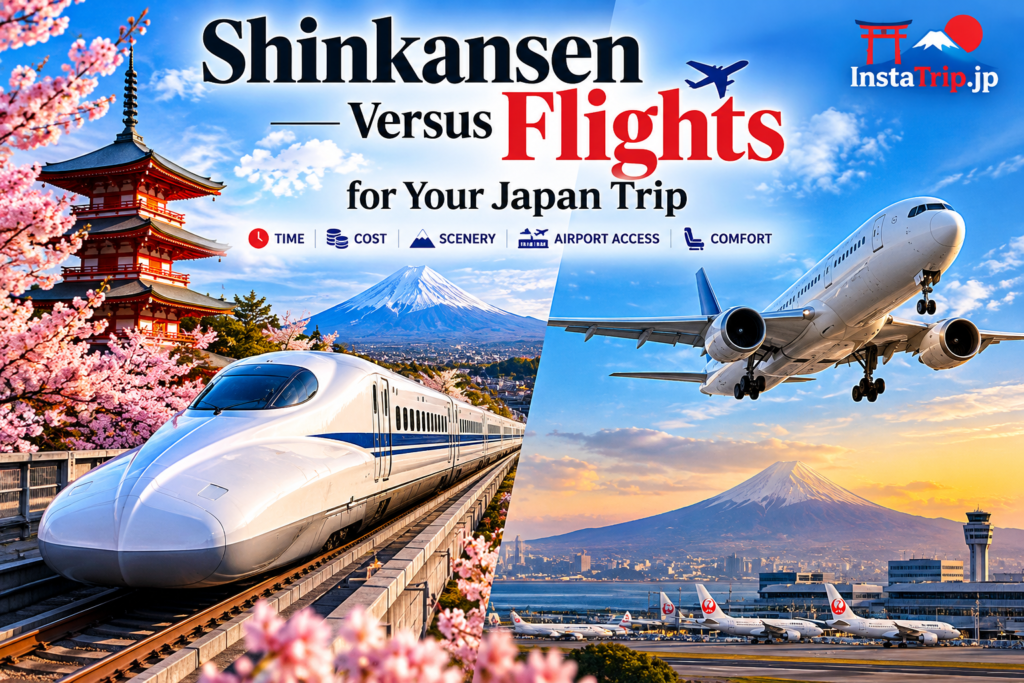
Choosing between the Shinkansen and a domestic flight in Japan is rarely about the advertised journey time alone. A flight may spend only an hour in the air, yet airport transfers, check-in, security, boarding, baggage collection, and the final ride into the city can change the result completely. A 新幹線 (Shinkansen) may look slower on paper but often carries you directly from one city center to another.
For travelers moving through Japan’s classic Tokyo–Kyoto–Osaka corridor, the train usually has a major door-to-door advantage. For long jumps to Hokkaido, Fukuoka, Okinawa, or other distant regions, 国内線 (kokunaisen / domestic flights) can save hours. This guide compares both options by real travel time, cost, luggage, comfort, booking flexibility, and the kind of trip you are planning.
Shinkansen vs Flights in Japan: Quick Answer
| Trip | Usually the better choice | Why |
|---|---|---|
| Tokyo → Kyoto | Shinkansen | Direct city-center travel; Nozomi takes about 2 hr 15 min |
| Tokyo → Osaka | Shinkansen | Fastest Tokyo–Shin-Osaka services take about 2 hr 21 min |
| Tokyo → Hiroshima | Depends | Train is seamless; flying can become competitive depending on airport access and fare |
| Tokyo → Fukuoka | Flight often wins | The rail journey is long enough that flying can save meaningful door-to-door time |
| Tokyo → Sapporo | Flight | No direct Shinkansen reaches Sapporo; air is dramatically faster |
| Tokyo → Okinawa | Flight | Okinawa is not connected to Honshu by rail |
Simple rule: if the Shinkansen journey is around three hours or less, rail is usually difficult to beat. Once the train approaches five hours, compare the complete flight journey instead of only the time in the air.
Door-to-Door Time Matters More Than Flight Time
The most common mistake in a Shinkansen vs plane comparison is putting a two-hour train beside a one-hour flight and stopping there. Air travel begins before takeoff and ends well after landing.

A domestic flight normally means:
- Travel from your hotel to the airport.
- Arrive early enough for airline procedures and security.
- Wait at the gate and board.
- Fly.
- Disembark and collect checked baggage if necessary.
- Travel from the arrival airport into the city.
With the Shinkansen, the main stations are already embedded in the urban transport network. 東京駅 (Tokyo Station), 品川駅 (Shinagawa), 京都駅 (Kyoto), 新大阪駅 (Shin-Osaka), 広島駅 (Hiroshima), and 博多駅 (Hakata) connect directly to local trains, subways, buses, taxis, and hotels.
JR Central states that the fastest Tokaido Shinkansen service between Tokyo and Shin-Osaka takes about 2 hours 21 minutes. Tokyo to Kyoto by Nozomi is about 2 hours 15 minutes. That city-center-to-city-center design is the Shinkansen’s biggest strategic advantage.
Tokyo to Kyoto: Shinkansen or Flight?
For most travelers, the 東海道新幹線 (Tokaido Shinkansen) is the clear practical choice between Tokyo and Kyoto. Kyoto does not have a major commercial airport of its own, so flying usually means landing at Osaka Itami or Kansai Airport and continuing overland.

Osaka Itami Airport’s official access information lists the limousine bus to Kyoto Station at about 50 minutes. That transfer comes after the flight itself and airport procedures. By comparison, the Nozomi arrives directly at Kyoto Station, where buses, subways, taxis, and local JR lines fan out across the city.
If your Kyoto hotel is near the station, the difference becomes even more pronounced. A morning Shinkansen can put you in Kyoto with enough time for lunch and an afternoon visit to Kyoto’s temples without turning the day into an airport operation.
Tokyo to Osaka: Shinkansen or Plane?
Tokyo–Osaka is closer. A domestic flight between Haneda and Itami spends much less time in the air than the Shinkansen spends on the tracks, but the total journey is not simply the flight duration.
JR Central lists the fastest Tokyo–Shin-Osaka Shinkansen journey at about 2 hours 21 minutes. Itami Airport lists limousine buses at approximately 25 minutes to Shin-Osaka and 30 minutes to Osaka/Umeda, before accounting for airport procedures at departure.
For travelers staying around Umeda, Namba, or central Osaka, both options can work. The Shinkansen tends to win on simplicity and predictability; a cheap Haneda–Itami fare can still make flying attractive if the schedule and airport transfers align perfectly.
Tokyo to Hiroshima and Fukuoka: Where the Balance Changes
As distance increases, flying becomes more competitive. Tokyo to Hiroshima is still a comfortable direct Shinkansen journey, and avoiding airport transfers can make rail appealing. But by Tokyo–Fukuoka, the fastest rail journey is long enough that a flight from Haneda to Fukuoka Airport often saves substantial time.
Fukuoka Airport is unusually convenient because it sits very close to the city center, strengthening the case for flying. This is exactly why a single rule does not work for every Japanese route: the location of the airports matters almost as much as the distance.
Sapporo and Okinawa: Flying Is the Practical Answer
For Hokkaido, flying is normally the practical choice for travelers with limited time. The Shinkansen currently reaches Hokkaido but does not continue all the way to Sapporo, so reaching Japan’s largest northern city by rail still requires a long onward journey.
For Okinawa, the answer is simpler: there is no rail connection from Japan’s main islands. Flying is the standard way to reach Naha and the wider Okinawan archipelago.
新幹線 vs 飛行機: Side-by-Side Comparison
| Factor | 新幹線 Shinkansen | 飛行機 Flight |
|---|---|---|
| City-center access | Excellent | Depends heavily on airport |
| Security/check-in friction | Very low | Higher |
| Best distance | Short to medium intercity routes | Long-distance routes and islands |
| Schedule flexibility | Very high on major corridors | Depends on fare and airline |
| Scenery | Excellent | Limited after takeoff |
| Large baggage | Rules apply over 160 cm total dimensions | Airline baggage limits and fees apply |
| Comfort to move around | Excellent | More restricted |
| Weather disruption | Possible | Possible |
| Tokyo–Osaka environmental impact | Much lower per seat according to JR Central | Higher |
The Shinkansen Experience: More Than Transportation
The Shinkansen is one of the rare transport systems that can become part of the trip rather than merely a way to move between attractions. Platforms are precisely organized, departures are frequent, the cabin is quiet, and the ride is exceptionally smooth.
On the Tokaido route west from Tokyo, the urban landscape gradually gives way to industrial towns, rivers, tea fields, mountains, and — when weather cooperates — 富士山 (Mount Fuji). For a Tokyo-to-Kyoto or Tokyo-to-Osaka journey, seats on the mountain side of the train offer the classic Fuji opportunity.
Buying an 駅弁 (ekiben) before departure is another small pleasure. These station bento boxes often feature regional ingredients and turn a transfer day into part of the food experience.
How Flexible Is the Shinkansen?
Frequency is one of rail’s biggest strengths. JR Central says Nozomi services can run up to 13 trains per hour on the Tokaido corridor. That means a missed preferred departure does not necessarily destroy the day.
For many travelers, SmartEX is the easiest official booking system for the Tokaido, Sanyo, and Kyushu Shinkansen. Advance-purchase products such as EX Hayatoku 21 can offer lower prices on selected routes when booked early, although seat availability and conditions are limited.
Japan Rail Pass: The Nozomi Rule Travelers Still Miss
The nationwide Japan Rail Pass does not automatically include free travel on the fastest のぞみ (Nozomi) and みずほ (Mizuho) services. Pass holders can use them by purchasing a separate special ticket.
The official Japan Rail Pass site currently lists the Nozomi/Mizuho supplement at ¥4,960 for Tokyo–Kyoto, ¥4,960 for Tokyo–Shin-Osaka, and ¥6,500 for Tokyo–Hiroshima per ride. Hikari, Sakura, and other eligible services remain alternatives depending on the route.
This matters because travelers sometimes compare a flight against the fastest Nozomi while assuming that Nozomi is automatically included in their pass. Price your actual train, not the theoretical cheapest rail option.
Shinkansen Luggage Rules: 160 cm Is the Number to Remember
On the Tokaido, Sanyo, Kyushu, and Nishi-Kyushu Shinkansen, baggage with combined dimensions of 160 cm or less can normally be carried without an oversized-baggage reservation.
If the total of length + width + height is more than 160 cm and up to 250 cm, JR Central requires a seat with an oversized baggage area. Reserving that seat does not add an extra charge, but bringing oversized baggage without the required reservation can result in a ¥1,000 baggage fee.
Baggage exceeding 250 cm in total dimensions cannot be brought aboard under the normal rules. If you travel with a very large suitcase, measure it before booking rather than discovering the rule on the platform.
When Flights Make More Sense
Domestic flights are strongest when geography creates a genuine distance problem. They are especially useful for Hokkaido, Okinawa, Kyushu, and routes where the destination airport is unusually close to the city.
Price can also change the calculation. Japanese airlines and low-cost carriers regularly offer advance fares, sales, and route-specific deals. A cheap flight can undercut a long Shinkansen fare, but compare the complete cost:
- Airport train or bus at both ends
- Checked baggage
- Seat selection
- Change or cancellation conditions
- Time lost reaching and waiting at airports
The lowest fare on the first screen is not always the cheapest complete journey.
Which Is More Comfortable?
For most travelers, the Shinkansen wins on physical comfort. Seats are spacious, you can stand and walk around, restrooms are easy to access, and there is no seat-belt period or cabin pressure change. You also keep your bags much closer to you.
A flight can still feel easier when the rail alternative is five or six hours long. Comfort is not only about the seat; it is also about how long you remain in transit.
Which Is More Sustainable?
JR Central’s current comparison for Tokyo–Osaka states that the N700-series Nozomi uses roughly one-eighth of the energy per seat and produces about one-twelfth of the CO₂ emissions per seat compared with the aircraft model used in its comparison.
That figure comes from the rail operator itself and applies to its stated Tokyo–Osaka comparison, not every possible rail or air route. Still, for travelers trying to reduce transport emissions along Japan’s main urban corridor, rail has a significant advantage.
Useful Gear for Train and Flight Days
(paid links)
- Compact digital luggage scales on Amazon — useful for airline limits and for keeping large suitcases under control.
- Carry-on travel backpacks on Amazon — easier to handle on station platforms, Shinkansen racks, airport trains, and short transfers.
Watch: 東海道新幹線 Tokyo to Shin-Osaka in 4K
This Japanese 4K cab-view video follows a N700A Nozomi from Tokyo to Shin-Osaka. There is no presenter dominating the video — just the railway, stations, and changing Japanese landscape across the full route.
Shinkansen vs Flights Japan FAQ
Is the Shinkansen faster than flying from Tokyo to Kyoto?
For most travelers, it is faster door to door. The Nozomi takes about 2 hours 15 minutes from Tokyo to Kyoto, while a flight requires airport transfers at both ends and Kyoto itself has no major commercial airport.
Is it better to fly or take the Shinkansen from Tokyo to Osaka?
The Shinkansen is usually simpler and highly competitive door to door. The fastest Tokyo–Shin-Osaka service takes about 2 hours 21 minutes. Flying can still make sense if you find a strong Haneda–Itami fare and your accommodation works well with airport access.
Is Shinkansen cheaper than flying in Japan?
Not always. Long-distance flights can be cheaper during sales, while Shinkansen prices are generally more predictable. Compare the full flight cost including airport transport and baggage.
Can I use the Japan Rail Pass on Nozomi?
Yes, but not with the pass alone. A separate Nozomi/Mizuho special ticket is required. The official supplement is currently ¥4,960 for Tokyo–Kyoto and Tokyo–Shin-Osaka.
Do I need to reserve luggage space on the Shinkansen?
If your suitcase’s three dimensions total more than 160 cm and up to 250 cm on the Tokaido, Sanyo, Kyushu, or Nishi-Kyushu Shinkansen, reserve a seat with an oversized baggage area.
Should I fly from Tokyo to Fukuoka?
Often, yes. The Shinkansen is comfortable but long; flying becomes much more competitive on this distance, particularly because Fukuoka Airport is close to central Fukuoka.
Should I fly to Sapporo?
For most visitors with limited time, yes. The Shinkansen does not currently run directly to Sapporo, so flying is much faster.
Choose the Journey, Not Just the Vehicle
If your itinerary follows Tokyo, Kyoto, Osaka, and Hiroshima, the Shinkansen keeps the trip connected to the cities and the landscape between them. If the map stretches toward Sapporo, Fukuoka, Okinawa, or another distant region, a domestic flight can protect hours of valuable travel time.
The best comparison is therefore not 新幹線 vs 飛行機 in the abstract. Compare the exact hotel, station, airport, baggage, ticket conditions, and arrival time for the journey you are actually taking. In Japan, both systems are excellent. The smart choice is the one that gives you more time at your destination.