
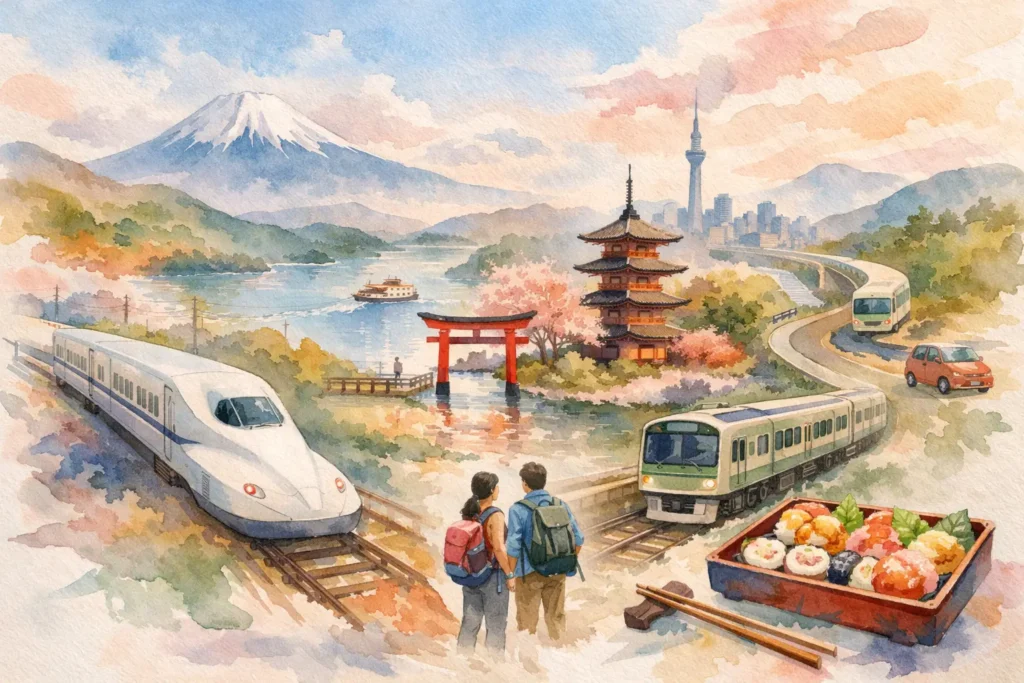
A Japan itinerary can look deceptively simple on a map: Tokyo to Kyoto, Kyoto to Osaka, then onward to Hiroshima or Hakone. Yet the right ticket strategy depends less on how many places you visit than on when, where, and how quickly you move between them. The best JR Pass alternatives can make room in your budget for a ryokan stay, a memorable kaiseki dinner, or an extra day wandering through a temple town after the early crowds have gone.
The nationwide Japan Rail Pass still has a place for travelers making several long Shinkansen journeys in a short period. But it is no longer the automatic choice it once seemed. Japan’s rail network is wonderfully extensive, but it is also a mosaic of JR lines, private railways, subways, local buses, and ferries. Choosing tickets that match your actual route often creates a more flexible, more revealing journey.
Start With Your Route, Not the Pass
Before buying anything, sketch every intercity journey with its approximate date. A Tokyo-Kyoto round trip is very different from Tokyo-Kanazawa-Kyoto-Hiroshima-Fukuoka in eight days. So is a trip built around Tokyo, Kamakura, Hakone, and Nikko, where private railways and regional transport play an important role.
Compare the cost of individual reserved or unreserved tickets against a pass only for the days you will truly use it. Include airport transfers, but do not inflate the calculation with local trips that an IC card will handle cheaply. Also check the trains you want to take. Some faster Shinkansen services and many privately operated scenic railways are not included in every JR product.

This small planning exercise changes the question from “Which pass is best?” to “What kind of Japan do I want time to experience?” A slower route through Hokuriku, Kyushu, or the Japanese Alps may reward a regional pass. A city-focused trip may not need a rail pass at all.
Regional JR Passes: The Strongest JR Pass Alternatives
Regional passes are often the most compelling option for travelers who plan to explore one part of the country deeply rather than race across the archipelago. They can cover consecutive travel days within a defined area and may include limited express trains and Shinkansen segments, depending on the pass.
Kansai, Kyoto, and the Seto Inland Sea
For an itinerary based in Kyoto or Osaka, a regional JR pass can be especially useful when paired with longer excursions. Hiroshima’s Peace Memorial Park and Miyajima’s floating torii gate create a powerful two-day extension from Kansai. Himeji, with its magnificent white castle, is another natural rail day trip. In these cases, a Kansai-and-westward pass may offer better value than a nationwide pass.
But there is a trade-off. Kyoto itself is best experienced on foot, by bus, subway, and private railways. The atmospheric approach to Arashiyama, the climb through Fushimi Inari’s vermilion torii gates, and the streets around Gion do not require a broad JR pass. Buy a regional pass for the long-distance portion of the journey, not merely because Kyoto is on the itinerary.
Kyushu and Hokkaido
Kyushu is made for regional rail exploration. From Fukuoka’s lively food stalls to Nagasaki’s layered history, the hot springs of Beppu, Kumamoto Castle, and the volcanic landscapes around Aso, distances add up quickly. A Kyushu rail pass can be a practical fit when several long rail days are clustered together.
Hokkaido works similarly, particularly for travelers combining Sapporo with Otaru, Hakodate, Furano, or Asahikawa. Yet winter weather, limited rural train schedules, and luggage can influence the decision. In some areas, a rental car or a guided day trip may be more useful than a rail pass. The goal is not to force the trip onto rails, but to choose the transport that lets the landscape set the pace.
Hokuriku and the Japanese Alps
Kanazawa’s preserved teahouse districts, the dramatic mountain villages of the Alps, and the coastal scenery around the Sea of Japan offer a quieter counterpoint to Japan’s headline cities. Regional options can help with routes connecting Tokyo, Nagano, Toyama, Kanazawa, and parts of Gifu or Niigata.
Study coverage carefully here. The most captivating sections of an alpine itinerary may involve private railways, local buses, or reservation-only services. A regional pass can still be valuable, but it may cover only one layer of the journey.
Use an IC Card for Everyday Freedom
For many visitors, an IC card is the most useful travel tool in Japan. It is a rechargeable transit card accepted across much of the country for ordinary JR trains, subways, city buses, and participating shops and vending machines. Tap in, tap out, and spend less time decoding ticket machines.
An IC card does not usually replace a long-distance Shinkansen ticket, and coverage or mobile-wallet availability can vary by phone and region. Still, it is ideal for the beautiful in-between moments that do not appear in big rail-pass calculations: a quick ride from Ueno to Asakusa, an evening train to Yokohama’s waterfront, or a local bus to a lesser-known temple outside central Kyoto.
It also encourages flexibility. You can leave a museum when the light turns golden, follow a lantern-lit shopping street, or stop for coffee in a neighborhood that catches your attention without worrying whether a specific pass covers the ride.
Buy Individual Tickets When Your Big Trips Are Few
Point-to-point tickets are often the cleanest choice for a first visit centered on Tokyo, Kyoto, and Osaka. These cities are connected by frequent, efficient trains, but a single round trip or one-way Shinkansen journey rarely justifies a nationwide pass by itself.
Buying individual tickets gives you the freedom to select departure times, reserve seats on busy travel days, and choose the service that suits you. It can be particularly sensible during cherry blossom season, autumn foliage season, and major holidays, when reservations matter more than theoretical pass savings.
This approach also works well for open-ended travel. If you plan to linger in Tokyo’s dynamic neighborhoods before spending three unhurried nights in Kyoto, there is little reason to buy unlimited rail travel for days spent exploring locally.
Consider Private Railway and City Passes
Some of Japan’s most memorable escapes run on private lines rather than JR tracks. This is where a nationwide pass can feel surprisingly narrow.
From Tokyo, Hakone passes can combine trains, buses, cable cars, ropeways, and sightseeing boats around a region of volcanic valleys, cedar forests, and views toward Mount Fuji. The experience is not just transportation. It is part of the destination, from the switchback railway to the passage across Lake Ashi.
In the greater Tokyo area, passes associated with private railways can suit day trips to Nikko, Kawagoe, Enoshima, Kamakura, or Yokohama. In Kansai, private lines provide excellent access to Nara, Kobe, Koyasan, and the Osaka-Kyoto corridor. City subway passes can also work for concentrated sightseeing days, although they are only worthwhile if you will make enough rides and are happy to stay within their network.
Read the boundaries before purchasing. A pass that reaches your destination may not cover every local bus or temple-area shuttle once you arrive. That is not a flaw, just a reminder that Japanese transport is a connected ecosystem rather than one single system.
Overnight Buses, Flights, and Cars Have Their Moment
For budget-minded travelers, overnight buses can replace an expensive hotel night while linking major cities. They make the most sense when your schedule is flexible and you are comfortable sacrificing some sleep for savings. Choose them thoughtfully: arriving exhausted before a full day of temples or hiking can diminish an experience that deserves your attention.
Domestic flights can be competitive for longer distances, especially between Tokyo and Hokkaido, Okinawa, or Kyushu. Factor in airport transfers and arrival time, not only the fare. Rail often wins for city-center convenience, while flying can save hours on a long north-to-south route.
A rental car is another overlooked alternative for rural Japan. It is particularly valuable for areas with sparse train service, including parts of Hokkaido, Tottori, Okinawa, and the countryside around Mount Fuji. It brings independence, but drivers should be ready for tolls, parking costs, narrow roads, and the need to arrange the proper documentation.
A Simple Way to Choose
If your itinerary has several long rail journeys within one region, begin with a regional JR pass. If it has one or two major intercity rides, price individual tickets and use an IC card locally. If Hakone, Nikko, Koyasan, or Kamakura is central to your plans, look closely at the private railway passes built around those destinations. And if remote coastlines, mountain villages, or island landscapes are the heart of the trip, compare rail with buses, flights, or a car before committing.
Japan’s transport network is more than a way to get from landmark to landmark. A local train rolling past rice fields, a mountain cable car rising through mist, or the first glimpse of the sea from a coastal platform can become part of the memory. Choose the ticket that leaves you free to notice it.
![[商品価格に関しましては、リンクが作成された時点と現時点で情報が変更されている場合がございます。]](https://hbb.afl.rakuten.co.jp/hgb/574e6375.e45b3e03.574e6376.37c1b1d7/?me_id=1365903&item_id=10002185&pc=https%3A%2F%2Fthumbnail.image.rakuten.co.jp%2F%400_mall%2Ff212032-takayama%2Fcabinet%2F08681762%2F10780736%2Frtc010_01.jpg%3F_ex%3D128x128&s=128x128&t=picttext "[商品価格に関しましては、リンクが作成された時点と現時点で情報が変更されている場合がございます。]")