
A Japanese train station can be far more than the point between one destination and the next. It may be a red-brick landmark beneath the Tokyo skyline, a vast hall shaped like a traditional theater, or a quiet timber gateway to a hot-spring town. The best Japanese train stations reveal the country’s remarkable ability to make movement feel meaningful – pairing precision and modernity with regional identity, architecture, food, and everyday life.
For travelers, these places reward an earlier arrival. Look up before rushing toward the platform, follow the aroma of a local bento, and notice how a station introduces the character of the city beyond its gates.
Quick picks: Tokyo, Kyoto and Kanazawa for architecture; Hakata for food; Kinosaki Onsen and Yufuin for hot-spring arrivals; Kawaguchiko and Shimonada for scenery. These twelve stops span Japan, so choose the ones that fit your regional itinerary rather than trying to visit them all in one trip.

12 Japanese Train Stations Worth Exploring
1. Tokyo Station (東京駅): a red-brick gateway to the capital
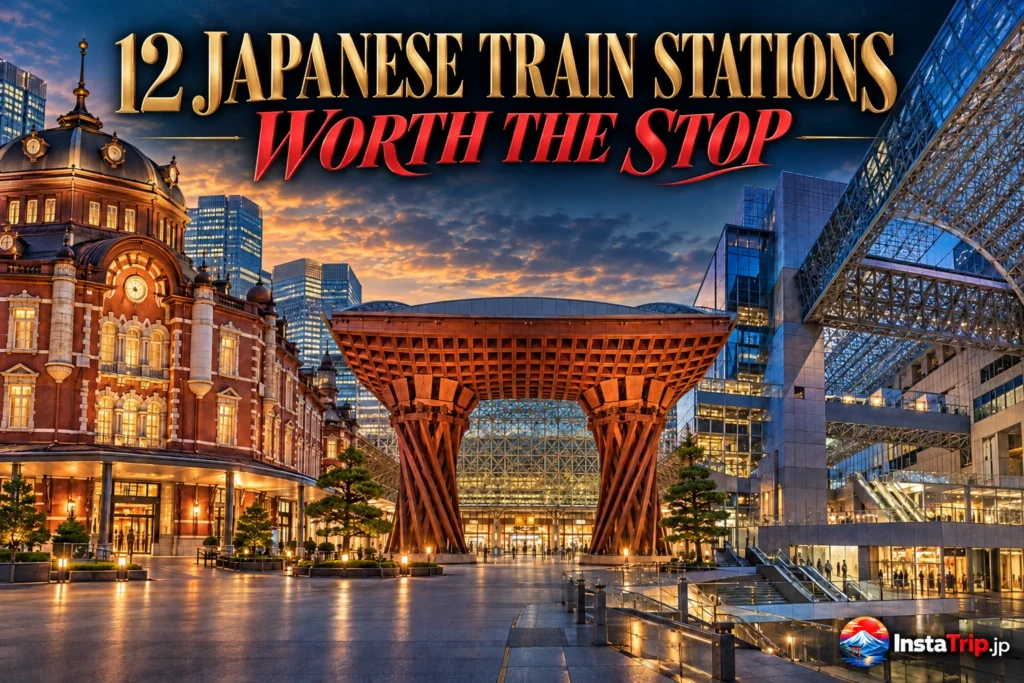
Tokyo Station’s Marunouchi Building remains one of the capital’s most magnificent arrivals. Opened in 1914 and restored in 2012, its elegant red-brick facade, white stone details, and domed roofs offer a striking contrast to the glass-and-steel towers of Marunouchi. It feels less like an anonymous transit hub than a grand civic entrance to modern Tokyo.
Inside, Tokyo Station is an entire urban world. Shinkansen platforms send travelers toward Kyoto, Kanazawa, Tohoku, and beyond, while the underground complex holds character shops, restaurants, and food halls. The surrounding area adds another layer: the Imperial Palace lies a short walk west, while Yaesu on the east side carries the restless energy of shops, buses, and business travelers. Come for the architecture, but leave time to explore the station’s food floors and pick up an ekiben, a regional boxed meal made for train journeys.
2. Kyoto Station (京都駅): modern architecture beside ancient Kyoto
Kyoto Station is intentionally dramatic. Its current building, designed by Hiroshi Hara and opened in 1997, rises in a vast composition of glass, steel, stairways, bridges, and open interior space. For a city closely associated with wooden machiya, temple roofs, and mossy gardens, this futuristic structure can be surprising. That contrast is precisely what makes it fascinating.
The building serves as a reminder that Kyoto is not frozen in time. It is a living city where centuries of spiritual and artistic heritage meet contemporary life. Ride the long escalators toward the upper levels for broad city views, especially around sunset, when Kyoto’s basin stretches toward the darkening mountains. From Kyoto Station, the JR Nara Line reaches Inari Station for Fushimi Inari Taisha; the JR Sagano Line reaches Saga-Arashiyama for Arashiyama. It is one of Japan’s most useful and visually memorable transport hubs.

3. Kanazawa Station (金沢駅): a gate with traditional resonance
Kanazawa Station makes a powerful first impression through its immense wooden Tsuzumi-mon Gate. Completed in 2005, the gate’s two twisting pillars recall the form of tsuzumi, a hand drum used in Noh theater. Beyond it, the glass Motenashi Dome shelters visitors with an airy, modern canopy. Together, the structures create a graceful dialogue between innovation and tradition.
That blend suits Kanazawa beautifully. The city is celebrated for gold leaf, lacquerware, tea culture, samurai history, and the atmospheric streets of Higashi Chaya District, yet its station announces a place that continues to create rather than merely preserve. Pause outside before heading to Kenrokuen Garden or the 21st Century Museum of Contemporary Art. It is one of the clearest examples of regional design becoming a cultural welcome.
4. JR Nara Station (奈良駅): a quieter entrance to an ancient capital
Nara Station does not seek to overwhelm. Its charm lies in a more measured sense of arrival. The former JR station building, built in 1934, now houses the Nara City Tourist Information Center. Its tiled roof and historic silhouette stand beside the modern JR station, giving this practical arrival point a distinctive sense of place.
From here, the walk toward Nara Park gradually reveals the city’s rhythm. Follow Sanjo-dori toward Nara Park, roughly a 20-minute walk from JR Nara Station; Kintetsu-Nara Station is closer to the park. Shops and cafés lead toward temples, museums, and open green spaces where deer wander beneath ancient trees. Nara’s greatest monuments, including Todai-ji and Kasuga Taisha, belong to a sacred landscape rather than a single attraction zone. The station provides a calm threshold to that timeless world.
5. Hakata Station (博多駅): the dynamic heart of Fukuoka
Hakata Station reflects Fukuoka’s energetic, outward-looking spirit. As a major Kyushu rail hub, it is constantly in motion: commuters, Shinkansen passengers, local travelers, and visitors from across Asia move through its bright, expansive interiors. Yet it is not simply a place to pass through. The station complex is one of the city’s most satisfying places to eat.
Its restaurant floors bring together Kyushu flavors, from rich Hakata ramen to seafood and regional sweets. For a different perspective, the JR Hakata City rooftop garden has a viewing terrace and a small railway shrine. This is a particularly useful stop for travelers who want to taste local specialties without spending precious time searching after a late arrival. Outside, the station leads toward a city known for yatai food stalls, lively nightlife, canal-side walks, and a relaxed urban confidence. Hakata Station is practical, polished, and deeply connected to Fukuoka’s food culture.
6. Osaka Station (大阪駅): a vast stage for urban life
Osaka Station and the neighboring Umeda district form one of Japan’s most exhilarating urban centers. The modern station complex is immense, layered, and full of movement, with elevated walkways, department stores, restaurants, hotels, and rail connections converging in a landscape that can feel like a city within a city.
Its spectacular roof canopy is worth seeing from Toki-no-Hiroba Plaza above the tracks, where the scale of Osaka’s northern commercial district becomes clear. The trade-off is that first-time visitors may find the network confusing, particularly because several stations in the wider Umeda area carry different railway lines and names. Give yourself extra time, follow the signs carefully, and treat the complexity as part of the experience. This is Osaka at its most dynamic: social, commercial, and always in motion.
7. Nagasaki Station (長崎駅): a fresh arrival in a historic port city
Nagasaki Station has been transformed through redevelopment and the opening of the Nishi Kyushu Shinkansen in 2022. Its contemporary spaces offer a bright, efficient starting point for a city shaped by centuries of exchange with the outside world. The station’s modern appearance is fitting, but Nagasaki’s deeper story waits just beyond it.
From here, travelers can reach the harbor, the former foreign settlement areas, hillside neighborhoods, and sites that invite thoughtful reflection on the city’s history. The approach is not as instantly theatrical as Kanazawa or Tokyo, but Nagasaki Station represents something equally compelling: a historic city continuing to evolve while honoring its complex past.
8. Sapporo Station (札幌駅): a winter city’s warm center
Sapporo Station is a gateway to Hokkaido’s broad landscapes and to one of Japan’s most enjoyable cities. In winter, when snow brightens the streets and temperatures fall sharply, its connected underground passages, shopping areas, and restaurants provide a welcome center of warmth and activity. The station is especially convenient for travelers heading to the Sapporo Snow Festival, Odori Park, the Historic Village, or day trips beyond the city.
It also reveals a different side of Japanese rail travel. Rather than temple districts or dense neon avenues, Sapporo offers wide roads, crisp northern light, and a food culture built around seafood, dairy, miso ramen, and local beer. The T38 observation deck in JR Tower, connected to the station, offers an expansive view of the city grid and the mountains beyond, making the station an ideal first encounter with Hokkaido’s scale.
Four Smaller Stations That Reward a Slower Arrival
9. Kinosaki Onsen Station (城崎温泉駅): step straight into an onsen town
The station is the beginning of the experience in Kinosaki, Hyogo. Walk toward the willow-lined canal and bridges, then return in the evening when guests in yukata move between the town’s public baths. Arriving by rail means you can leave the car behind and enjoy the compact streets at your own pace.
Why stop: A short stroll changes the mood from platform bustle to hot-spring quiet. Limited express trains connect the town with Osaka and Kyoto; check current services before planning. Official Kinosaki travel guide.
10. Kawaguchiko Station (河口湖駅): a first glimpse of Mount Fuji
At the terminal of the Fujikyu Railway, the station building itself can frame Mount Fuji on a clear day. Step outside, turn toward the mountain and give the view a moment before joining the buses for the lakeside. Clouds can hide Fuji without warning, so this is a bonus to savor rather than a guaranteed photograph.
Why stop: The station is both a useful transfer point and a recognizable Fuji viewpoint. Fujikyu’s official viewing guide shows the spot.
11. Yufuin Station (由布院駅): design that frames the mountains
Architect Arata Isozaki designed this gateway to Oita’s hot-spring town. The high, open hall and dark timber give the building a different rhythm from a big-city terminal; beyond it, Mount Yufu sets the backdrop. Rather than rushing to the busiest shopping street, pause at the station and take in the shape of the valley.
Why stop: The architecture makes the arrival itself part of Yufuin’s art-and-onsen atmosphere. Check the official Oita guide for current local information.
12. Shimonada Station (下灘駅): the sea at the edge of the platform
On Ehime’s Yosan Line, this small unmanned station opens toward the Iyo-nada Sea. A coastal road now separates the platform from the water, but the wide horizon and simple bench still make the wait feel cinematic, especially in the softer light of late afternoon. Shimonada is a place to linger respectfully, not a quick detour from a Shinkansen stop.
Why stop: An unusually intimate sea view and one of Shikoku’s most memorable station settings. Local trains are infrequent, so plan your return in advance using JR Shikoku’s station information; the official Ehime guide covers the viewpoint.
Map: Find the 12 Stations
These stops are spread from Hokkaido to Kyushu and Shikoku. The map starts at Tokyo Station; open any station below for its exact location and directions. Check the operator’s latest timetable before adding a distant stop to your trip.
- Tokyo Station 東京駅
- Kyoto Station 京都駅
- Kanazawa Station 金沢駅
- JR Nara Station 奈良駅
- Hakata Station 博多駅
- Osaka Station 大阪駅
- Nagasaki Station 長崎駅
- Sapporo Station 札幌駅
- Kinosaki Onsen Station 城崎温泉駅
- Kawaguchiko Station 河口湖駅
- Yufuin Station 由布院駅
- Shimonada Station 下灘駅
Video: A Walk Through Kyoto Station
To feel the building’s scale before you arrive, take a visual walk from its north side to the south entrance. The player stays compact and starts only when you press play.
Video: The KYOTO — Strolling Tour of Kyoto Station.
Paid links
If you are planning several rail days, these may help you prepare:
- Browse Japan rail travel guidebooks on Amazon
- Browse compact power banks on Amazon
- Browse lightweight daypacks on Amazon
How to Experience Japan’s Stations More Fully
The busiest stations are easiest to enjoy outside peak commuter hours, generally avoiding the morning and evening rush. Most exterior landmarks and public concourses can be visited without a train ticket; platforms and some facilities are beyond ticket gates or have their own admission. If you are transferring between trains, allow more time than a map suggests, especially at Tokyo, Shinjuku, Osaka, and Hakata. Japan’s signage is excellent, but the scale of major hubs can be astonishing.
Look for station-specific details rather than treating every stop the same. Tokyo Station deserves time outdoors at Marunouchi Plaza. Kyoto Station is best appreciated from its upper terraces and skyways. Kanazawa’s gate is most dramatic when you step outside and view it from a distance. At smaller stations, a local bakery, market counter, or ekiben stand may offer the most memorable discovery.
For more of the practical side of rail travel, see our guide to Japan’s IC cards and the future of Japanese rail. Japan’s rail network makes travel famously efficient, but its stations give the journey a richer texture. On your next itinerary, leave room for the arrival itself. The platform is not always the end of transit – sometimes it is the first scene of the place you came to discover.
Official Planning References
- Tokyo Station City: Marunouchi building and restoration
- Kyoto City: Kyoto Station building
- Visit Kanazawa: Tsuzumi-mon Gate and Motenashi Dome
- Nara City: former JR station tourist information center
- JR Hakata City: facilities, food and rooftop
- Osaka Station City: Toki-no-Hiroba Plaza
- Discover Nagasaki: Nagasaki Station
- Welcome to Sapporo: JR Tower T38