

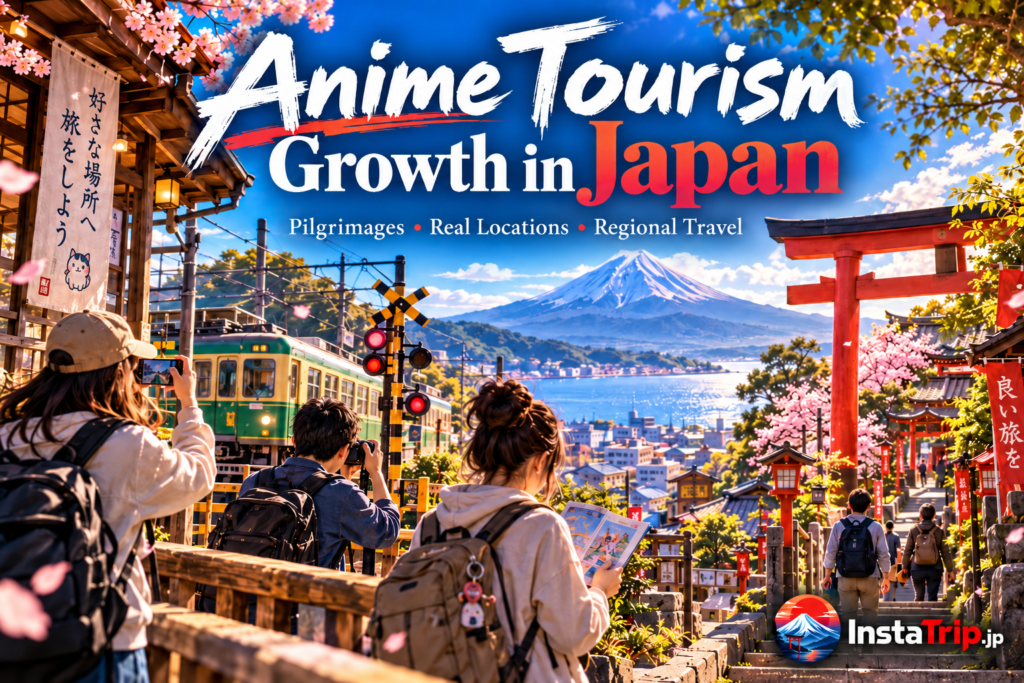
A staircase in Tokyo, a quiet harbor in Shizuoka, or a modest shopping street in a regional town can become a destination of global fascination after appearing in an anime. Anime tourism growth in Japan has transformed the way many travelers encounter the country: not through a conventional sightseeing checklist, but through the emotional geography of stories they already love.
For visitors, this is more than a search for a recognizable backdrop. It is an opportunity to see how animated worlds are shaped by real neighborhoods, railway stations, shrines, coastlines, and everyday rituals. For local communities, it can bring fresh energy, international attention, and a new reason to preserve the atmosphere that made a place memorable in the first place.
Anime Tourism Growth in Japan: What the Evidence Shows
The Japan National Tourism Organization’s February 16, 2026 briefing reports that about 11.8% of visitors surveyed in 2024 identified visiting film- and anime-related sites as an activity for a future trip to Japan. The same briefing reports that overseas votes accounted for 49% of the Anime Tourism Association’s 2025 poll.
These measures point to international interest, but neither is a count of completed anime pilgrimages or an annual visitor-growth rate. Anime-industry revenue also measures a different market from tourism spending. The practical takeaway is to plan around documented destinations and local visitor guidance, rather than treating every viral location as an established attraction.

The Anime Tourism Association’s destination directory and GO TOKYO’s anime-spot guide offer useful starting points for finding locations and understanding their connections to a work.
Why Anime Tourism Growth in Japan Feels Different
Japan has long inspired travelers through its temples, seasonal landscapes, food culture, and dynamic cities. Anime adds another dimension. A series can make a small town feel intimate and familiar to someone who has never set foot in Japan, while a Tokyo street corner can suddenly carry the weight of a favorite scene.
This form of travel is often called anime pilgrimage, or seichi junrei, meaning a visit to a sacred place. The term may sound grand, but it captures something sincere. Fans visit real-life settings not simply to recreate a screenshot, but to experience the mood of a story in its original environment: the sound of a passing train, the changing light at sunset, the rhythm of a local shopping arcade.
Unlike a theme park attraction, these places remain living communities. That is part of their appeal and part of the responsibility. A station platform is still used by commuters. A shrine remains a spiritual site. A residential lane is still home to families. The most meaningful anime-inspired journeys leave room for that reality.

From Tokyo Landmarks to Quiet Coastal Towns
Tokyo is an obvious starting point, especially for travelers drawn to the electric visual language of anime, manga, and games. Akihabara remains a captivating center of contemporary pop culture, with its specialist shops, bright signs, collectible displays, and dense concentration of fan communities. Yet anime tourism reaches far beyond this vibrant district.
The steps near Suga Shrine in Tokyo became internationally recognizable after appearing in Your Name. The appeal lies not only in finding the exact viewpoint, but in seeing how an ordinary slope in Yotsuya can hold cinematic power. Nearby streets, apartment buildings, and train lines reveal the textured urban landscape that animation can turn into something almost dreamlike.
In Kanagawa, the coastline around Enoshima and Kamakura offers another kind of anime atmosphere. Sea breezes, railway crossings, sandy shores, and views toward the horizon have inspired countless scenes of youth, summer, and quiet reflection. Even when a traveler is not following one specific title, these places make clear why artists return to this part of Japan again and again.
Elsewhere, the connection can be remarkably direct. Numazu in Shizuoka has welcomed fans of Love Live! Sunshine!!, whose story is closely intertwined with the city’s waterfront setting and the Izu Peninsula. Oarai in Ibaraki has become closely associated with Girls und Panzer, while Washinomiya Shrine in Saitama gained lasting recognition among fans of Lucky Star. These destinations show how a series can introduce a local place to audiences who might otherwise never have found it on a map.
The experience varies by location. Some towns have maps, themed displays, collaborative events, or character decorations in local businesses. Others offer almost no formal infrastructure, leaving visitors to appreciate a familiar bridge, school-like building, or scenic road with little more than a saved image for reference. Both can be rewarding. The first is festive and social; the second can feel quietly personal.
The Cultural Value Behind the Visit
Anime tourism is sometimes reduced to merchandise and photo opportunities, but its deeper value is cultural exchange. Animation is rooted in observation. Background artists study architecture, street furniture, light, landscapes, seasonal color, and the smallest visual details of daily life. When viewers visit these locations, they encounter the real craftsmanship and local character behind the imagined world.
A journey inspired by an anime can also lead naturally into history and tradition. A fan visiting a shrine because of a beloved series may become curious about its festivals, its architectural details, or the etiquette of making an offering. Someone drawn to a coastal town for an animated setting may discover a fishing harbor, a regional dish, or a local museum. The story opens the door, but the place has much more to say.
This matters particularly in regional Japan. Major cities offer extraordinary experiences, yet smaller communities often hold distinctive landscapes, traditions, and local identities that can be overlooked by international itineraries. Anime can create a meaningful first connection, encouraging travelers to stay longer, eat locally, use regional rail lines, and explore beyond the one famous scene.
Still, the benefits are not automatic. A sudden influx of visitors can strain narrow streets, public transport, or small businesses. It can also create disappointment when travelers expect a location to resemble its animated version exactly. Animation edits reality with intention: it removes clutter, heightens color, shifts perspectives, and turns an ordinary afternoon into a defining moment. The real place is not a lesser version. It is the source, with its own pace and dignity.
How to Visit Anime Locations Respectfully
The most memorable anime pilgrimage is one that feels welcome to both visitors and residents. Before traveling, check whether photography is permitted, especially at shrines, stations, schools, private property, and small businesses. Never enter restricted grounds or block a road to capture a matching angle.
Timing also matters. Visiting early in the morning or on a quiet weekday can offer a more reflective experience while reducing pressure on busy locations. If a destination is residential, keep voices low and avoid gathering in large groups. When local shops offer collaborative menus, displays, or souvenirs, supporting them is a thoughtful way to contribute to the community.
It is also worth expanding the day beyond anime. Pair a visit to a famous Tokyo location with a neighborhood café, garden, or museum. In Numazu, make time for the port and the views around Suruga Bay. In Kamakura or Enoshima, explore temples, coastal paths, and the changing character of the sea. The anime connection may shape the route, but it does not need to limit the experience.
Planning an Anime-Inspired Journey Through Japan
A successful itinerary begins with a simple question: what kind of connection are you looking for? Some travelers want the thrill of standing in an exact scene. Others are more interested in the atmosphere of anime culture, from exhibitions and independent art to shopping districts and creative neighborhoods.
Tokyo is ideal for travelers seeking variety and convenience. It offers iconic anime-related districts, recognizable urban locations, galleries, cafés, and easy rail access to surrounding areas. A broader route can combine Tokyo with Yokohama, Enoshima, Kamakura, or regional destinations connected to a particular series.
For a more focused trip, choose one town or region and give it time. This approach is especially rewarding in places where anime tourism is woven into local life. A single overnight stay can reveal details that a rushed day trip misses: evening lights along a harbor, early morning streets before shops open, or a seasonal festival that has nothing to do with animation but everything to do with the place.
Travelers should also be flexible. Pop-up collaborations, exhibitions, themed train decorations, and local events can be temporary. A destination’s relationship with a series may evolve, and not every shop or display seen online will still be there. Treat the anime reference as an invitation rather than a guarantee, and the journey will feel richer.
Anime Pilgrimage Destinations: Choose Your Type of Visit
| Destination | Anime connection | Planning approach |
|---|---|---|
| Yotsuya, Tokyo | Your Name staircase near Suga Shrine | Keep stairs and entrances clear; combine the stop with a neighborhood walk. |
| Numazu, Shizuoka | Love Live! Sunshine!! | Allow time for the waterfront and check local collaboration information before traveling. |
| Oarai, Ibaraki | Girls und Panzer | Build in local meals and shopping rather than making a single photo stop. |
| Sendai, Miyagi | Haikyu!! monuments and themed installations | Use current local maps and allow time between dispersed sites. |
| Kumamoto Prefecture | ONE PIECE bronze statues | The statues are spread across several municipalities; choose a realistic route. |
JNTO’s anime and manga travel briefing documents the Sendai and Kumamoto examples. These are character-related attractions; they are a different kind of visit from finding the backdrop of a specific animated scene.
How to Plan an Anime Pilgrimage in Japan
- Choose a title and a compact area. Start with one neighborhood or one regional base instead of trying to recreate every scene across Japan.
- Check the connection. Distinguish confirmed settings, visual inspiration and fan speculation. Animation can combine or alter real places.
- Check access. Public streets, paid exhibitions, private buildings and schools have different visitor rules.
- Plan the transport. Save the correct entrance and return connection. Use our Tokyo subway guide for city travel.
- Leave time for the place itself. Add a local meal, harbor walk or cultural stop, and check temporary collaborations separately.
For a first Tokyo visit, combine an anime-culture shopping district with one location walk rather than several distant stops. Our Tokyo stay-planning guide can help you leave room for the rest of the city.
Useful Japanese for Anime Tourism
- 聖地巡礼 (seichi junrei): pilgrimage to places connected with a beloved work.
- 舞台 (butai): setting; useful when researching a story’s real-world connections.
- 撮影禁止 (satsuei kinshi): photography prohibited.
- 立入禁止 (tachiiri kinshi): no entry.
At railway crossings, remain behind the barriers and keep the road clear. Avoid photographing identifiable residents without permission or entering a home, school or business simply because it resembles a scene. Read our Tokyo photography guide for a considerate approach.
Useful Gear for Anime Location Walks
A compact power bank helps keep maps available, and a lightweight daypack leaves your hands free on longer walks. Check the item’s size and charging compatibility before buying.
Travel picks (paid links): Compact power banks · Lightweight daypacks.
Watch: Your Name Locations and the Hida Region
This travel video explores locations connected with Your Name in the Hida region and also visits Shirakawa-go. It offers a visual example of combining an anime-inspired route with wider sightseeing. Not every place shown is an anime setting; confirm access and transport separately.
For the village portion of a similar trip, see our Shirakawa-go travel guide.
Anime Tourism in Japan: FAQ
What is anime tourism?
It includes visits to real-world settings, places that inspired a work, and anime-related exhibitions or attractions. These categories overlap but do not mean the same thing.
Is anime pilgrimage only for dedicated fans?
No. A location walk can also appeal to travelers interested in architecture, coastal scenery and the relationship between stories and everyday places.
Are anime locations free to visit?
Some public streets and outdoor locations are free to access. Museums, exhibitions, transport and other attractions may charge; private property is not automatically open to visitors.
Can I visit every location on an online fan map?
No. A map pin does not establish permission or confirm a connection to the work. Verify the location and its visitor rules before setting off.
Does the 11.8% figure measure actual anime-tourism visits?
No. It refers to interest in film- and anime-related sites for a future trip among visitors surveyed in 2024, as reported by JNTO in 2026.
A New Way to See Japan
Anime tourism reveals a fascinating truth about Japan: extraordinary places are often embedded in ordinary life. A crossing, a riverbank, a school route, or a sunlit station platform can carry immense feeling when viewed through the lens of a story.
For travelers, the lasting reward is not proving that a scene was real. It is noticing how Japan’s living landscapes, local traditions, and contemporary creativity continue to inspire stories that travel far beyond the country’s shores. Follow the frame if you wish, then look beyond it. The real journey begins when the destination becomes more vivid than the anime that first led you there.