

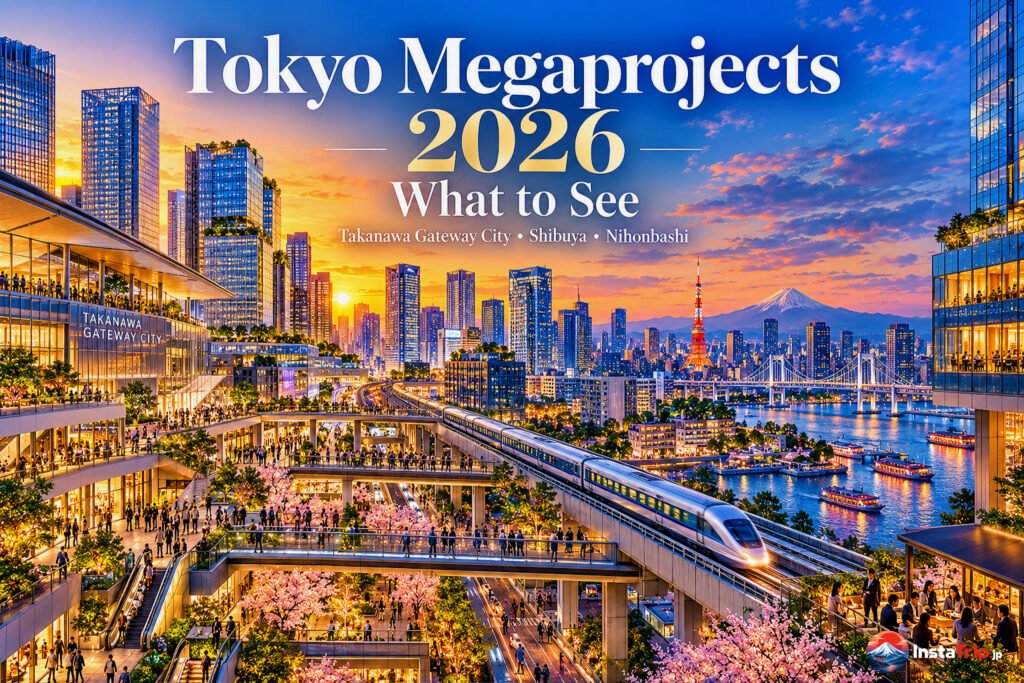
Tokyo megaprojects in 2026 are no longer just renderings of a future skyline. Several major districts have opened this year, while others have reached important construction milestones that make Tokyo’s long-term transformation visible on the ground.
The most important change is in the south: TAKANAWA GATEWAY CITY and OIMACHI TRACKS both opened on March 28, 2026, giving travelers two completely new station-centered districts to explore. Elsewhere, Shibuya’s reconstruction continues toward the 2030s, Tokyo Midtown Nihonbashi is approaching completion ahead of a 2027 opening, and Torch Tower is rising beside Tokyo Station for a planned 2028 debut.
Tokyo Megaprojects 2026: What Is Open Now?
| Project | 2026 status | Area | Visit now? |
|---|---|---|---|
| TAKANAWA GATEWAY CITY | Grand opened Mar. 28, 2026 | 高輪 / Shinagawa | Yes |
| OIMACHI TRACKS | Opened Mar. 28, 2026 | 大井町 | Yes |
| Shibuya Station redevelopment | Major work ongoing | 渋谷 | Yes, but expect changing routes |
| Tokyo Midtown Nihonbashi | Main complex scheduled for completion in 2026; grand opening 2027 | 日本橋 | See the district, not the finished complex yet |
| Tokyo Torch / Torch Tower | Under construction | 東京駅 / 大手町 | District yes; tower not yet |
Japanese search terms worth knowing: 東京再開発 (Tokyo redevelopment), 都市再開発 (urban redevelopment), 高輪ゲートウェイシティ, 大井町トラックス, 日本橋再開発, and 渋谷再開発.

1. TAKANAWA GATEWAY CITY: Tokyo’s Biggest 2026 Opening
TAKANAWA GATEWAY CITY is the clearest answer to “what actually opened in Tokyo in 2026?” JR East officially grand opened the district on March 28, 2026, after years of development around Takanawa Gateway Station.
The project occupies former railway land between Tamachi and Shinagawa and forms the centerpiece of JR East’s broader Greater Shinagawa strategy. Rather than functioning as a single mall or tower, it mixes offices, hotels, residences, public spaces, cultural facilities, retail, technology, art, and station infrastructure.
That makes it interesting even if you are not usually drawn to business districts. The experience is about walking through a newly built urban system: elevated connections, landscaped public space, contemporary architecture, rail views, and a station designed as part of the neighborhood rather than simply a transport stop.
JR East describes March 28 as the district’s grand opening and the full-scale launch of the Greater Shinagawa area. See the official TAKANAWA GATEWAY CITY opening information before visiting for current events and facility hours.

Why travelers should care
Takanawa sits between central Tokyo and Shinagawa, one of the city’s major rail gateways. If your Japan trip includes the Tokaido Shinkansen, Yokohama, or Haneda connections, the district can be added without crossing Tokyo purely for sightseeing.
2. OIMACHI TRACKS: A New District That Opened the Same Day
One of the most useful additions to this article is OIMACHI TRACKS (大井町トラックス), because it also opened on March 28, 2026 and is part of the same broader Greater Shinagawa transformation.
The development includes an outdoor-style commercial area with roughly 80 shops and restaurants, public space, entertainment, wellness functions, offices, residences, and Hotel Metropolitan Oimachi Tracks Tokyo. The project is directly connected to Oimachi Station, making it much easier for travelers to experience than a remote construction showcase.
For 2026 visitors, this is a better “new Tokyo” stop than staring at a tower that will not open for two more years. The official site currently lists seasonal events and programming, which makes Oimachi feel like a functioning neighborhood rather than a project announcement. Check OIMACHI TRACKS official information for current events.
3. Shibuya Redevelopment: Still One of Tokyo’s Biggest Transformations
Shibuya’s redevelopment is far from finished. The important 2026 update is not a single dramatic grand opening but the fact that the station and pedestrian network remain in a long transition toward a much larger final form.
Tokyu’s current official roadmap says the major station and multilayer pedestrian network are expected to reach a key completion stage in 2030. Shibuya Scramble Square Phase II, including its central and west buildings, is planned for 2031, while the broader transformation around Hachikō Plaza continues toward 2034.
That timeline explains why Shibuya can still feel confusing even after major projects such as Shibuya Stream, Scramble Square East Tower, and Sakura Stage opened. Routes, temporary barriers, station passages, and viewpoints may continue changing.
For travelers, that is part inconvenience and part urban history happening in real time. Pair the new architecture with Shibuya’s streets, music culture, and smaller neighborhoods rather than spending the whole visit inside towers.
Tokyu publishes the current milestones on its official Shibuya redevelopment roadmap.
4. Tokyo Midtown Nihonbashi: A 2026 Milestone, 2027 Opening
The Nihonbashi redevelopment has become much more concrete in 2026. Mitsui Fudosan and Nomura Real Estate announced the name Tokyo Midtown Nihonbashi for the large Nihonbashi 1-Chome Central District project.
The main tower, Nihonbashi Nomura Mitsui Tower, is planned at about 284 meters. According to the developers, completion of the main project is scheduled for the end of September 2026, while the district’s grand opening is planned for autumn 2027.
So this needs to be described accurately: Tokyo Midtown Nihonbashi is one of Tokyo’s most important 2026 construction milestones, but it is not yet a finished visitor attraction in 2026.
The larger vision is especially interesting because it connects to the Nihonbashi River Walk and the ongoing relocation of sections of the Metropolitan Expressway underground. The long-term goal is to reopen views and public space around the Nihonbashi River, dramatically changing an area associated with Tokyo’s merchant history.
See the official Tokyo Midtown Nihonbashi announcement for the current schedule.
5. Tokyo Torch and Torch Tower: Watch the Skyline Change Until 2028
TOKYO TORCH, beside Tokyo Station and Otemachi, remains one of the most visible future-shaping projects in central Tokyo. But it is important not to present Torch Tower as a 2026 opening.
The official Tokyo Torch site currently lists Torch Tower as “Coming out in 2028”. Until then, visitors can explore the already developed parts of the district and watch the tower reshape the skyline from the Tokyo Station, Otemachi, and Nihonbashi area.
This is a good example of how to experience Tokyo megaprojects realistically: some are open, some are still construction sites, and some are most interesting because you can compare them with the completed city around them.
From here, it is easy to combine new architecture with Tokyo Station’s restored Marunouchi façade, the Imperial Palace area, or the older commercial fabric of Nihonbashi.
Greater Shinagawa: The Bigger Story Behind Takanawa and Oimachi
JR East now frames the southern corridor from 浜松町 (Hamamatsuchō) through 田町 (Tamachi), 高輪ゲートウェイ, 品川 (Shinagawa), and 大井町 (Oimachi) as Greater Shinagawa.
The important 2026 moment was March 28: JR East describes that date as the full-scale launch of the wider area, tied to the Takanawa Gateway City grand opening and Oimachi Tracks opening.
For travelers, this gives Tokyo’s new architecture a useful geographic logic. Takanawa and Oimachi are not isolated developments; they are parts of a south-Tokyo corridor becoming increasingly important for rail, hotels, business, and international access.
Which Tokyo Megaprojects Are Actually Worth Visiting in 2026?
Go now: TAKANAWA GATEWAY CITY and OIMACHI TRACKS. Both opened in 2026 and function as real neighborhoods with public spaces, shops, restaurants, hotels, and events.
Go for the transformation: Shibuya. It is already packed with completed towers, but the station district is still visibly being rebuilt.
Go for context: Tokyo Station, Nihonbashi, and Tokyo Torch. The interesting part is seeing finished historic Tokyo beside projects scheduled for 2027 and 2028.
A Smart 2026 Route for Architecture Fans
If contemporary Tokyo architecture is a major interest, one efficient day could begin around Takanawa Gateway City, continue one stop south to Oimachi Tracks, then move north toward Tokyo Station and Nihonbashi. Save Shibuya for late afternoon or evening when its vertical cityscape becomes more dramatic.
Do not turn the day into tower collecting. Tokyo works best when the new city is paired with older layers: a merchant street in Nihonbashi, a small shrine between office blocks, or Sensō-ji and Asakusa after a morning among glass towers.
Useful Gear for Exploring New Tokyo
(paid links)
- Compact travel power banks on Amazon — useful for maps, photography, transit apps, and long architecture walks.
- Comfortable walking shoes on Amazon — these districts are best explored on foot, often across multiple station levels and pedestrian decks.
Tokyo Megaprojects 2026 FAQ
What major Tokyo project opened in 2026?
TAKANAWA GATEWAY CITY and OIMACHI TRACKS both opened on March 28, 2026, making them two of the most important new urban destinations of the year.
Is Takanawa Gateway City fully open?
JR East officially marked March 28, 2026 as the grand opening of TAKANAWA GATEWAY CITY. Individual tenants, exhibitions, events, and facility hours can still change, so check the official site before visiting.
Is Torch Tower open in 2026?
No. The official Tokyo Torch site currently lists Torch Tower for 2028.
Is Tokyo Midtown Nihonbashi open?
Not yet as a completed district. The developers schedule completion of the main project for the end of September 2026 and the grand opening for autumn 2027.
When will Shibuya redevelopment be finished?
Tokyu’s current roadmap places major station and pedestrian-network milestones in 2030, Shibuya Scramble Square Phase II in 2031, and the broader station-area completion including Hachikō Plaza toward 2034.
Are Tokyo megaprojects good for tourists?
Yes, especially if you enjoy architecture, urban planning, public space, railways, technology, or contemporary Tokyo. The best visits combine the new districts with older neighborhoods rather than treating redevelopment as a standalone attraction.
Tokyo Is Never Really Finished
The fascinating thing about Tokyo’s 2026 megaprojects is that they reveal several versions of the future at once. Takanawa and Oimachi are newly open. Shibuya is rebuilding while millions of people continue using it every day. Nihonbashi is preparing for 2027, and Torch Tower is still a 2028 promise on the skyline.
That unfinished quality is part of Tokyo’s identity. The city constantly rebuilds without completely erasing what came before. Look up at the new towers — then look back down at the alleys, station platforms, old shop signs, and small sacred spaces that keep the city human.