
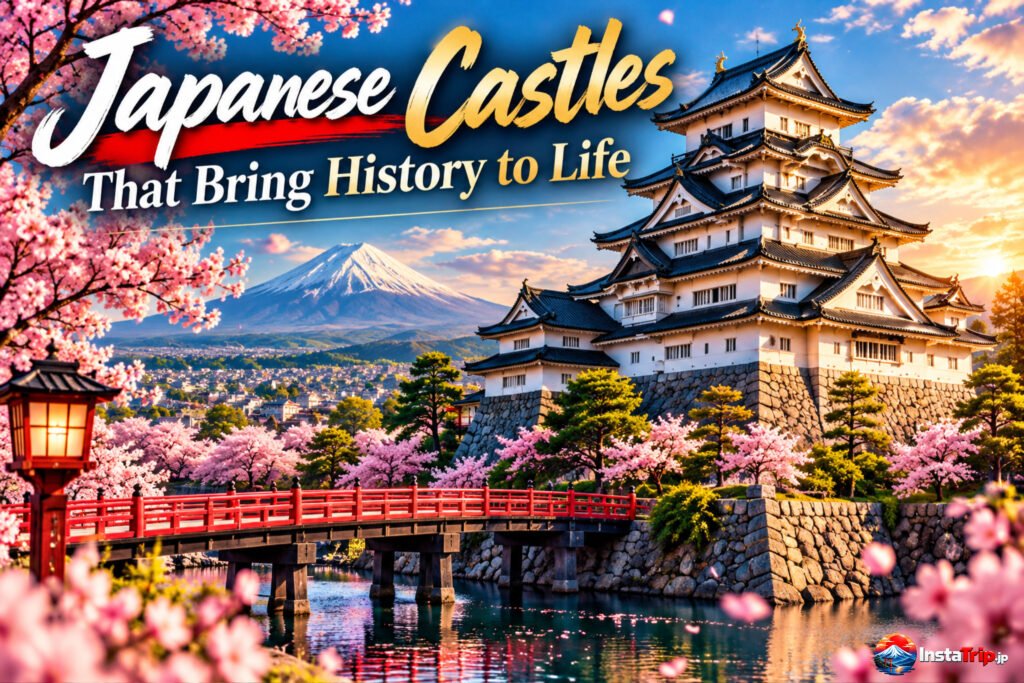
A castle rising above a Japanese city can feel almost cinematic: white plaster brilliant against a blue sky, dark timber framed by mountain air, or a stone base glowing softly after rain. Yet Japanese castles are far more than dramatic landmarks. They are records of power, ingenuity, craftsmanship, and survival – places where the country’s feudal past remains vividly present.
For travelers, Japanese castles offer a captivating way to see how landscape and architecture shaped history. A visit may lead through a maze of gates designed to slow an enemy, up steep wooden staircases polished by generations of footsteps, or into a quiet garden where the military function of a former stronghold gives way to seasonal beauty.
Why Japanese Castles Feel So Distinctive
Unlike many European fortresses, which often appear as broad stone structures with massive walls, Japanese castles combine defensive engineering with an extraordinary sense of visual refinement. Their most recognizable feature is the tenshu, or main keep: a tall, multi-tiered tower crowned with elegantly curved roofs. White plaster, black wood, gold leaf, intricate roof ornaments, and carefully balanced silhouettes transform a defensive center into an architectural statement.
The beauty was strategic as well as symbolic. A castle needed to impress allies, intimidate rivals, and communicate the authority of the lord who ruled from it. Inside, however, the experience could be practical and austere. Narrow corridors, low doorways, steep staircases, and small openings for observation reveal that these were working strongholds, not simply ceremonial residences.

The surrounding grounds matter just as much as the keep. Moats, high stone ramparts, gates, earthen embankments, and winding approach routes were engineered to disrupt an attacking force. At the same time, many castle towns developed around these centers of rule, shaping the streets, markets, and neighborhoods that visitors still explore today.
The Stories Behind Japan’s Great Keeps
Japan’s castle-building age reached its height from the late 16th to early 17th centuries, when powerful warlords competed for territory during the turbulent Sengoku period. Unification under Oda Nobunaga, Toyotomi Hideyoshi, and Tokugawa Ieyasu changed the political landscape, but it also produced some of the country’s most ambitious castles.
The Tokugawa shogunate later restricted the number of castles each domain could maintain. Many fortresses declined, were dismantled, or were transformed as Japan modernized in the 19th century. Fires, earthquakes, war, and redevelopment caused further losses. That makes the surviving original keeps especially precious: they are rare wooden structures that preserve the physical atmosphere of the feudal era.
Not every castle tells the same kind of story. Some are original surviving structures, while others are careful reconstructions built after destruction. A reconstructed keep may contain a museum, elevator access, or panoramic viewing deck rather than historic interiors. That does not make it less worthwhile, but it changes the experience. Travelers interested in original architecture should check what survives before visiting; those drawn to history, views, and castle-town atmosphere will find meaning in both kinds of sites.

Himeji Castle: The White Heron’s Magnificent Flight
Himeji Castle, in Hyogo Prefecture, is often the first name mentioned among Japan’s great castles, and for good reason. Its brilliant white exterior and soaring rooflines have earned it the nickname White Heron Castle. More importantly, its complex of walls, gates, corridors, and defensive routes remains exceptionally intact.
Approaching Himeji is part of the experience. The keep seems to shift in scale as you move through the grounds, appearing graceful from a distance and increasingly formidable as the route tightens around stone walls and turns. Inside, the unpainted timber, sloping stairs, and structural beams offer a direct encounter with the building’s age and sophistication.
Himeji rewards unhurried exploration. Arrive early if possible, particularly during cherry blossom season, when crowds gather around the moats and gardens. The castle is a powerful reminder that elegance and military strategy were never separate ideas in this period of Japanese architecture.
Matsumoto Castle: Black Walls and Mountain Light
Matsumoto Castle offers a striking visual contrast. Known for its black exterior, it stands beside a moat with the Japanese Alps often visible beyond its roofline. The result is one of Japan’s most memorable castle scenes: dark timber, reflective water, and snow-bright peaks depending on the season.
Its main keep is one of the country’s surviving original keeps, and its interior feels notably intimate. The staircases are steep and narrow, the rooms are dimmer than modern visitors may expect, and the worn wood carries a sense of real age. This is not an experience designed around spectacle alone. It is a chance to feel the physical demands of moving through a historic defensive tower.
Matsumoto also works beautifully as part of a wider day in the city. The castle’s presence anchors a compact area of museums, cafés, traditional streets, and mountain views, making it especially appealing for travelers who want history without losing the rhythm of everyday Japan.
Hikone and Matsue: Castles With a Quieter Power
Hikone Castle, on the shores of Lake Biwa, is smaller than Himeji but richly rewarding. Its original keep, graceful gardens, and views across the water create a more intimate encounter with feudal architecture. The nearby former administrative buildings add another layer, showing that a castle was also a seat of governance, not merely a tower on a hill.
Matsue Castle, in Shimane Prefecture, has a darker, more imposing presence. Its black wooden keep rises above a moat and is recognized as one of the few remaining original castles. The city’s waterways and nearby cultural sites make Matsue an evocative choice for travelers who prefer a less hurried, more atmospheric side of Japan.
These castles demonstrate why the most famous destination is not automatically the best fit. Himeji is extraordinary for scale and preservation. Matsumoto is ideal for architecture and mountain scenery. Hikone suits visitors drawn to gardens and lakeside calm, while Matsue offers a strong sense of regional history and quiet grandeur.
How to Visit Japanese Castles Well
A meaningful castle visit starts with allowing more time than the keep alone appears to require. The grounds, gates, stone walls, moats, and gardens often reveal more about the site’s original design than a single museum display can. Look back frequently as you walk: changing angles explain how the approach was controlled and why the castle occupied that particular hill, plain, or waterfront.
Wear comfortable shoes with reliable grip. Original keeps commonly have steep wooden stairs, and visitors may be asked to remove their shoes indoors. Large bags can be inconvenient in narrow interiors, while summer heat and winter winds can feel stronger on exposed grounds. Early morning usually offers softer light for photography and a calmer atmosphere.
Cherry blossom season creates unforgettable scenes, but it also brings large crowds. Autumn foliage can be equally beautiful and sometimes easier to enjoy at a slower pace. In summer, castle parks often host festivals, evening illuminations, or local events, while winter can reveal the clean geometry of roofs and stonework without heavy foliage.
It is also worth noticing what lies beyond the walls. Many former castle towns preserve districts of merchant houses, samurai residences, shrines, canals, food stalls, and local museums. The castle was once the center of a living political and economic world. Exploring the surrounding city turns a landmark visit into a fuller encounter with place.
Which Japanese Castle Should You Visit?
| Castle | Best fit | Plan around |
|---|---|---|
| Himeji | A monumental white keep and extensive defensive grounds | Walking slopes and climbing stairs inside the keep |
| Matsumoto | A striking black keep in a compact historic city | Very steep interior stairs and entry time slots |
| Hikone | A smaller keep, gardens and a Lake Biwa itinerary | The uphill approach and separate museum arrangements |
| Matsue | A historic keep with a quieter regional stay | Official repair notices and access restrictions |
All four retain original keeps. That does not mean every gate, wall or building survives unchanged: a castle site can combine historic structures, restorations and later additions.
Tickets and Accessibility: Check Before You Go
At the time of this update, Himeji’s general adult admission is ¥2,500; the castle and Koko-en garden combination is ¥2,600. Matsumoto lists adult timed-entry e-tickets at ¥1,200 and tickets bought at the counter at ¥1,300. Check the official pages for your travel date, eligibility rules, opening hours and booking conditions.
Original keeps are demanding places to climb. Himeji and Matsumoto have no lifts inside their keeps; Matsumoto’s narrow stairs can be particularly steep. You may need to remove your shoes and carry them. Visitors with limited mobility should ask about accessible grounds and gardens separately from admission to the tower.
Official planning pages: Himeji Castle visitor information, Matsumoto Castle tickets and opening hours, Hikone Castle and Matsue Castle notices.
Watch: A Walking Tour Inside Himeji Castle
Video Street View Japan’s walking tour gives you a look at Himeji’s grounds and interiors. Use the recording to understand the setting; check the official website for current tickets and access restrictions.
Watch this walking tour on YouTube.
Useful Japanese Castle Words
城 (shiro, or jō in castle names) means castle; 天守 (tenshu) is the main keep; 石垣 (ishigaki) means stone walls; and 城下町 (jōkamachi) is a castle town. Exploring the surrounding town helps connect the military landmark with everyday history.
Japanese Castle Visit FAQ
Which castle is a good first visit?
Himeji is a strong choice if its location fits your route and you can manage the climb. Matsumoto offers a different visual character and works well when you are already visiting central Japan.
Can I visit without climbing the keep?
Grounds and surrounding gardens can still be rewarding. Check each site’s ticket boundaries and accessibility information before booking; tower access and outdoor access are different questions.
How much time should I allow?
Reserve a half-day for the castle, queues and nearby streets or gardens. Allow more time if you want museums or a relaxed lunch; travel to the city is additional.
For a Kansai route, see our Kyoto and Osaka comparison. For the broader design context, explore how Japanese design connects tradition and modern life.
Useful travel items (paid links): compact daypacks and Japanese castle architecture books.
More Than a Monument
Japanese castles are sometimes photographed as symbols of a distant past, but their meaning is more immediate than that. They show how Japan’s leaders shaped land, built cities, displayed taste, and imagined permanence during centuries of change. They also reveal fragility: so many castles disappeared that every surviving beam, gate, and stone wall carries unusual weight.
When you visit, pause before rushing to the main tower. Follow the curve of a moat, study the massive fitted stones, listen to the creak of old floorboards, and let the surrounding town come into view. The most memorable Japanese castles do not simply tell you what happened there. They make history feel close enough to walk through.