
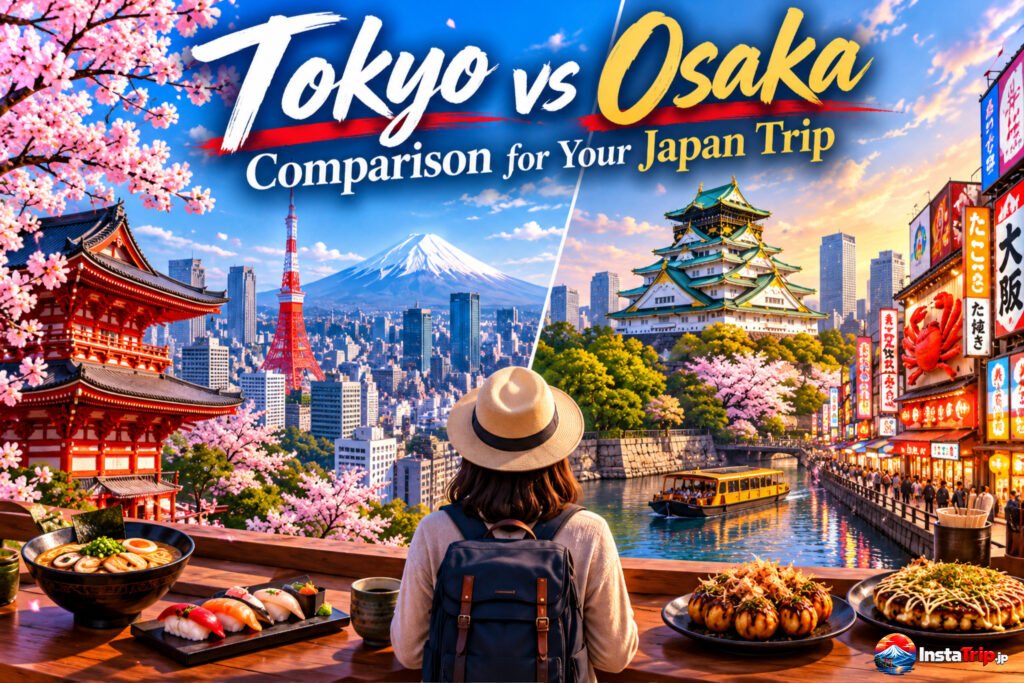
Tokyo can feel like several magnificent cities layered into one vast metropolis: the lantern-lit approach to Sensō-ji in Asakusa, the restless screens of Shinjuku, the polished galleries of Ginza, and the futuristic waterfront of Odaiba. Osaka announces itself differently. It is immediate, energetic, proudly down-to-earth, and often centered on a shared pleasure: eating well. This Tokyo Osaka comparison is not about choosing a winner. It is about recognizing two cities with distinct rhythms, histories, and ways of welcoming a traveler.
For a first journey to Japan, Tokyo and Osaka can complement each other beautifully. Yet if time asks you to choose, the better city depends on whether you are drawn to endless urban variety, intimate food culture, historic neighborhoods, late-night energy, or easy day trips into Kansai’s extraordinary heritage.
Tokyo Osaka Comparison: The Feeling of Each City
Tokyo is immense, but it is not one uniform experience. Its character changes with the train line, the hour, and the neighborhood. In the early morning, the grounds around Meiji Jingu offer a moment of calm beneath towering trees. By evening, Shibuya’s crossings, Shinjuku’s glowing streets, and Roppongi’s contemporary art spaces reveal a city in constant motion. Tokyo rewards curiosity. Turn down a side street in Yanaka, Kichijoji, or Kagurazaka, and the scale suddenly gives way to small shrines, family-run shops, quiet cafes, and residential life.
Osaka is more compact in feeling, even though it is a major city in its own right. Its central districts are animated and theatrical: Dotonbori’s canal-side signs and crowds, Namba’s nightlife, Umeda’s elevated railways and department stores, and the retro charm of Shinsekai. But Osaka’s most lasting impression often comes from its openness. The city has a reputation for direct humor and lively conversation, though visitors should never expect people to perform a stereotype. What many travelers do notice is a sociable, practical warmth expressed through street food, busy counters, and neighborhoods that invite you to linger rather than rush onward.

Tokyo feels like a collection of worlds. Osaka feels like a city that wants you to join the table.
Food: Precision in Tokyo, Pleasure in Osaka
Both cities are exceptional places to eat, and neither can be reduced to a single culinary identity. Tokyo has astonishing range, from carefully composed sushi and soba to ramen counters, department-store food halls, coffee culture, and restaurants representing every region of Japan. Its dining scene can feel refined, experimental, and intensely specialized. A small shop may devote itself to one bowl of noodles or one style of grilled eel with remarkable focus.
Osaka’s food culture is more visibly woven into the street. The phrase kuidaore, often interpreted as eating oneself into ruin, is closely associated with the city and captures its celebratory reputation. Takoyaki, savory round bites filled with octopus, is a familiar Dotonbori favorite. Okonomiyaki, a savory pancake with many regional variations, is another essential experience. Kushikatsu, skewered and fried foods, belongs especially to the atmosphere of Shinsekai.
The difference is one of mood rather than quality. Tokyo is ideal for travelers who want breadth and culinary precision across many neighborhoods. Osaka is unforgettable for those who want their meals to be part of the street scene, with steam rising from grills and the sound of a busy counter around them. In either city, seek out modest local establishments as well as famous dishes, and be mindful of house rules, queues, and dining etiquette.

History, Art, and Cultural Texture
Tokyo’s history is often hidden in plain sight. The city was rebuilt repeatedly after fire, earthquake, and wartime destruction, then transformed into one of the world’s most dynamic urban centers. That makes its surviving and reconstructed cultural spaces feel especially meaningful. Sensō-ji, Tokyo’s oldest temple, remains a living place of worship and a vivid introduction to Buddhist tradition. Nearby Asakusa preserves a nostalgic downtown atmosphere, while Ueno brings together major museums, a park, and traces of the old cultural center of Edo.
Osaka carries a different historical weight. It was long a commercial powerhouse and an important center of trade, theater, and urban culture. Osaka Castle, while reconstructed, remains a powerful landmark connected to the dramatic unification struggles of the late sixteenth century. The Osaka Museum of History offers useful context for the city’s long transformation, while the National Museum of Art presents a strong contemporary contrast.
For travelers seeking older architectural landscapes, Osaka has a practical advantage: Kyoto and Nara are close enough for rewarding day trips. Kyoto’s temple districts, gardens, and traditional townscapes are not interchangeable with Osaka, but they expand a Kansai stay into a deeper encounter with Japan’s artistic and spiritual heritage. From Tokyo, Kamakura, Nikko, Hakone, and Yokohama offer equally compelling excursions, though the journeys often feel more separate from the capital’s central pulse.
Neighborhoods and Nightlife
Tokyo offers a neighborhood for almost every interest. Akihabara remains a fascinating center for games, electronics, anime, and fan culture. Harajuku and Omotesando create a striking collision of youth fashion, design, and architecture. Ginza brings luxury storefronts, traditional craft, and elegant dining, while Koenji and Shimokitazawa appeal to travelers looking for vintage shops, live music, and independent energy.
Osaka’s districts are fewer in number for a short-term visitor, but they are easy to understand and rewarding to revisit. Dotonbori is bright, loud, and undeniably popular, best enjoyed with patience and a willingness to look beyond the iconic signs. Hozenji Yokocho, nearby, feels more intimate, with narrow stone-paved lanes and a moss-covered Fudo Myoo statue. Amerikamura is youthful and fashion-forward, Nakazakicho has small galleries and cafes in older buildings, and Umeda offers a polished, vertical vision of modern Osaka.
After dark, Tokyo gives you vast choice, from hidden cocktail bars to music venues and late-night ramen. Osaka’s evenings can feel more spontaneous and concentrated, particularly around Namba, Umeda, and Tenma. Neither city is automatically better for nightlife. Tokyo provides scale and variety; Osaka often makes a single evening feel easier to shape around food, conversation, and wandering.
Cost, Transportation, and Time
Accommodation costs depend on the neighborhood, dates, room size and booking conditions; compare equivalent hotels before deciding which city is cheaper. Its extraordinary rail network makes reaching almost anywhere possible, but first-time visitors may need a day or two to feel comfortable navigating its size. Staying near a station is often more useful than staying near a famous landmark.
Osaka can offer better value for hotels, and its core sightseeing areas are easier to connect on foot or by short subway rides. That said, prices change with seasons, events, and booking timing, so the gap is not guaranteed. Osaka is especially efficient if your itinerary includes Kyoto, Nara, Kobe, or Himeji.
Tokyo deserves more days if you want to experience several contrasting districts without treating the city as a checklist. Four to six days gives room for both headline sights and slower discoveries. Osaka can feel satisfying in two to four days, or longer when used as a base for Kansai. Travelers with limited time should avoid trying to absorb both cities in a single rushed weekend.
Tokyo vs Osaka: Quick Travel Comparison
| Planning question | Tokyo | Osaka |
|---|---|---|
| What is the appeal? | A huge range of districts, museums, shopping and cultural scenes | Food-focused evenings and a convenient base for parts of Kansai |
| How should I organize days? | Group sights by neighborhood to reduce cross-city travel | Group central sights and plan regional excursions separately |
| Which station matters? | Tokyo or Shinagawa for the Tokaido Shinkansen | Shin-Osaka for the Shinkansen; Osaka and Namba for different downtown areas |
| Which is cheaper? | Compare like-for-like accommodation and your complete itinerary | |
Tokyo to Osaka: Plan the Whole Journey
A Nozomi service connects Tokyo and Shin-Osaka in around two and a half hours, depending on the service. This is station-to-station time. Add travel to the departure station, time to find your platform and the onward journey from Shin-Osaka to your hotel.
Shin-Osaka is not Osaka Station or Namba. Check the final address before selecting a ticket or estimating arrival time. The official SmartEX website provides Tokaido Shinkansen reservations and current booking information. Check the fare, change conditions and any luggage reservation requirements for your ticket.
If comparing a flight, include airport transfers, check-in and baggage costs. Compare both complete journeys rather than the flight time with the train time alone.
How to Split a Week Between Tokyo and Osaka
A useful starting point is four days in Tokyo and three days in Osaka or the wider Kansai area. Count the intercity transfer within that week, and reduce your sightseeing ambitions on the travel day. If Kyoto is a major priority, use our Kyoto and Osaka comparison to decide where to sleep.
For your budget, compare equivalent room sizes and cancellation conditions on the same dates. Add intercity transport, local journeys and attraction tickets. A lower nightly hotel price can be offset by a location that adds long daily transfers.
Watch: Osaka at Night, from Dotonbori to Tsutenkaku
Rambalac’s walking tour shows Osaka’s illuminated streets and the route from Dotonbori toward Tsutenkaku. Use it to get a feel for the city’s evening atmosphere; storefronts and local conditions may have changed since filming.
Watch this walking tour on YouTube.
Useful Japanese Station Names
東京 (Tōkyō) means Tokyo; 大阪 (Ōsaka) means Osaka; 新大阪 (Shin-Ōsaka) identifies the Shinkansen station. 新幹線 (shinkansen) is the high-speed railway. Recognizing these names helps avoid confusing your long-distance arrival station with your hotel’s local station.
Tokyo or Osaka: Frequently Asked Questions
Is Osaka always cheaper than Tokyo?
No. Hotel prices depend on dates, location and availability. Compare your actual booking options and transport costs before choosing a base for budget reasons.
Can I comfortably visit both in a week?
Yes, if you select a manageable shortlist and account for the transfer day. Adding many regional excursions leaves less time to experience either city.
Should I stay near Shin-Osaka?
It can suit an itinerary with repeated Shinkansen journeys. For evenings in downtown Osaka, compare hotels near the districts you plan to visit and check the actual local journey.
Prepare with our guides to navigating Tokyo’s subway and cash and card payments in Japan.
Useful travel items (paid links): travel packing cubes and travel card holders.
Which City Should You Choose?
Choose Tokyo if you want the greatest range of museums, architecture, pop culture, shopping, dining styles, and neighborhood atmospheres. It is especially rewarding for repeat visitors because every return can focus on a different side of the city. Choose Osaka if food is central to your journey, if you prefer a more compact urban experience, or if you want Kyoto and Nara within easy reach.
A solo traveler may appreciate Tokyo’s endless options and Osaka’s approachable bar and counter culture. Families may find either city rewarding, though Osaka’s compactness and attractions such as the Osaka Aquarium can make logistics feel lighter. Photographers may be drawn to Tokyo’s constantly shifting cityscape, while Osaka offers vivid neon, canals, retro streets, and the visual drama of everyday eating culture.
If your itinerary allows both, resist the urge to compare every moment. Let Tokyo astonish you with its scale, then let Osaka slow you down over a hot plate of okonomiyaki or a walk along the Dotonbori canal. The most memorable Japan trip often begins when you stop searching for the better city and start noticing what each one teaches you to see.