

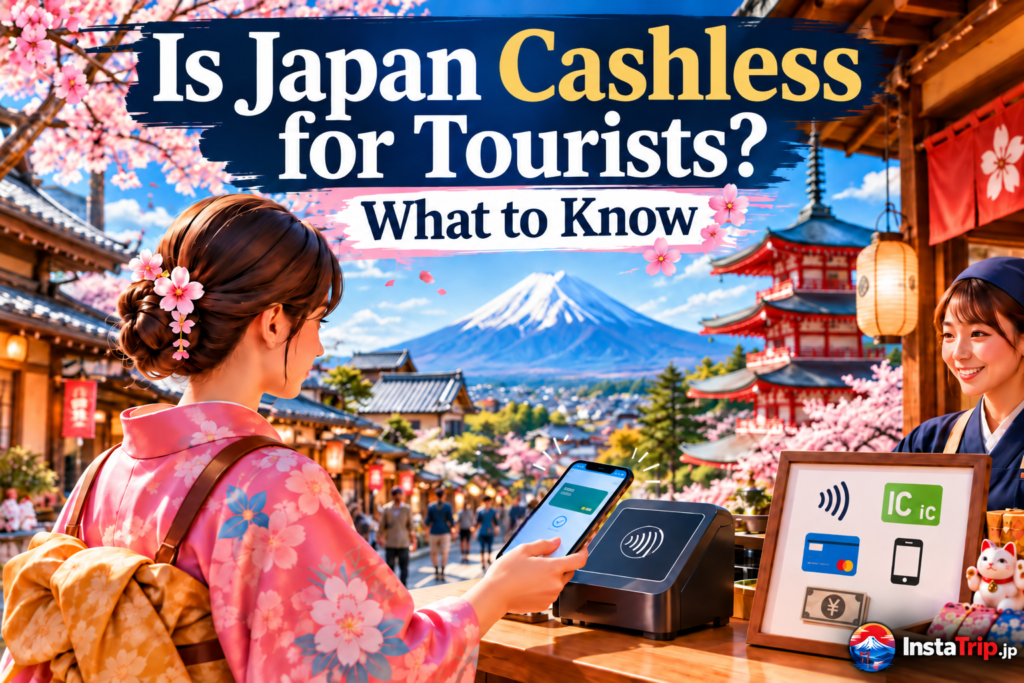
A glowing vending machine on a quiet Tokyo side street, a tiny ramen counter in Shinjuku, a temple approach lined with snack stalls: Japan can feel thrillingly high-tech and beautifully timeless at once. That contrast shapes a practical question for every visitor: Is Japan cashless for tourists? Not completely. Japan is far more card-friendly than it was a decade ago, especially in its dynamic cities, but cash still has a meaningful place in everyday travel.
The best approach is not to choose between cash and cards. Arrive with a payment mix that lets you move easily from Tokyo’s glittering Ginza storefronts to a family-run soba shop in Kyoto, from a contactless train gate to a quiet rural bus stop. With a little preparation, paying in Japan becomes one of the simplest parts of the journey.
Is Japan cashless for tourists in 2026?
Japan is increasingly cashless, but it is not a fully cashless destination. Major hotels, department stores, museums, chain restaurants, convenience stores, airports, and many popular attractions widely accept credit cards. Contactless payments are also increasingly common, particularly in Tokyo, Osaka, Kyoto, Yokohama, and other large urban centers.
Yet cash remains essential in situations that make Japan memorable: a neighborhood bakery, an independent izakaya, a market stall, a countryside inn, a small temple shop, or a local taxi outside the busiest districts. Some businesses accept cards but have minimum purchase amounts, while others may only take cash. A sign reading cash only is still not unusual, and it is worth treating it as a normal part of the travel experience rather than an inconvenience.

Japan’s continuing relationship with cash is practical rather than old-fashioned. Yen is trusted, easy to use, and deeply woven into daily routines. Small businesses avoid card-processing costs, while many people value the clear sense of budgeting that physical money provides. For travelers, this means a polished futuristic cityscape does not always guarantee a tap-to-pay terminal around the corner.
The payment mix that works best
Carry a credit card, a modest supply of yen, and an IC transportation card if your itinerary includes cities. This three-part combination covers nearly every setting without forcing you to carry a large amount of cash.
A credit card is most useful for larger purchases: hotels, larger restaurants, department stores, attraction tickets, luggage forwarding counters, and shopping in places such as Akihabara or Roppongi. Visa and Mastercard are generally the safest choices, though acceptance can differ by merchant and by card issuer. Tell your bank about your trip if required, and bring a backup card separately in case one does not work.
Cash is for the smaller, more local moments. Keeping several ¥1,000 notes and coins makes paying at casual eateries, markets, temple and shrine shops, coin lockers, and smaller transport services much easier. Japan’s coins are genuinely useful, not merely pocket clutter. They pay for vending-machine drinks, station lockers, capsule-toy machines, and the occasional exact-fare bus ride.
An IC card adds remarkable convenience to urban travel. These rechargeable cards are used at train and subway gates and are often accepted at convenience stores, vending machines, station shops, and some restaurants. They are particularly helpful when navigating Tokyo’s vast rail network, where a quick tap feels wonderfully efficient amid the movement of the city.
A practical first-day plan
After arriving, withdraw some yen from an ATM, set up an IC card if it suits your phone or travel plans, and keep your main credit card ready for larger purchases. You do not need to exchange a huge amount of currency at the airport. Instead, replenish cash as needed, especially before heading to smaller towns, mountain areas, festival grounds, or neighborhood districts where independent businesses define the local character.
For many travelers, having the equivalent of roughly ¥10,000 to ¥20,000 in cash available is a comfortable starting point. The right amount depends on your style of travel. A hotel-and-museum itinerary in central Tokyo requires less cash than a food-focused trip built around small restaurants, local markets, and regional rail connections.
Where cards work well in Japan
Card acceptance is strongest where tourism, large-scale retail, and modern infrastructure meet. You can usually expect cards to work at major hotels, department stores, electronics retailers, convenience-store chains, many rail stations, and well-known museums or observation decks. Larger supermarkets and pharmacies are also commonly card-friendly.
Tokyo’s major neighborhoods illustrate the shift clearly. In Ginza, polished storefronts and elegant cafés are overwhelmingly card-ready. In Odaiba, shopping complexes and entertainment venues are built for digital payments. Even in the electric energy of Akihabara, where gaming, anime, electronics, and collectibles fill every floor, card acceptance is common at larger retailers.
Still, do not assume that one district follows one rule. A few blocks away from a card-accepting department store may be a tiny kissaten café where cash is preferred. These smaller places often offer the most intimate atmosphere: a carefully brewed coffee, a handwritten menu, the soft sound of a radio behind the counter. Having yen lets you say yes to such discoveries.
When cash matters most
Cash is most valuable at independent restaurants, food stalls, traditional shopping streets, small bars, local markets, and parts of rural Japan. It is also wise to have cash for temple and shrine offerings, though these are voluntary gestures and should be made respectfully rather than treated as a required tourist activity.
Local transportation can be another variable. Major rail systems are highly efficient with IC cards and tickets, but smaller bus networks differ by region. Some accept IC cards, others rely on cash, and some may require exact or near-exact fare. Check the payment instructions when boarding, especially in destinations beyond the main urban corridors.
Cash also offers a useful backup when technology fails. Foreign cards can occasionally be declined for reasons unrelated to your balance, such as an issuer’s fraud settings or a terminal’s limitations. A few notes in your wallet can save time and keep a missed payment from interrupting an otherwise captivating day.
ATMs and withdrawing yen
Rather than carrying all your spending money from home, many visitors withdraw yen during their trip. ATMs at convenience stores and post offices are often practical options for international cards, although access depends on your card network, your bank, and the specific machine. Airport ATMs are useful on arrival, but they are not your only opportunity.
Before leaving home, check your bank’s foreign transaction and ATM fees. Choose Japanese yen when an ATM asks which currency to use. If you are offered a conversion into US dollars, declining it is often preferable because your bank or card network may provide a better exchange rate.
Keep receipts and pay attention to your balance as you travel. Japan can be wonderfully tempting, whether you are collecting regional ceramics, sampling seasonal sweets, or finding a small print by a contemporary artist. A clear payment routine leaves more room to enjoy those moments.
Payment etiquette worth knowing
The mechanics of paying are simple, but a few customs make the experience smoother. At many restaurants and shops, you place cash in the small tray near the register rather than handing it directly to the cashier. Change is typically returned carefully, and exact payment is appreciated when convenient, though it is not expected.
Tipping is generally not customary in Japan. Excellent service at a ryokan, restaurant, or taxi is part of professional hospitality, not an invitation to add a percentage. If a service charge applies, it will normally be included in the bill. Trying to leave loose change on the table can create confusion.
When using a card, wait for the staff member’s direction. You may tap, insert, or hand over the card depending on the terminal. Keep in mind that a signature or PIN requirement can vary. The process is usually calm and orderly, even in the most vibrant stations and busiest shopping streets.
Cash, Credit Card or IC Card: A Quick Comparison
| Method | Useful for | Check first |
|---|---|---|
| Yen cash | Cash-only shops, offerings and some local transport | Keep small notes and coins; check ATM access before rural travel. |
| Credit or debit card | Hotels, larger shops and merchants displaying your network | Acceptance, PIN and issuer fees; contactless is not guaranteed. |
| Transport IC card | Compatible local transport and shops with the relevant logo | Balance, coverage and top-up method; it is not a universal rail pass. |
| Phone wallet or QR app | Compatible terminals and supported payment services | Device, card and account eligibility; a local QR logo does not guarantee access for visitors. |
JNTO’s cashless-payment guidance recommends cash as an alternative if card payment fails. GO TOKYO’s money guide also notes that independent businesses may not accept cards.
ATMs and Welcome Suica: Official Details
Seven Bank’s overseas-card guide lists supported networks, service hours and withdrawal limits. The stated limit is ¥100,000 per withdrawal for overseas-issued cards, with a ¥30,000 limit for magnetic-stripe transactions; your own bank may impose a lower limit. Some cards are not accepted even when their network logo is listed, and fees vary.
The physical Welcome Suica is valid for 28 days from purchase. Check the specific product’s balance, refund and charging rules before loading a large amount. Physical cards and phone-based products have different setup requirements. An IC card cannot automatically cover every rural line or every journey between separate IC areas.
Useful Japanese at the Register
- 現金 (genkin): cash.
- 現金のみ (genkin nomi): cash only.
- クレジットカードは使えますか? (Kurejitto kado wa tsukaemasu ka?): Can I use a credit card?
- 領収書 (ryoshusho): receipt.
Watch: Paying in Japan: Cards, IC Cards and Cash
This payment guide offers practical examples of the three main methods. Use the official links above for current product rules and ATM conditions.
Organize Your Travel Wallet
A small coin pouch keeps yen easy to reach, while a separate card holder can help organize your backup card. Choose items that fit your routine.
Useful travel items (paid links): Small coin pouches · Travel card holders.
Is Japan Cashless for Tourists? FAQ
Can I travel with only a bank card?
You may encounter cash-only businesses or a declined card. Carry a cash reserve appropriate to your route.
Does every shop accept Suica?
No. Look for the accepted-payment logos and ask before ordering.
Will Apple Pay or Google Wallet always work?
No. Acceptance depends on the payment service, merchant terminal, device and linked card. Keep another payment method available.
Is ¥10,000–¥20,000 a required cash amount?
No. It is a planning example, not an official minimum. Estimate your cash-only expenses and ATM access rather than treating one amount as right for everyone.
What if my card is declined?
Use a backup method, check your issuer’s alerts and contact the bank if needed. Repeated attempts at the same terminal may not resolve an issuer restriction.
Plan for places that reward spontaneity
The real pleasure of carrying both yen and cards is freedom. You can reserve a special dinner with a card, then follow the aroma of grilled skewers into a tiny alleyway without wondering whether you can pay. You can tap through the gates at a Tokyo station, then buy a warm drink from a vending machine before stepping into the night.
Japan is not cashless for tourists in the absolute sense, but it is easy to navigate when you prepare for its layered rhythm of tradition and technology. Keep cash for the unexpected, use cards for comfort and larger expenses, and let an IC card carry you through the daily pulse of the city. Then the question of payment fades into the background, leaving Japan’s magnificent details free to take center stage.