
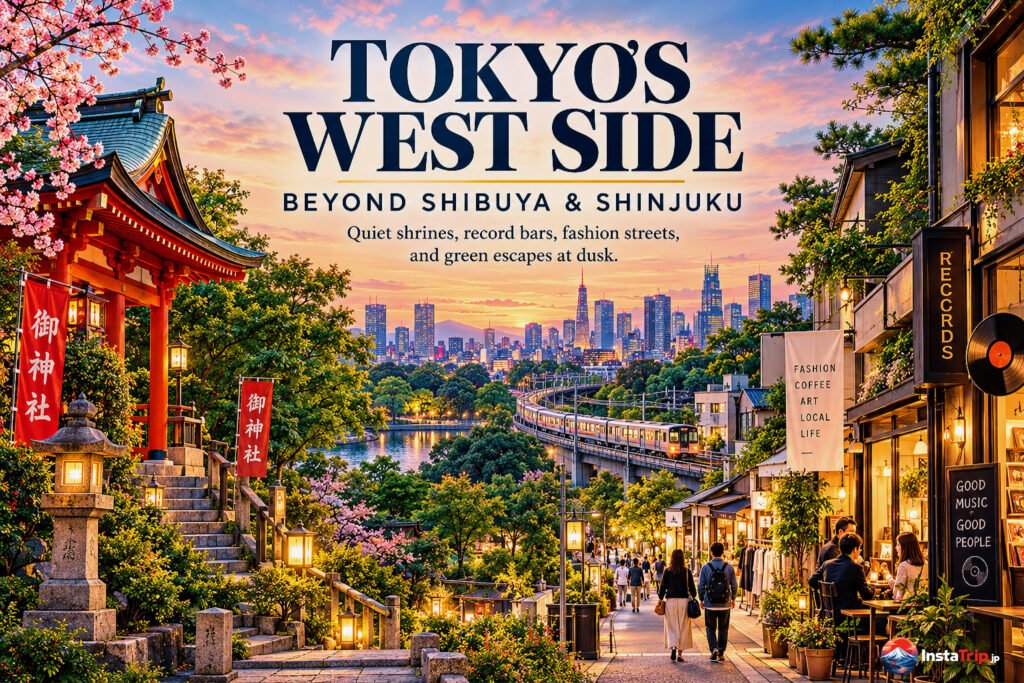
The great scramble crossing outside Shibuya Station is only the opening scene. A few train stops, a quieter backstreet, or a walk beneath tall zelkova trees can reveal a Tokyo that feels remarkably different: creative, residential, green, and full of small rituals. Exploring Tokyo’s west side means moving beyond the city’s famous neon landmarks to encounter vintage clothing, neighborhood cafés, independent music, peaceful shrines, and parks where everyday Tokyo unfolds at a gentler pace.
Tokyo’s west side is not an official district with a fixed boundary. It is better understood as a constellation of neighborhoods spreading from Shibuya and Harajuku toward Shimokitazawa, Nakano, Koenji, Kichijoji, and the leafy edges of Setagaya and Musashino. Each has its own rhythm. Together, they show why Tokyo is never just one city.
Tokyo’s West Side Is a City of Contrasts
Central Tokyo can feel vertical and cinematic, defined by towers, department stores, packed platforms, and brilliant screens. West of those core scenes, the city often becomes more intimate. Low-rise lanes replace wide avenues. Small businesses sit beside family homes. A centuries-old shrine may be a short walk from a shop selling experimental design, used records, or carefully brewed coffee.

This contrast is part of the area’s appeal. Shibuya and Shinjuku remain essential gateways, especially for first-time visitors, but west Tokyo rewards curiosity rather than a rigid checklist. The most memorable moments often arrive between destinations: the sound of a train passing above a narrow street, a handwritten menu outside a tiny restaurant, or a neighborhood festival banner fluttering over a shopping arcade.
It is also a side of Tokyo shaped by youth culture and artistic independence. Since the postwar decades, areas such as Koenji and Shimokitazawa have drawn musicians, performers, writers, collectors, and fashion-minded residents. Their character has changed as Tokyo has developed, and popular streets can be busy on weekends, but their inventive spirit still sets them apart from the polished commercial centers.
Begin with Sacred Space in Harajuku and Yoyogi
Harajuku is often associated with colorful fashion and Takeshita Street’s energetic crowds. Yet one of Tokyo’s most powerful transitions lies only minutes away at Meiji Jingu. Passing through its immense wooden torii gate, visitors leave the commercial pulse of Harajuku for a broad forested approach that feels unexpectedly distant from the city.

Dedicated to Emperor Meiji and Empress Shoken, Meiji Jingu was established in 1920 and rebuilt after the Second World War. The surrounding forest was deliberately created by generations of volunteers and planners, making it both a spiritual site and a remarkable urban landscape. It is a place to slow down, observe the shrine etiquette posted on site, and appreciate how reverence and daily city life coexist in Tokyo.
Nearby Yoyogi Park offers another version of open space. On pleasant afternoons, its lawns and paths draw runners, families, dancers, musicians, and friends gathering beneath the trees. In spring, cherry blossoms transform the atmosphere; in autumn, the changing leaves bring a softer, golden color. The park can be lively, especially on weekends, but it provides welcome breathing room after Harajuku’s dense shopping streets.
Shimokitazawa and Koenji Keep Creativity Close to the Street
Shimokitazawa, often called Shimokita by locals, is one of the west side’s most appealing places to wander without a plan. Its web of narrow streets holds thrift shops, record stores, small theaters, bakeries, curry restaurants, and casual bars. The neighborhood developed around rail connections and a long-standing live-music and theater scene, giving it an informal, creative identity that still feels personal despite its popularity.
Come in the afternoon to browse slowly, then stay into the evening when the storefront lights and restaurant chatter give the lanes a warm, lived-in energy. Shimokitazawa is particularly rewarding for travelers who enjoy finding a meal by instinct rather than pursuing one famous address. Small establishments may have limited seating, so flexibility is more useful than a tightly timed reservation schedule.
Koenji carries a grittier, more eccentric energy. It is celebrated for vintage fashion, punk and underground music culture, and shopping arcades that retain a distinctly local character. Look beyond the station area, and you will find old-fashioned shotengai, compact eateries, and streets where independent businesses create a sense of continuity rarely felt in Tokyo’s newest developments.
Neither neighborhood should be treated as a stage set for “alternative Tokyo.” They are real communities, and their appeal comes from that ordinariness as much as their creative reputation. Keep voices low in residential lanes, avoid blocking storefronts while taking photos, and remember that the best discoveries usually require time rather than speed.
Nakano Offers Pop Culture with a Collector’s Eye
For a different kind of cultural energy, head to Nakano Broadway. This aging shopping complex has become a fascinating destination for collectors of manga, anime, vintage toys, idol memorabilia, watches, film posters, and other pieces of Japanese popular culture. Its maze-like interior feels less curated than a major retail complex, and that is precisely the charm.
Nakano Broadway is not only for devoted collectors. Even casual visitors can appreciate the visual history contained in its displays: characters from different generations, retro packaging, hand-drawn artwork, and objects that reveal how deeply popular culture can become part of everyday memory. Prices and stock vary widely, so it is better approached as a place to browse than a guaranteed shopping mission.
Outside, Nakano’s covered Sun Mall arcade leads back toward the station through everyday restaurants and shops. It is a useful reminder that Tokyo’s pop-culture landmarks are woven into ordinary neighborhood life, not separated from it.
Kichijoji Brings the City to the Edge of Nature
Kichijoji is where many Tokyo residents go when they want a day that feels both urban and relaxed. The neighborhood has excellent dining, department stores, small boutiques, and the bustling Harmonica Yokocho alleyways near the station. But its defining presence is Inokashira Park, a beloved green space centered on a pond and framed by mature trees.
A walk around the water reveals a quieter Tokyo. Couples paddle rental boats, artists sketch, children play, and seasonal light changes the mood of the landscape. During cherry blossom season, the park becomes especially popular, which means early mornings offer the most peaceful experience. At other times of year, it is an ideal place for a picnic or an unhurried pause between city explorations.
At the park’s western edge, the Ghibli Museum in Mitaka is a major draw for animation admirers. Timed entry is generally required, so it works best as a planned centerpiece rather than a spontaneous stop. Even without a museum visit, the walk through Inokashira Park makes Kichijoji worth the journey.
How to Spend a Day on Tokyo’s West Side
A satisfying route depends on what you want to feel. For fashion, architecture, and shrine atmosphere, begin around Harajuku in the morning, visit Meiji Jingu, then continue through Omotesando or Daikanyama before an evening in Shibuya. This route is polished, visually dynamic, and easy to reach, though it is also the busiest.
For music, vintage finds, and neighborhood character, start with lunch in Nakano or Koenji, move to Shimokitazawa for browsing and a café break, then stay for dinner or a small live performance. This version of west Tokyo is less about famous sights and more about atmosphere. Allow extra time because the most compelling shops and streets are often the ones you notice unexpectedly.
For a slower, nature-centered day, make Kichijoji your anchor. Spend time in Inokashira Park, explore Harmonica Yokocho and the surrounding streets, then return toward Shibuya or Shinjuku in the evening. It is an especially good choice for travelers visiting Tokyo after several intense days of major landmarks and crowded shopping districts.
Tokyo’s rail network makes these combinations practical, but avoid trying to collect every neighborhood in one day. West Tokyo is best experienced at walking speed. Keep a transit card ready, check the last train if you plan a late night, and carry a little cash for smaller shops and older restaurants that may not accept every form of payment.
Let the Neighborhood Set the Pace
The west side reveals a Tokyo that is magnificent not because it is always monumental, but because it is layered. A sacred forest can stand beside fashion streets. A theater district can grow from quiet residential lanes. A pond, a record store, a bowl of curry, and a train platform can all belong to the same afternoon.
Leave room in your itinerary for the unscripted turn down a side street. That is often where Tokyo’s west side becomes more than a destination and begins to feel like a place you have briefly, vividly entered.
![[商品価格に関しましては、リンクが作成された時点と現時点で情報が変更されている場合がございます。]](https://hbb.afl.rakuten.co.jp/hgb/574e2500.a2b8df34.574e2501.cd642176/?me_id=1430209&item_id=10000077&pc=https%3A%2F%2Fthumbnail.image.rakuten.co.jp%2F%400_mall%2Ff131091-shinagawa%2Fcabinet%2Fsi000%2Fsi000-013.jpg%3F_ex%3D128x128&s=128x128&t=picttext "[商品価格に関しましては、リンクが作成された時点と現時点で情報が変更されている場合がございます。]")