
At a stream in northern Japan, the creature came for a horse. By morning, the horse had delivered the creature to the stable instead. The villagers then had to decide what to do with their unexpected prisoner.
That reversal is one of Tōno’s most memorable kappa (河童) stories. It has followed the little river spirit for generations, from the pages of Tōno Monogatari (遠野物語) to a quiet wooded pool where visitors still look at the water a second time.
The horse that brought a kappa home
In tale 58 of Tōno Monogatari, a kappa tries to pull a horse into the water at Obako-buchi (姥子淵), on the Kogarase River (小烏瀬川). The plan goes wrong: the horse drags the kappa back to its stable. The villagers debate its fate, then release it after it promises to stop troubling people. According to the tale, it heads upstream toward Aisawa Falls.
There is a small but fascinating geographical wrinkle. Obako-buchi, the setting of the horse story, is not the same place as the visitor site called Kappa-buchi (カッパ淵). Tōno’s tourism association explains the distinction. The famous pool gives you a place to encounter the wider tradition; it does not turn every episode of the book into an event at that one spot.

The 1910 collection grew out of stories told by Tōno native Kizen Sasaki (佐々木喜善) to folklorist Kunio Yanagita (柳田國男). Its strange presences include kappa and the household spirit zashiki-warashi (座敷童子). Read it as a record of how people described their landscape and fears, rather than a claim that a monster was captured.
What kind of creature is a kappa?
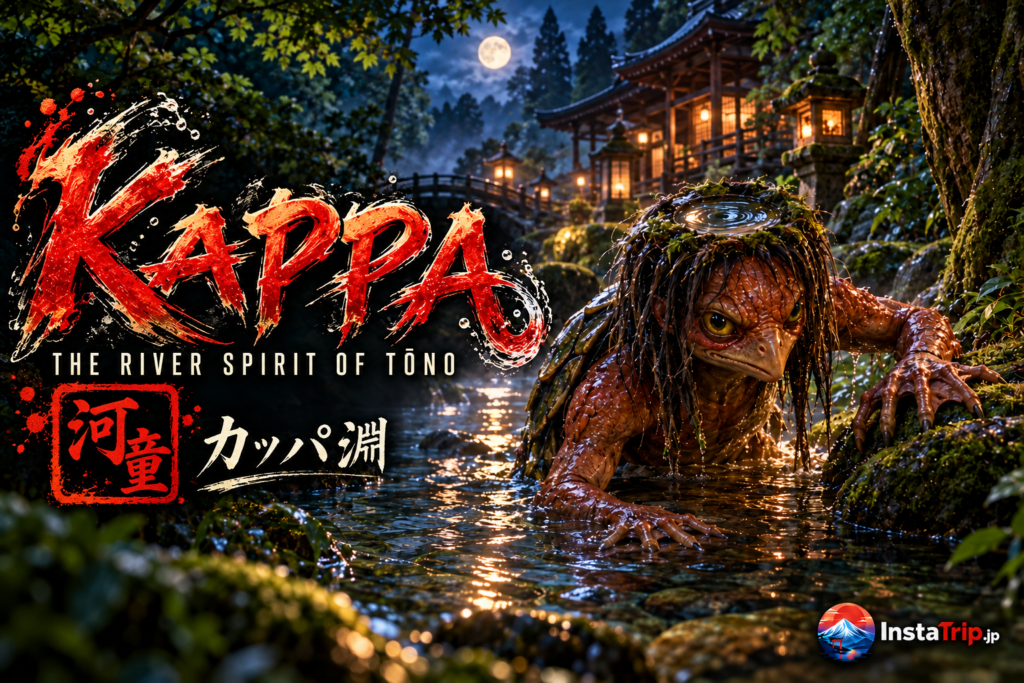
A kappa is a water-dwelling yōkai (妖怪), an uncanny figure in Japanese folklore. Images vary by region. In Tōno, it is often pictured as reddish, with a pointed nose, a shell and a water-holding plate on its head (皿). Elsewhere you may meet a green, turtle-like version. The details shift; the river remains its domain.
That is part of the story’s staying power. A kappa might be dangerous to horses or children near water, yet people also approach it with humor, offerings and requests for help. It gives a face to the risk of a beautiful stream. The cucumber (きゅうり) traditionally associated with kappa later became the bait in Tōno’s playful “catch a kappa” pastime.
If other Japanese objects seem to acquire lives of their own, meet the tsukumogami (付喪神). Tōno’s kappa belongs to the water instead of the storeroom, but both stories make familiar surroundings feel a little less predictable.

At Kappa-buchi, listen before you look
The stream called Kappa-buchi runs behind Jōken-ji Temple (常堅寺), near Denshōen (伝承園). This is no grand waterfall. It is a narrow, leafy watercourse: just enough darkness under the branches for the eye to invent a movement. Two kappa figures and a small shrine (祠) keep the local stories close to the path. The shrine is also associated with prayers for breast milk, a reminder that the creature’s role here is more complicated than a simple villain.
The video below records the soundscape of Kappa-buchi. Produced by EMOCAL with the Tōno Tourist Association, it lets the stream do the talking.
Kappa-buchi soundscape, filmed for the EMOCAL project with the Tōno Tourist Association.
You may see a kappa-catching permit (カッパ捕獲許可証) offered in town: a cheerful souvenir, not an actual wildlife licence. The tourism association currently uses a replica cucumber at the pool because of bear precautions. Leave food behind neither for a spirit nor for an animal.
Planning a visit to Tōno
For the folklore trail, start with Denshōen, then walk toward Jōken-ji and Kappa-buchi. The official site places the pool roughly a ten-minute walk from the Denshōen-side parking area; it has no dedicated parking at the stream itself. Tōno is in Iwate Prefecture (岩手県), and the town’s stories reward a slower stop rather than a hurried photo.
Check the official Kappa-buchi visitor page before setting out. Recent bear sightings can affect access. Keep to the marked path, follow local signs, and carry out anything you bring in. If you want to trace the horse tale itself, consult the Tōno City telling of the episode; remember that Obako-buchi and this visitor pool are distinct locations.
The best souvenir may be the question the place leaves with you. Was that disturbance under the branches only a fish? Tōno has spent more than a century making room for a longer answer.
Keep exploring Mystical Japan
Stay in Tōno with the zashiki-warashi, the child spirit of the house, or travel north to meet Oga’s masked Namahage (なまはげ).
Paid links
If you want to read further, browse English editions of Tōno Monogatari on Amazon or books about Japanese yōkai on Amazon.
Map: Kappa-buchi (カッパ淵)
Behind Jōken-ji Temple, near Denshōen, Tōno, Iwate. Open Kappa-buchi in Google Maps.