
What if the thing you threw away still remembered you?
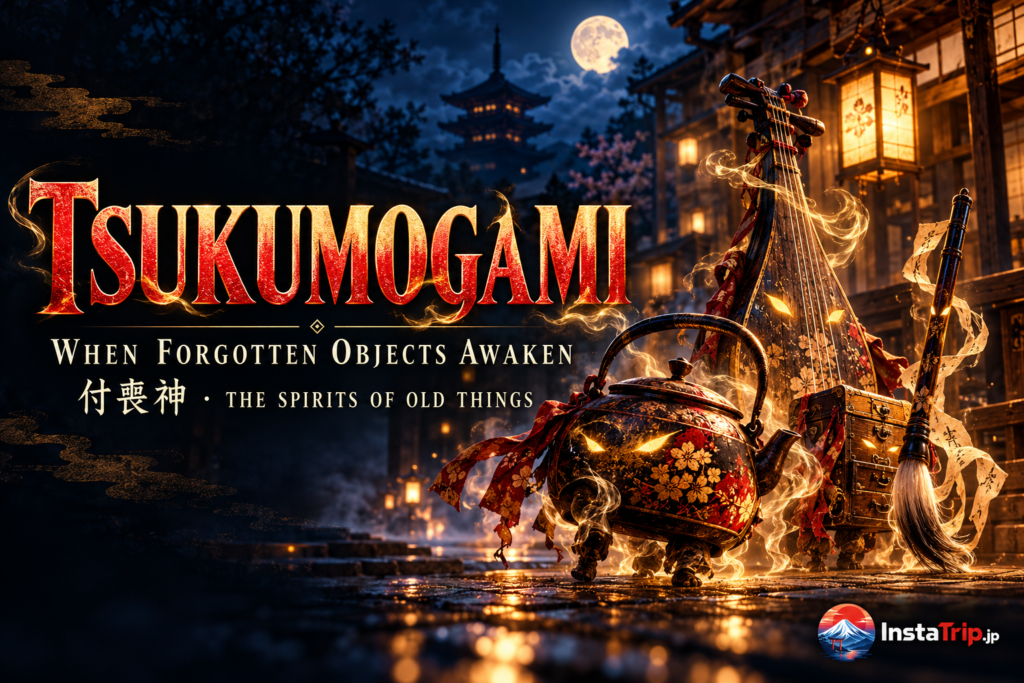
In Japanese folklore, an old household object can cross a startling threshold: it may wake up, move, and acquire a will of its own. These beings are tsukumogami (付喪神), a wonderfully unsettling kind of yōkai (妖怪). A musical instrument may wander away. A forgotten tool may join a procession after dark. But the most revealing tsukumogami tale is far stranger than a simple story about haunted possessions.
What are tsukumogami (付喪神)?
The familiar telling says that a tool or utensil can become a spirit after 100 years. Treat that number as part of the legend, not a timer attached to every antique in Japan. The creatures are often imagined with expressive faces, arms or legs, yet they remain recognizably the things they used to be. That mixture makes them funny at first glance—and disturbing a moment later.
The Japanese word furudōgu (古道具) means old tools or used household goods. In the tale preserved in the Tsukumogami Emaki (付喪神絵巻), their age matters, but being discarded is what drives the plot. The National Diet Library’s digital exhibition on the scroll gives the story its dramatic shape.

The night the abandoned objects fought back
The story is set in the capital during a year-end cleaning, susuharai (煤払い), when people clear away dust and unwanted things before the New Year. The old utensils are cast aside. To their owners, they are rubbish. To the objects themselves, the dismissal feels like a betrayal.
They gather, swear revenge, and prepare to become something more dangerous. One of their number is different: a string of prayer beads that has taken the form of Ichiren Shōnin (一連上人), a Buddhist monk. He urges restraint. The other objects reject his advice and drive him away.
On the night of Setsubun (節分), the abandoned things transform into yōkai. They march through the streets and attack living beings. The tale’s sudden turn from neglected household goods to a monstrous uprising is part of its power: the familiar world has become unrecognizable, and its former owners cannot simply shut the door on it.
The National Diet Library notes that the narrative is set in an earlier era, while the surviving scroll tradition is later; its own copy dates from the Edo period. The story is a work of folklore and illustrated literature, not a historical report of a real procession.

From revenge to redemption
The rampage does not end with the objects triumphant. Buddhist power subdues them. The defeated yōkai reconsider what they have done and seek out the very monk they had rejected. In the scroll’s conclusion they take Buddhist vows and attain enlightenment. A story that begins with discarded possessions and revenge becomes a story about repentance.
That ending is easy to lose when tsukumogami are reduced to a cute umbrella with one eye or a kettle with legs. The Tsukumogami Emaki asks what happens when things we used every day are treated as if they never mattered—and what might happen after anger has had its say. Reading it today as a reminder to care for belongings is an interpretation, rather than a rule that the legend imposes on modern life.
Who marches in the Night Parade (百鬼夜行)?
The Hyakki Yagyō (百鬼夜行), or Night Parade of the Demon Horde, is one of the most memorable images in Japanese yōkai art. In a National Diet Library image-bank entry on the Hyakki Yagyō Emaki (百鬼夜行絵巻), many of the figures moving through Kyoto’s night streets are identified as tsukumogami: everyday utensils turned strange.
Look for the outlines of ordinary objects hiding inside impossible bodies. A biwa (琵琶), a short-necked lute, or a koto (琴) can become an uncanny character in later yōkai art. Edo-period artist Toriyama Sekien’s illustrated creatures offer another way to see how a familiar instrument can acquire a personality; the library’s guide to his yōkai drawings is worth exploring.
You can also view the library’s Tsukumogami Emaki images. The old artwork is the best companion to the tale: these beings are more varied, inventive, and unsettling than a single modern mascot.
Watch the old yōkai move again
This short official film records the 2026 Yokai Immersive Experience Exhibition TOKYO, which brought historic yōkai imagery, including tsukumogami, into animated installations. It is a glimpse of a past exhibition, not a current event listing.
Why the legend stays with us
Tsukumogami make an unnerving thought visible: perhaps our everyday surroundings are less silent than we assume. The hundred-year transformation gives old objects a secret future, while the scroll gives them a motive. They remember being useful. They remember being abandoned. And, in the end, they are capable of changing again.
If you enjoy Japan’s spirits that live close to ordinary people, meet the zashiki-warashi (座敷童子), the childlike presence of a home, or follow the shape-shifting kitsune (狐) through its fox-spirit legends. Neither follows the same rules as a tsukumogami, but all three make a familiar place feel suddenly alive.
Kyoto on the map
The Hyakki Yagyō Emaki imagines its night procession through Kyoto, Japan’s old capital. This map locates the city as a setting for the folklore; the scroll does not establish a verified parade route or a particular street to visit.
Continue exploring
Paid links