

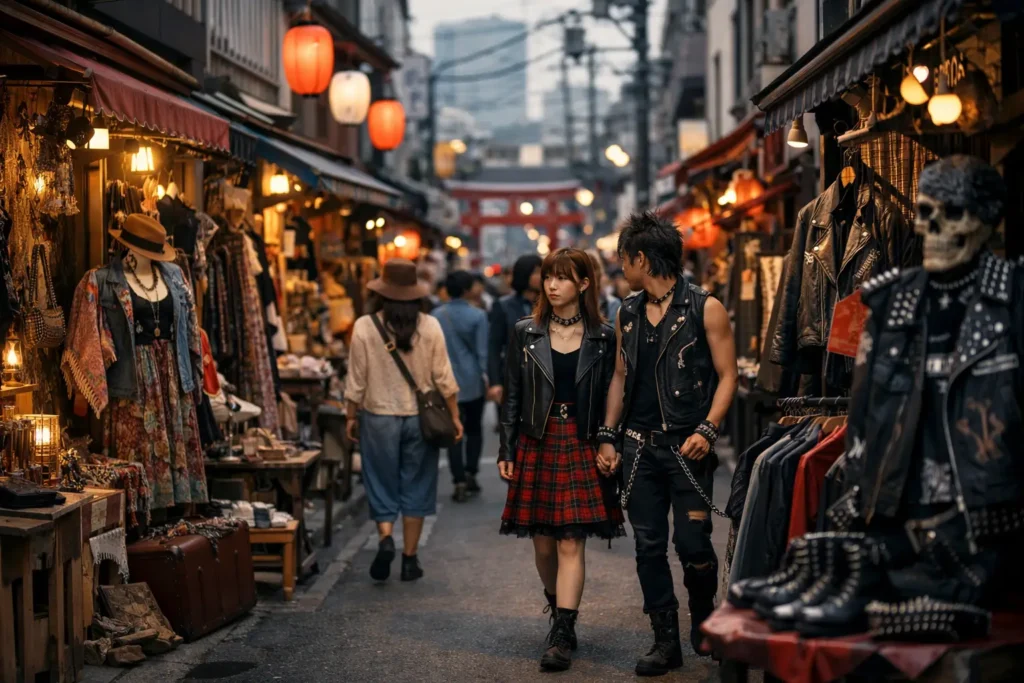
A few stops west of Shinjuku, Koenji (高円寺) trades Tokyo’s polished spectacle for something more personal: thrift-store rails spilling toward the sidewalk, hand-painted gig posters, tiny record shops, and the pulse of a live band warming up behind an unmarked door. This is a neighborhood shaped by bohemian, vintage, retro, underground culture, alternative music, and punk rock – not as a staged attraction, but as an everyday creative ecosystem.
Koenji is one of Tokyo’s most captivating places to wander without an agenda. Its appeal lies in the layers. A traditional shopping street may lead to a café filled with mid-century furniture; a quiet residential lane can suddenly reveal a secondhand clothing store, an independent gallery, or a basement live house. For travelers drawn to the city’s expressive, imperfect, and deeply human side, it offers a vivid counterpoint to the sleek towers and famous crossings of central Tokyo.
Why Koenji Feels Different
Koenji grew into a hub for students, artists, musicians, and independent-minded residents in the postwar decades, helped by comparatively attainable rents and convenient rail access. Its creative reputation became especially visible through its live music culture, small theaters, used-clothing shops, and the kinds of businesses that thrive when regulars, rather than passing crowds, keep coming back.

The neighborhood has never belonged to one single scene. Punk, folk, experimental music, psychedelic sounds, jazz, indie rock, and noise have all found audiences here. That variety matters. Koenji is not a museum of rebellion, frozen in a particular decade. It is a working neighborhood where old influences are constantly reinterpreted by new musicians, stylists, collectors, and café owners.
There is also a refreshing lack of pressure to perform Tokyo coolness. The streets can feel lively, but they are less choreographed than trend-driven districts. You may see someone in a carefully assembled 1970s jacket walking beside an office worker, a parent with a stroller, and a band carrying equipment toward soundcheck. The atmosphere is distinctive precisely because it remains part of daily life.
Koenji’s Bohemian Vintage and Retro Streets
Begin around Koenji Station and give yourself permission to take the narrow side streets. The covered shopping arcades near the station provide the neighborhood’s social backbone, with small restaurants, snack counters, barbers, grocers, and long-running local businesses alongside newer independent shops. They are useful on a rainy day, but they are also a window into the ordinary rhythms that make the district feel lived-in.

Koenji is particularly celebrated for vintage and secondhand fashion. Stores range from carefully curated boutiques with Americana, military pieces, denim, leather, and designer archival clothing to less polished treasure-hunt shops where the joy is in sorting through the racks. Prices and quality vary widely, which is part of the experience. A serious collector may find rare details and beautifully preserved garments, while a casual visitor may simply enjoy discovering an outfit with more character than anything available in a department store.
The best approach is to browse slowly. Vintage shopping in Koenji rewards curiosity more than efficiency, and individual shops often have strong points of view. One may lean toward 1960s mod silhouettes, another toward workwear, another toward colorful retro dresses or Japanese streetwear. Keep in mind that sizing can be inconsistent, particularly with older Japanese and imported pieces, so trying items on is essential when possible.
The district’s retro appeal extends beyond clothing. Look for record stores, old magazines, collectible toys, film posters, used books, and small interiors filled with analog objects. These are not merely nostalgic decorations. They reflect a broader appreciation for things with history, craftsmanship, and evidence of previous lives. In a city famous for speed and renewal, Koenji makes room for the pleasure of the found object.
A Neighborhood Made for Wandering
Koenji is at its best when you resist the urge to turn every stop into a checklist. Follow a hand-lettered sign down a staircase. Pause at a record-store window. Notice the mix of fading shopfront typography, bicycles, potted plants, and colorful flyers taped to utility poles. This visual density gives the area its cinematic quality.
That said, the neighborhood is not uniformly vintage. New cafés, design-minded bars, and contemporary fashion spaces continue to appear, sometimes replacing older businesses. The balance between independence and rising popularity is delicate. Visiting with respect means treating the streets as a community rather than a backdrop – keep voices low in residential lanes, ask before photographing people or shop interiors, and support small businesses when you can.
The Sound of Alternative Music and Punk Rock
Koenji’s musical identity is inseparable from its intimate venues, often called live houses in Japan. These compact spaces have long given emerging and established artists a place to perform close to the audience. The experience can be immediate and electrifying: a few dozen listeners standing shoulder to shoulder, amplifiers close enough to feel in your chest, and little distance between performer and crowd.
Punk remains part of Koenji’s cultural vocabulary, but it is only one thread in a wider musical fabric. Depending on the night, you might encounter garage rock, hardcore, singer-songwriters, avant-garde improvisation, reggae, funk, metal, electronic experiments, or bands that deliberately resist easy categories. The point is not to arrive expecting one definitive Koenji sound. It is to enter with an open ear.

For visitors, the practical challenge is language and timing. Event listings may be posted primarily in Japanese, and lineups can change. Yet this should not discourage you. Look for posters near venues and station-area streets, ask politely at a record shop or café, and be prepared for a cover charge that may include a drink order. Weekends can be especially energetic, while weeknights may offer a more local, low-key view of the scene.
The etiquette is straightforward. Arrive on time if you want to see a specific act, avoid blocking entrances, and follow staff instructions in close quarters. Photography policies differ, so do not assume it is welcome. What makes a Koenji show memorable is not its scale but its proximity: you are experiencing a living network of artists and listeners rather than consuming a polished production from a distance.
Food, Cafés, and the Pleasure of Staying Late
Koenji’s food scene matches its unpretentious personality. Small eateries serve comforting bowls of ramen, curry rice, yakitori, gyoza, and casual Japanese dishes, while modest bars and cafés offer places to linger after shopping or before a show. The strongest meals are often found in compact, specialized establishments with limited seating, so flexibility is useful.
Retro cafés are especially suited to the district’s mood. Some embrace warm wood, old posters, record sleeves, or softly worn furniture; others are unmistakably contemporary but preserve the sense of independence that defines the neighborhood. Rather than chasing a single famous address, choose a place that catches your attention and allow time to sit. Koenji reveals itself gradually, often over coffee, a simple dessert, or a late-night drink.
When to Visit Koenji
Late afternoon through evening is ideal for first-time visitors. Shops are open, the streets are active, and the neighborhood begins to shift toward dinner, bars, and live music. Visit on a weekday if you prefer a calmer browse, or on a weekend for greater energy and a fuller sense of its social rhythm. Because many small stores keep individual hours and may close unexpectedly, leave room for improvisation.
If your trip falls in late August, Koenji’s Awa Odori festival offers a strikingly different expression of local culture. One of Tokyo’s best-known summer dance festivals, it fills the streets with rhythmic music, coordinated dancers, spectators, and festival stalls. It is crowded and far removed from the quiet pleasure of a vintage-shopping afternoon, but it shows another essential truth about Koenji: beneath its outsider reputation is a neighborhood with powerful communal traditions.
Koenji is easily reached from Shinjuku on the JR Chuo-Sobu Line, making it an excellent addition to a Tokyo itinerary. Pair it with nearby Nakano if you are interested in collectibles and subculture, or give Koenji a full unhurried evening if music and vintage finds are your priority.
Come for a jacket, a record, or a punk show, but leave space for the unexpected. Koenji’s real gift is the feeling that Tokyo still has room for the eccentric, the handmade, the secondhand, and the beautifully unfinished.
![[商品価格に関しましては、リンクが作成された時点と現時点で情報が変更されている場合がございます。]](https://hbb.afl.rakuten.co.jp/hgb/574e4ebe.b55a6785.574e4ebf.4b040b74/?me_id=1422081&item_id=10000003&pc=https%3A%2F%2Fthumbnail.image.rakuten.co.jp%2F%400_mall%2Ff141003-yokohama%2Fcabinet%2Frtc%2Frtc010_s.jpg%3F_ex%3D128x128&s=128x128&t=picttext "[商品価格に関しましては、リンクが作成された時点と現時点で情報が変更されている場合がございます。]")