
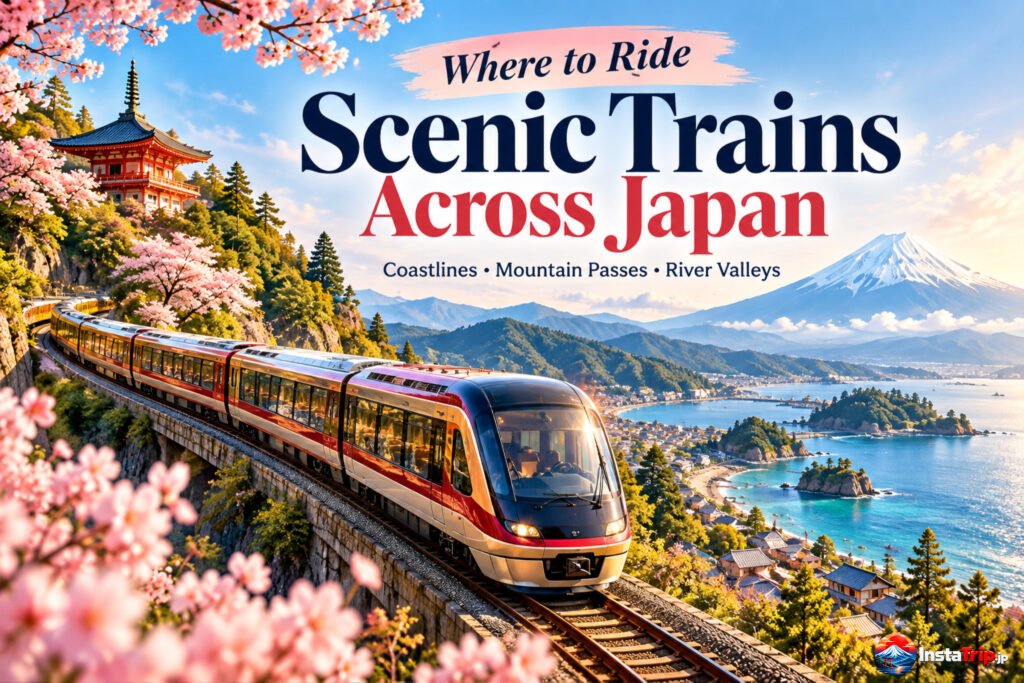
A Japanese train window can frame far more than a route between destinations. It can reveal cedar forests rising through morning mist, rice fields flashing bright green after rain, fishing villages facing an immense blue sea, and valleys shaped by rivers that have carried people for centuries. To ride scenic trains in Japan—on sightseeing services known as kankō ressha (観光列車) or scenic local lines—is to exchange speed for attention and see the country at the pace of its changing landscapes.
Japan’s rail network is famously efficient, but its most memorable journeys are not always the fastest. Scenic railways turn travel into part of the experience, connecting dramatic terrain with local history, seasonal color, and everyday life beyond the major cities. Some use nostalgic carriages and openable windows; others offer broad observation seats, local food, or a carefully choreographed view around every bend.
Why scenic rail travel feels different in Japan
Railways have helped shape modern Japan since the nineteenth century, linking mountain communities, port towns, hot-spring resorts, and regional capitals. On a local scenic line, that history feels tangible. Small stations may be staffed by only a few people, platforms can sit beside vegetable gardens, and passengers might include schoolchildren, hikers, and residents carrying groceries.

The experience is also deeply seasonal. Spring brings cherry blossoms and fresh mountain greens. Summer fills valleys with dense foliage and the sound of cicadas. Autumn turns hillsides into magnificent layers of red, gold, and amber, while winter can make a coastal or northern route feel almost cinematic. The best journey depends less on finding one universally “best” train than on choosing a landscape that suits the Japan you hope to encounter.
There is a trade-off. These routes are often slower, less frequent, and more vulnerable to weather than major Shinkansen (新幹線) services. That is precisely why they reward a looser itinerary. Leave room for a missed connection, an unplanned station stop, or a quiet lunch in the town at the end of the line.
Five unforgettable places to ride scenic trains

Sagano Romantic Train (嵯峨野トロッコ列車), Kyoto (京都)
The Sagano Romantic Train, often called the Sagano Torokko, follows the Hozugawa River (保津川) between the Arashiyama (嵐山) area of Kyoto and Kameoka (亀岡). Its vintage-style cars move through a gorge of wooded slopes, tunnels, and river views, offering a striking contrast to the temples, gardens, and lively lanes of nearby Arashiyama.
This is one of Japan’s classic autumn rail experiences, when maple leaves brighten the valley. Spring and early summer have their own appeal, with softer greens and a more tranquil atmosphere. An open-sided car can make the ride especially vivid, though it also means exposure to wind, rain, and colder temperatures. Reservations are wise during foliage season and other busy periods.
The route is short, which makes it easy to combine with a fuller Kyoto day. Yet it is more rewarding when treated as a transition: a brief passage from the city’s historic neighborhoods into the rural basin beyond its western hills.
Hakone Tozan Railway (箱根登山鉄道), Kanagawa (神奈川)
From Hakone-Yumoto (箱根湯本) toward Gora (強羅), the Hakone Tozan Railway climbs through a steep, forested landscape that feels worlds away from Tokyo. The train negotiates sharp curves and switchbacks, gaining elevation as hot-spring inns, hydrangea-lined slopes, and mountain streams appear outside the windows.
Hakone’s appeal lies in its layers. A scenic train ride can lead into an onsen stay, a museum visit, a walk beside Lake Ashi, or a view toward Mount Fuji when the weather is clear. In early summer, hydrangeas create a particularly captivating setting along parts of the line. In autumn, the mountains shift toward fiery color.
Because Hakone is a popular escape, the experience can be busy on weekends and holidays. Travelers seeking a quieter atmosphere should consider a weekday morning or spend the night rather than rushing through on a day trip. The mountain weather changes quickly, so a clear view is never guaranteed, but mist and rain can give the landscape an equally atmospheric character.
Oigawa Railway (大井川鐵道), Shizuoka (静岡)
Oigawa Railway is one of the most evocative ways to encounter the tea-growing landscapes of central Japan. Its routes travel through the Oi River valley, where neatly ordered tea fields meet forested mountains and traditional settlements. Depending on operations and season, the railway may also offer the rare pleasure of traveling behind a steam locomotive.
The line is not simply a nostalgic attraction. It reflects the rhythms of a region where river valleys, agriculture, and rail transport remain closely connected. Looking out across the slopes, it becomes easier to understand why Shizuoka tea is associated with clear water, mountain air, and carefully tended terrain.
This journey needs a little extra planning. Services and route conditions can change, especially after severe weather or maintenance work. Check current operating information before building your day around a specific train, and allow time to enjoy the station towns rather than treating them as a quick photo stop.
JR Tadami Line (只見線), Fukushima (福島) and Niigata (新潟)
The JR Tadami Line is a quieter, more contemplative journey through the mountains of northeastern Japan. It runs across a region of broad rivers, deep snow, wooded ridges, and small communities whose scenery changes dramatically with the seasons. The best-known view is the train crossing a steel bridge above the Tadami River, a composition that has become an enduring symbol of rural rail travel in Japan.
What makes the Tadami Line special is not spectacle alone. It is the sense of distance and patience. The train moves through places where the landscape seems larger than the settlements, and where a station stop can feel like a glimpse into a distinct local world. In winter, snow transforms the route into an almost monochrome panorama. In warmer months, the river and forest take on lush, saturated color.
The line is ideal for travelers who enjoy photography, slow travel, and regional Japan beyond the standard circuit. Trains can be infrequent, so study the timetable carefully and have a realistic plan for food, lodging, and onward transportation.
Resort Shirakami (リゾートしらかみ) and the Gono Line (五能線), Aomori (青森) and Akita (秋田)
Along Japan’s northern Sea of Japan coast, the Gono Line offers a dramatic meeting of railway, shoreline, and open horizon. Resort Shirakami is a sightseeing train designed to make the most of this route, traveling through the region near the Shirakami-Sanchi mountains and stopping at selected places of local interest.
The journey has an expansive quality that differs from Japan’s mountain railways. One moment the sea seems close enough to touch; the next, the train enters wooded country or passes a quiet station where waves and wind set the mood. The region is also known for its food culture, including seafood and apples, giving travelers another reason to slow down between train segments.
This is a longer commitment than the Sagano Torokko or Hakone Tozan Railway, and that is part of its appeal. Reserve ahead when possible, especially in high season, and consider staying overnight in Aomori or Akita rather than forcing the ride into a packed itinerary.
How to choose the right scenic train ride
Start with the kind of scenery that stays with you. Kyoto and Hakone suit travelers drawn to temples, hot springs, and mountain beauty near major cities. Shizuoka offers tea-country character and old-fashioned rail romance. The Tadami Line is for those willing to travel farther for stillness and broad natural views. The Gono Line feels made for travelers who want sea air, northern light, and the pleasure of an unhurried coastal journey.
Then consider timing. Fall foliage makes many routes exceptionally popular, while spring can bring blossoms but also variable weather. Summer offers vivid green landscapes, though heat and humidity can be intense in some areas. Winter scenery can be extraordinary, especially in Tohoku, but snow may affect travel plans. If your schedule is fixed, choose the route that works well even without ideal weather rather than chasing a single seasonal image.
A rail pass may be useful for longer regional itineraries, but not every scenic train is covered in the same way. Some require a separate seat reservation, an express supplement, or a special ticket. Private railways have their own fares and rules. Always confirm what your ticket covers before boarding, particularly when a route includes a sightseeing or reserved-seat service.
Compare Scenic Trains Before You Book
| Route | Best fit | Important planning detail |
|---|---|---|
| Sagano Romantic Train | A short gorge ride during a Kyoto stay | Book the sightseeing train separately; plan your return from Kameoka |
| Hakone Tozan Railway | Mountain scenery and an onsen itinerary | The train, cable car and ropeway are separate sections |
| Oigawa Railway | Tea country and heritage rolling stock | Check the operating section, locomotive type and bus connection |
| Tadami Line | Rural rail travel and seasonal photography | Check the last return train before leaving your base |
| Resort Shirakami | A longer coastal sightseeing journey | All seats require reservations; select a train that runs on your date |
Reservations, Rail Passes and Current Route Conditions
Sagano’s full route takes about 25 minutes, but access to the station and your onward journey need extra time. Torokko Kameoka is not JR Kameoka Station. Use the official Sagano website for operating dates, access and ticket booking.
In Hakone, the railway climbs from Hakone-Yumoto to Gora; continuing toward the ropeway involves a cable-car transfer. Check the operator’s route guide rather than assuming one train covers the whole sightseeing circuit.
As checked in October 2026, Oigawa’s main line remains closed between Kawane-Onsen-Sasamado (川根温泉笹間渡) and Senzu (千頭) following typhoon damage. The operator directs travelers heading toward Senzu to transfer to the town bus at Ieyama (家山); connections are not guaranteed. Consult the official timetable and service notices before booking.
Resort Shirakami requires both a valid basic fare ticket or covering pass and a reserved-seat ticket. Check JR East’s reservations and operating calendar. For Tadami, use the prefecture’s access and timetable guide. Pass coverage depends on the specific railway, service and pass.
Watch: Sagano Romantic Train Through Spring Scenery
This short scenic film from eo official shows the Sagano train and the Hozukyo landscape in spring. It is inspiration for the route, rather than a guide to current fares or operating dates.
Scenic Train Travel FAQ
Which ride is easiest to add to a first Japan trip?
Sagano fits a Kyoto stay, while Hakone suits a mountain or hot-spring visit near Tokyo. Compare the entire journey from your hotel, not just time on the scenic train.
Is every sightseeing train included in the JR Pass?
No. Private railways and special services have their own rules. Confirm both fare coverage and seat reservations for the exact train.
Can I photograph the famous Tadami bridge from onboard?
The view of a train crossing the bridge is taken from outside the train. An onboard ride and a visit to a photography viewpoint require different plans.
Plan the rest of your journey with our JR Pass alternatives and Kyoto–Osaka comparison.
Useful rail-trip items (paid links): compact daypacks and travel power banks.
Small habits that make the journey richer
Arrive early enough to find your platform without rushing. Buy a local snack or drink when the station has one, and keep your camera ready without letting it replace the experience itself. On popular trains, observation windows and the most photogenic seats may fill first, but every side of a winding route eventually gets its moment.
Be considerate of the people who use these railways as transportation, not just as an attraction. Keep luggage compact, speak quietly, and avoid blocking doors or aisles for photographs. Rural stations and villages are living communities, and respectful curiosity is part of what makes a visit meaningful.
Japan’s most beautiful rail journeys do not demand that you rush toward a landmark. Sometimes the destination is the quiet curve of a river, a flash of a red bridge through trees, or the moment a local train leaves the city behind and carries you into a landscape with its own enduring rhythm.