
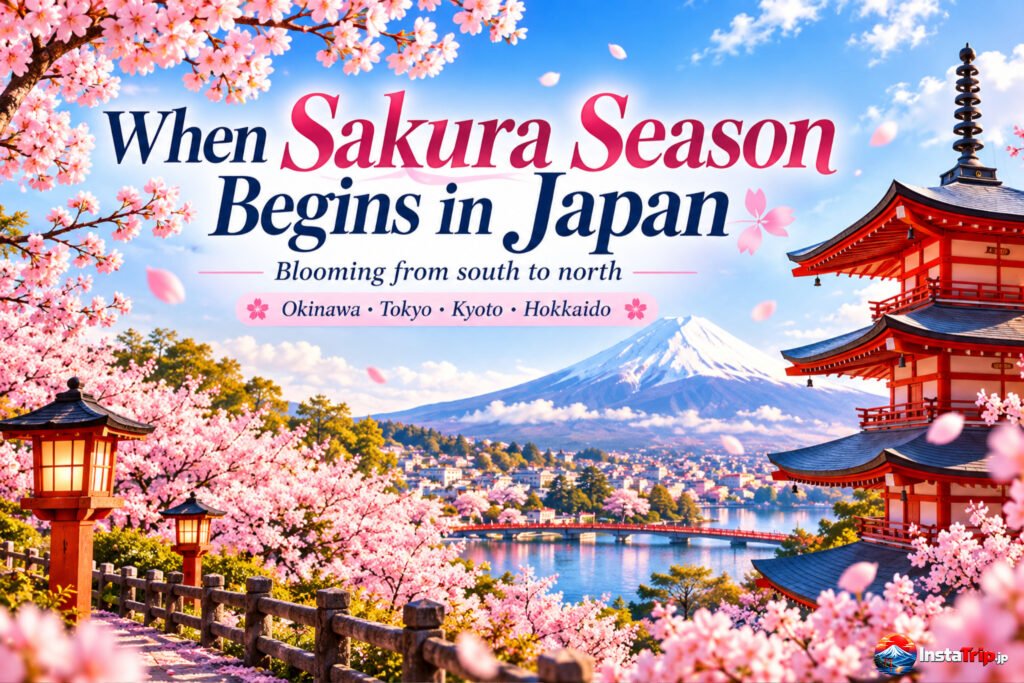
A pale pink branch against a Tokyo (東京) skyline can make sakura (桜), Japan’s cherry blossom season, feel like a single, perfectly timed event. In reality, the answer to when does cherry blossom start in Japan changes dramatically from one island to the next. The first blossoms may arrive in subtropical Okinawa (沖縄) during January, while Hokkaido’s (北海道) celebrated trees often wait until late April or May.
That shifting calendar is part of the magic. Cherry blossom season is not one date to circle, but a living procession of color that moves north through Japan, transforming city parks, castle grounds, riversides, mountain towns, and temple approaches along the way.
When Does Cherry Blossom Start Across Japan?
For many travelers, “cherry blossom season” means the flowering of Somei Yoshino (染井吉野), Japan’s most widely planted ornamental cherry tree. Its soft, five-petaled blooms create the luminous pink-and-white canopies seen in photographs of Tokyo, Kyoto, and beyond. Yet Japan has hundreds of cherry varieties, and some begin flowering much earlier or later than Somei Yoshino.

Typical cherry blossom windows by region look like this. Okinawa’s winter blossoms are mainly kanhizakura (寒緋桜); they are a different variety from the Somei Yoshino that dominates many mainland spring displays:
- Okinawa: January through early February, often beginning with the deeper pink kanhizakura variety rather than Somei Yoshino.
- Kyushu (九州) and Shikoku (四国): Late March, though warm years can bring blooms earlier.
- Tokyo, Yokohama (横浜), Kyoto (京都), Osaka (大阪), and much of central Japan: Late March to early April.
- Tohoku (東北): Early to late April, moving north through cities such as Sendai, Morioka, and Aomori.
- Hokkaido: Late April into May, offering one of Japan’s last major chances to see spring sakura.
These are travel-planning windows, not guarantees. A few days of unusual warmth can advance flowering, while a lingering cold spell can hold buds closed. If cherry blossoms are the centerpiece of your trip, leave room for flexibility rather than building an itinerary around one predicted peak day.
Blooming Is Not the Same as Full Bloom
Japan’s annual sakura forecasts often use two milestones: kaika (開花), the official opening of the first blossoms, and mankai (満開), or full bloom. The distinction matters.
When a city announces its flowering date, only a small number of flowers may be open on a designated sample tree. The scene can still be beautiful, especially in gardens where early-blooming varieties mingle with plum trees and fresh spring greenery, but it may not yet resemble the dense floral clouds many visitors imagine.

Full bloom generally arrives around five to 10 days later, depending on temperatures. This is when mature Somei Yoshino trees are at their most magnificent, their branches layered with blossoms before the leaves fully emerge. A warm spell may shorten that interval; cool, stable weather can extend it.
The peak itself is fleeting. Strong rain or wind can scatter petals quickly, yet the falling blossoms have their own captivating atmosphere. A pathway dusted in pink, or a canal carrying a delicate drift of petals, is not a disappointing second act. It is one of the season’s most evocative moments.
Why the Cherry Blossom Calendar Changes Every Year
Cherry trees respond to conditions accumulated over months, not simply to a warm afternoon in March. Winter chill helps buds complete a dormant phase, then warming temperatures in late winter and early spring encourage development. The relationship is complex, which is why forecasts are refined repeatedly as the season approaches.
Tokyo is often one of the first places international travelers watch because its parks and riversides are famous, accessible, and vividly urban. In a typical year, blossoms there open in late March and reach full bloom around the turn of April. Kyoto and Osaka frequently follow a similar rhythm, but their timing can differ by several days even in the same year.
Elevation also reshapes the experience. In areas around Mount Fuji, Nikko, Hakone, and other upland landscapes, spring may arrive later than in nearby cities. That means travelers can sometimes extend their sakura journey simply by moving from lowland streets to cooler mountain scenery. The trade-off is that local timing is more variable, so a forecast for Tokyo should never be treated as a forecast for every destination in the Kanto region.
The Best Time to Plan a Sakura Trip
For a first visit focused on Tokyo, Kyoto, Osaka, or Nara, the final week of March through the first week of April is the traditional target. It is also one of Japan’s busiest travel periods. Hotels, rail seats, and popular viewing spots can fill quickly, while famous parks are especially lively on weekends.
Planning for a slightly broader window is wiser than chasing a single perfect day. Arrive a few days before the expected full bloom, stay long enough to absorb a weather shift, and build in experiences that remain rewarding whether blossoms are early, late, or falling. A morning in Asakusa, a museum afternoon in Ueno, a stroll through Gion, or a quiet temple garden can turn a changed forecast into part of the journey rather than a setback.
Travelers with more flexibility can follow the season north. Early April may be ideal for central Japan, while late April brings sakura to parts of Tohoku and Hokkaido. This later period also offers a different visual character: castle parks, broad skies, snow-touched mountains in the distance, and spring light that feels more spacious than the concentrated energy of Tokyo’s peak.
Where Sakura Feels Most Memorable
Cherry blossoms are woven into ordinary life as much as landmark scenery. In Tokyo, Ueno Park becomes a vibrant gathering place beneath mature trees, while the Meguro River frames petals against cafes, bridges, and city lights. Chidorigafuchi’s moat creates a more reflective scene, where blossoms gather above the water near the Imperial Palace grounds.
Kyoto offers another mood entirely. Sakura can appear beside temple gates, stone paths, traditional wooden townhouses, and calm canals. Maruyama Park is known for its evening atmosphere, while the Philosopher’s Path pairs a cherry-lined canal with a slower, contemplative walk. In Nara, flowering trees share the landscape with expansive parkland and roaming deer, creating a distinctive blend of nature, history, and daily life.
For a less urban perspective, seek out a castle town, a lakeside promenade, or a local riverside park. Japan’s most moving sakura scenes are not always the most famous ones. A neighborhood schoolyard, a station platform, or a small shrine approach may reveal how deeply cherry blossoms belong to the seasonal rhythm of communities.
Hanami (花見): More Than a Beautiful View
The custom of hanami, literally “flower viewing,” is one of spring’s most recognizable Japanese traditions. During the season, friends, families, classmates, and coworkers gather under the trees for conversation, food, and a welcome pause from routine. It is joyful, social, and often wonderfully relaxed.
At the same time, hanami carries a reflective quality. Sakura are admired partly because their beauty does not last. Their brief flowering season has long inspired poetry, art, and an awareness of life’s passing moments. This is not a somber idea. It is an invitation to be present: to notice the change in the air, the light filtering through petals, and the shared excitement of spring’s arrival.
Visitors can join this atmosphere with care. Follow posted rules, use designated picnic areas, take all trash with you, and avoid shaking branches or picking flowers. Do not spread blankets in areas reserved for walking, temple access, or photography. At shrines and temples, remember that blossoms may frame a sacred place, not merely a backdrop.
Use Blossom Dates Correctly When Planning
| Term | Meaning | What it means for your trip |
|---|---|---|
| Kaika (開花) | The first flowering milestone | It does not mean an entire park is in bloom |
| Mankai (満開) | The full-bloom milestone | Different varieties and individual trees may still vary |
| Hanami (花見) | Flower viewing | Check picnic, opening-hour and illumination rules locally |
| Sakura zensen (桜前線) | The cherry blossom front | A broad seasonal progression, rather than one national date |
The Japan Meteorological Agency defines first flowering using five or six open flowers on a sample tree, and full bloom at approximately 80% or more of its blossoms. These observations describe that reference tree, not every tree in the city. Its published Tokyo climate normals for 1991–2020 are March 24 for first flowering and March 31 for full bloom: historical averages, not a forecast for your travel year. See JMA’s definitions and Tokyo records.
For an upcoming spring trip, check the year and revision date of every forecast you read. A previous season’s dates do not establish the next season’s peak. Start with JNTO’s cherry blossom planning page, then confirm the exact park through local visitor information as your dates approach.
Watch: Ueno Park Cherry Blossoms in Tokyo
Video Street View Japan filmed this evening walk through Ueno Park (上野公園) on March 26, 2026. It shows how flowering can vary between trees within one park. The recording illustrates a past season and does not predict future bloom dates.
Cherry Blossom Timing FAQ
Does Japan’s cherry blossom season always begin in March?
No. Okinawa’s kanhizakura can bloom in January. Many mainland Somei Yoshino displays arrive later, followed by northern and higher-elevation locations.
Should I arrive on the first flowering date?
Choose a longer window if possible. First flowering is the opening milestone, while the fullest display generally follows; temperature, variety and weather affect the gap.
What if I miss the peak in Tokyo?
Check current reports for later-flowering varieties or cooler destinations before changing your route. A northern location is a possibility, not a guarantee.
Can I picnic anywhere beneath the trees?
No. Use designated areas and follow the park’s rules. Keep paths clear and avoid touching branches or picking flowers.
Build a flexible route with our Ueno Park sakura guide, Kyoto temples guide and scenic train ideas.
Useful spring-trip items (paid links): compact travel umbrellas and packable rain jackets.
How to Follow the Forecast Without Letting It Rule Your Trip
Begin checking annual bloom forecasts in late winter, but treat early predictions as broad estimates. As March approaches, forecasts become more precise and local reports become increasingly useful. Look for both opening and full-bloom dates, then compare them with your exact destinations rather than Japan as a whole.
If your travel dates are fixed, choose places with different elevations or bloom varieties. Early-blooming cherries, weeping cherries, and late-flowering yaezakura can extend the season well beyond the brief peak of Somei Yoshino. Gardens and historic landscapes often offer this variety more reliably than a single park planted with one dominant type.
The finest sakura experience is rarely about arriving at the mathematically perfect hour. It may be a quiet morning when buds are only beginning to open, an evening lantern glow beneath full branches, or the gentle pink snowfall of petals after the peak has passed. Let the forecast guide your route, then let Japan’s spring reveal its own timing.