
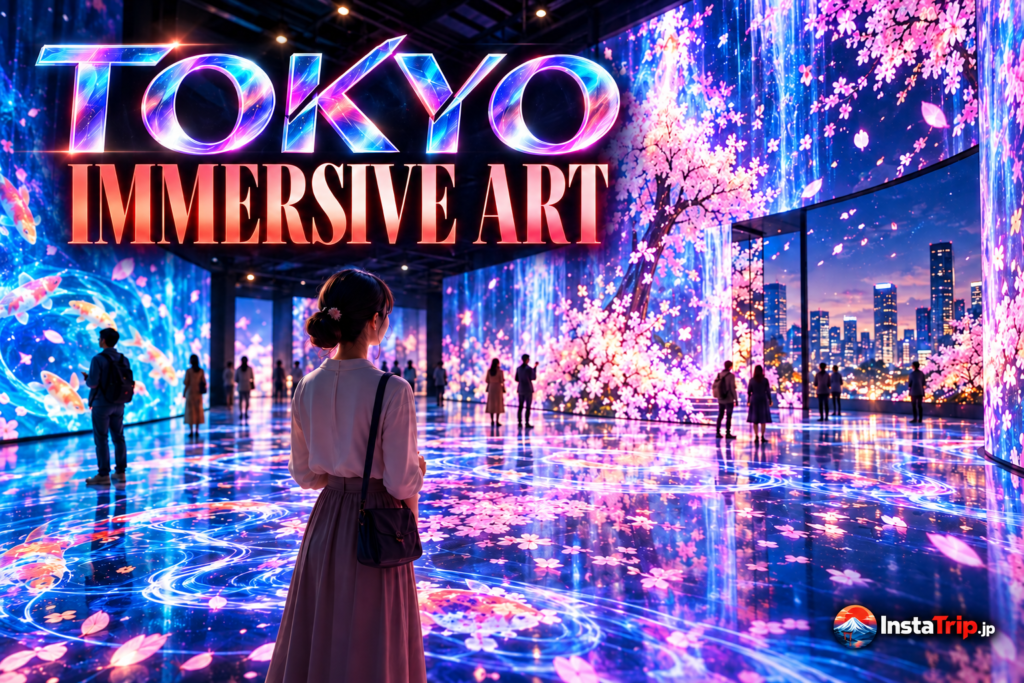
Tokyo’s most captivating galleries no longer always ask visitors to stand quietly behind a line. Tokyo immersive art trends invite people to walk through light, alter a projected landscape with a gesture, hear their own footsteps become part of a composition, or pause in a room where digital flowers seem to follow the seasons. In a city shaped by precision, density, and constant reinvention, this art feels less like spectacle alone and more like a new way of paying attention.
The movement is often associated with large-scale digital installations, but its roots are wider and more fascinating. Tokyo’s immersive art scene brings together contemporary technology, traditional sensitivity to nature, theatrical spatial design, and the Japanese idea that an experience can be shaped by time, weather, and the presence of others. The result is an art culture that feels vibrant and futuristic while remaining closely connected to older ways of seeing.
Why Tokyo immersive art trends feel different
Immersive art exists in many cities, but Tokyo gives it a distinctive rhythm. Space is precious, so artists and designers frequently create entire worlds within former warehouses, compact exhibition floors, shopping complexes, and carefully controlled dark rooms. A visit may move from a luminous digital waterfall to a mirrored environment, then into a quiet space filled with scent, mist, or water.
This emphasis on atmosphere has a meaningful cultural context. Japanese gardens, seasonal festivals, tea spaces, and temple precincts have long guided attention through carefully composed transitions. They ask visitors to notice texture, shadow, sound, and the changing character of a place. Contemporary installations do not simply reproduce those traditions. Yet many share a related instinct: the artwork is not only an object to observe but an environment to inhabit.

That is why the strongest experiences are not necessarily the loudest. A room of projected color can be dazzling, but a subtler installation may stay longer in the memory because it changes how a visitor notices rain on a window, the sound of a river, or the outline of another person in darkness.
From digital spectacle to living environments
Tokyo’s best-known immersive venues helped make digital art a major reason to visit neighborhoods such as Toyosu and Azabudai. The visual language is immediately memorable: limitless reflections, drifting blossoms, luminous particles, and scenes that respond to human movement. These works photograph beautifully, which has helped them travel rapidly across social media and shape global expectations of Tokyo’s contemporary culture.
But the most interesting trend is a shift away from treating immersion as a backdrop for photographs. Artists are increasingly creating responsive environments where no two visits are exactly alike. Movement, crowd density, sound, and time can alter the work. Rather than presenting a fixed image, the installation becomes a changing ecosystem.
This matters because it changes the visitor’s role. You are not just consuming an attraction. You are contributing to its conditions, however lightly. In a room where a projected field bends around bodies, your presence affects what others see. In an installation built around water or light, slowing down can reveal details missed by visitors rushing toward the next image.

The trade-off is clear. Highly interactive work can feel magical, but crowded time slots may reduce that sense of discovery. A busy room can become more about navigating people than responding to the art. Travelers who want a contemplative experience should favor early weekday sessions, evening hours where available, or smaller gallery exhibitions over the city’s most celebrated blockbuster venues.
Where to experience immersive art in Tokyo
For a first visit, the two permanent teamLab venues make a useful comparison. They are separate museums in different neighborhoods, so choose the one that matches the kind of experience you want rather than assuming one ticket covers both.
teamLab Borderless at Azabudai Hills (麻布台ヒルズ)
teamLab Borderless lets works wander between rooms, so exploring without a fixed route is part of the experience. It is in Garden Plaza B at Azabudai Hills, close to Kamiyacho Station. The official site lists current admission times, changes to artworks, accessibility information, and filming rules. The museum can be dark and some areas use flashing light, loud sound, scents, or mirror floors; check its guidance before booking if those conditions affect your visit.
teamLab Planets in Toyosu (豊洲)
teamLab Planets is more physical: visitors move through water and other large-scale spaces as part of the work. It is near Shin-Toyosu Station, on the Tokyo Bay side of the city. The official visitor guide explains access and what to expect; check the latest instructions for clothing and mobility before you go.
For a closer look at the Azabudai museum, see our teamLab Borderless visitor review or pair it with our guide to Tokyo museums.
Watch: the official teamLab film introduces the atmosphere of Borderless without starting automatically.
Nature, seasonality, and the digital Tokyo landscape
Nature is one of the most persistent themes in Tokyo’s immersive installations. This is not simply an aesthetic preference for flowers and forests. Seasonal change remains deeply embedded in Japanese visual culture, from spring cherry blossoms and summer fireworks to autumn maples and winter snow. Digital artists can animate those cycles at an extraordinary scale, turning a gallery wall into a field of flowers that blooms, scatters, and fades.
The appeal lies partly in impermanence. A projected blossom cannot be taken home, and its beauty may last only seconds before the scene shifts. That transience echoes a long-standing appreciation for fleeting natural moments, though visitors should resist reducing it to a single cultural label or postcard image. In contemporary Tokyo, it can also speak to urban life itself: crowded, fast-moving, intensely visual, and always changing.
Some projects go further by bringing natural material into the experience. Water, plants, stones, wind, scent, and changing light create installations that blur the boundary between art space and landscape. These works can feel especially powerful after days spent among the concrete canyons of Shinjuku, the neon energy of Akihabara, or the polished streets of Ginza. They offer a pause without pretending that the city and nature are separate worlds.
Neighborhoods become part of the artwork
Location shapes immersive art more than visitors may expect. A high-tech installation in Toyosu carries the character of Tokyo Bay’s evolving waterfront, where broad skies and large new developments create room for ambitious cultural spaces. In central Tokyo, an exhibition inside a contemporary complex may feel connected to the city’s polished architectural ambition and international creative energy.
Elsewhere, smaller galleries and experimental spaces offer a different kind of immersion. In areas with independent art scenes, the experience may be less polished and more challenging: sound works, temporary projections, performance, or exhibitions that require visitors to question how technology directs their attention. These are often the places where emerging artists test ideas before they reach a larger audience.
For travelers, this means it is worth pairing an immersive exhibition with the neighborhood around it. A waterfront visit can continue with an evening view across the bay. An art stop in Roppongi can lead into museums, architecture, and nightlife. A quieter gallery visit may be followed by a walk through an older district, where temples, small shops, and everyday streets provide a vivid counterpoint to digital fantasy.
The rise of multisensory storytelling
Light remains central, but Tokyo’s immersive art is becoming more multisensory. Sound design is now often as important as projection, creating environments that can feel meditative, uncanny, or exhilarating. Some exhibitions use vibration, fragrance, temperature, or tactile surfaces to establish mood. Others place visitors within narratives that unfold gradually as they move from room to room.
This approach reflects a broader shift in contemporary exhibition design. People increasingly expect cultural spaces to be experiential, not only informative. Yet the best immersive art does not abandon ideas for stimulation. It uses sensory intensity to ask a question: How do we relate to the natural world? What happens when a crowd becomes part of a visual system? Can technology make us more aware of each other, rather than more isolated?
That distinction is worth seeking out. An installation may be fun, beautiful, and intensely shareable without saying much beyond its surface. There is nothing wrong with delight, especially while traveling. But exhibitions with a clear artistic concept usually reward a second look. Read the wall text, notice the artist’s materials and references, and allow time for one room to unfold before moving on.
What this trend reveals about Tokyo
Immersive art is sometimes described as proof that Tokyo is living in the future. The phrase is tempting, but incomplete. Tokyo’s creative power comes from its ability to place advanced technology beside extraordinary care for ritual, craft, season, and place. A digital installation can use sensors and algorithmic imagery while drawing emotional force from rain, flowers, rivers, calligraphy, or the simple act of walking through a threshold.
The trend also reveals the city’s appetite for reinvention. Tokyo continually remakes itself through architecture, fashion, food, design, and nightlife. Immersive art fits naturally into that dynamic because it can transform a familiar interior into a temporary universe. A blank room becomes a forest. A corridor becomes a night sky. A visitor becomes a moving point of light.
Still, the most memorable Tokyo experiences often happen when the digital and the ordinary speak to each other. After an afternoon surrounded by responsive projections, step outside and notice the real city: reflections trembling in a rain-slick street, lantern light near a shrine, the warm glow of a restaurant curtain, or the changing colors above Tokyo Skytree at dusk. Immersive art can sharpen the eye for those moments, too.
For travelers drawn to Tokyo’s magnificent contrasts, that may be the trend’s greatest gift. It does not replace the city’s living streets, historic places, or natural edges. At its best, it sends you back into them more alert, more curious, and ready to see Tokyo as an artwork still in motion.
Map: Tokyo’s immersive art venues
The map below marks teamLab Borderless at Azabudai Hills. Open the Toyosu location of teamLab Planets on Google Maps. Check each venue’s official site before booking: exhibitions, access guidance, admission slots, and photography rules can change.
Paid links