

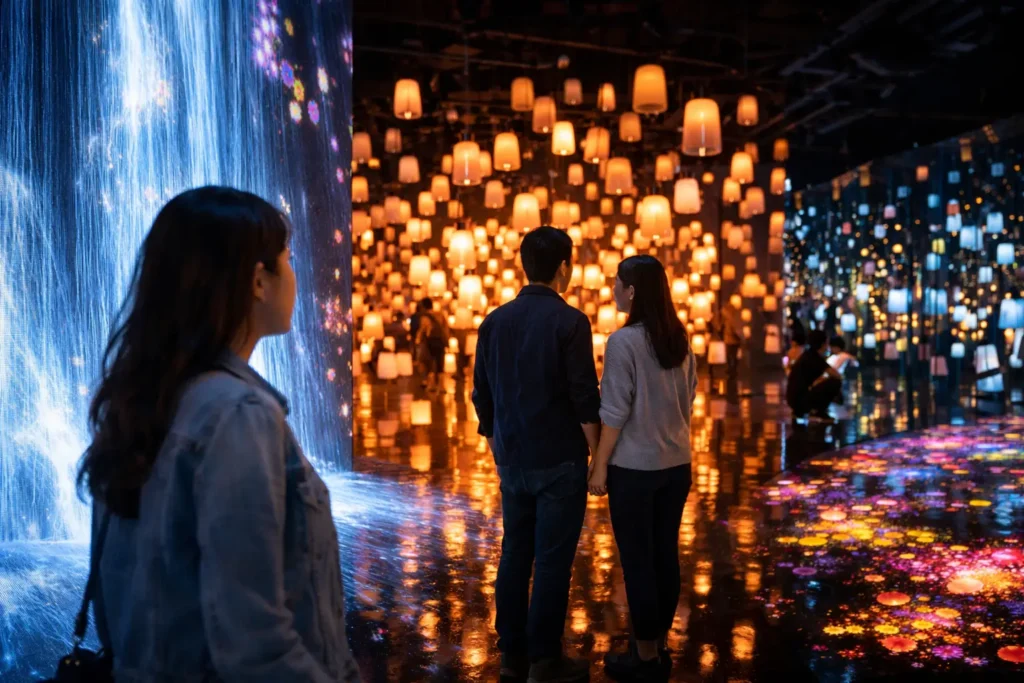
Tokyo rarely asks you to leave your sense of direction at the door. teamLab Borderless does exactly that. This teamLab Borderless visitor review looks beyond the photogenic projections to ask what the museum truly feels like, what makes its new home compelling, and whether it deserves a precious place on a Tokyo itinerary.
Located inside Azabudai Hills, the digital art museum is not a collection of rooms to move through in order. It is an unfolding landscape of light, sound, mirrors, flowers, water, and shadow. Artworks spill from one space into another, change according to the movement of visitors, and sometimes seem to vanish before you can decide whether you have understood them. That uncertainty is central to the experience.
A Museum Designed for Wandering
The word “Borderless” is not simply a memorable name. It describes teamLab’s core idea: digital artworks can travel beyond frames, walls, and fixed viewing positions. A waterfall may appear to run through a darkened hall. Seasonal flowers drift across floors and climb the walls. A flock of luminous creatures may scatter when people approach, then re-form somewhere else in the museum.

This makes the visit feel less like viewing an exhibition and more like entering a temporary world. There is no single correct route, no neat sequence of masterpieces, and no guarantee that two visitors will encounter the same moment in the same way. For travelers accustomed to Tokyo’s precise rail lines and carefully organized department stores, that freedom can feel wonderfully surprising.
It can also be disorienting. Signage is intentionally limited in many areas, and the galleries are dark. You may circle back to a place you have already seen or miss an installation entirely on your first pass. Rather than treating that as a flaw, it helps to approach the museum as a place to revisit within the same ticketed session. The second encounter often reveals more than the first.
What Makes the New Location Special
teamLab Borderless originally became an Odaiba phenomenon, drawing international visitors with images that made the museum appear almost impossible to photograph badly. Its Azabudai Hills home gives the experience a different urban setting. The development sits near Tokyo Tower and brings together contemporary architecture, offices, residences, dining, greenery, and cultural spaces in one dynamic district.
Inside, the museum retains the dreamlike intensity that made it famous, but it feels especially fitting in this part of central Tokyo. Azabudai Hills represents a city constantly redesigning its future, while teamLab creates art that is never visually still. The pairing is captivating: an immersive museum inside one of Tokyo’s newest neighborhoods, with the familiar silhouette of Tokyo Tower nearby.

The museum is also more than a backdrop for social media. teamLab’s work is built through collaboration among artists, programmers, engineers, mathematicians, architects, and sound designers. Its installations invite a broader question about where art exists. Is it on the wall, in the projected image, in the code, or in the visitor’s movement through the space? At Borderless, the answer is often all of them at once.
The Most Memorable Moments
The strongest installations have a sense of scale that photographs cannot fully reproduce. Large rooms can feel like nocturnal forests, underwater worlds, or endless fields of color. Reflections multiply lights overhead and beneath your feet, creating the strange sensation that the architecture has dissolved.
The flower-based works are often among the most beautiful. Petals bloom, scatter, and fade in richly colored waves, drawing on the visual language of Japanese seasonal awareness. They should not be read as a direct recreation of a traditional Japanese garden or painting. Instead, they echo a cultural attentiveness to transience – the brief flowering moment, the changing weather, the passage from one season to another – through a distinctly contemporary medium.
Other spaces reward playfulness. Some works react when visitors touch, step on, or move near them. Children are likely to respond immediately, but adults who permit themselves a little curiosity will get more from the experience too. The museum’s best moments come when you stop trying to capture proof that you were there and simply watch the artwork respond around you.
The En Tea House Is Worth Considering
One of the most distinctive additions is the En Tea House, where tea becomes part of the digital artwork. As tea is prepared and served, flowers appear to bloom inside the cup and continue to shift as you hold it. It is a small, quieter contrast to the museum’s vast projection rooms.
This is not a traditional tea ceremony, and visitors should not expect a formal lesson in chanoyu. It is a contemporary art encounter inspired by the intimacy of tea, attention, and shared presence. If your schedule allows, it offers a welcome pause from the sensory abundance outside. If you are traveling on a tight budget or prefer to spend every minute in the main galleries, it is an optional enhancement rather than an essential part of the visit.
A Candid teamLab Borderless Visitor Review
Is teamLab Borderless worth visiting? For many first-time visitors to Tokyo, creatives, families, photographers, and anyone interested in digital art, yes. It delivers a vivid experience that is difficult to replicate elsewhere. The museum is especially rewarding if you enjoy contemporary art that is felt physically and emotionally rather than explained through long wall labels.
The trade-off is popularity. Even with timed entry, crowded periods can make certain rooms feel less contemplative. People naturally pause for photos, and narrow or highly sought-after spaces can become congested. The darkness that creates such a magnificent atmosphere can also make it harder to move comfortably if you are tired, traveling with very young children, or sensitive to flashing imagery and loud sound.
It is also not the right choice for everyone. Visitors looking for a conventional museum survey of Japanese art, historical objects, or detailed cultural interpretation may find it visually stunning but intellectually light. For that kind of encounter, Tokyo offers excellent museums focused on painting, craft, archaeology, and design. Borderless is best understood as contemporary experiential art, not a replacement for them.
The value depends on how you visit. Rushing through in 45 minutes to collect a few familiar photos may leave you wondering what the excitement was about. Allowing time to wander, return to rooms, sit down when possible, and follow unexpected sounds turns it into something more memorable. Plan for roughly two to three hours, with flexibility to stay longer if the museum’s rhythm catches you.
Practical Ways to Enjoy It More
Buy tickets in advance, especially for weekends, holidays, and peak travel seasons. Timed admission helps manage arrivals, but it does not guarantee empty galleries. An earlier entry time can be appealing if you want to explore before the museum feels busiest, while later sessions may suit travelers who prefer an atmospheric evening in central Tokyo.
Wear comfortable shoes and choose clothing you can move in easily. This is a walking museum, and some areas encourage interaction or require careful footing in low light. Avoid treating every room as a photo set. Take the images you want, then put the phone away for a few minutes. The constantly changing projections are more affecting when they are not reduced to a screen within a screen.
If you are visiting with children, establish a meeting point and stay attentive in the darker, more maze-like areas. If you are prone to motion sensitivity, sensory overload, or discomfort in dark enclosed spaces, check current visitor guidance before booking. The same immersive qualities that delight many guests can be intense for others.
Finally, give Azabudai Hills some of your day rather than treating it only as a transit point. The neighborhood offers a striking view of Tokyo’s evolving cityscape, and its proximity to Tokyo Tower makes it easy to pair modern digital art with one of the capital’s enduring icons.
More Than a Viral Tokyo Stop
teamLab Borderless succeeds because it understands a simple but fascinating truth: people do not experience a place from a fixed position. We move, pause, turn around, notice someone else’s reaction, and see familiar things differently when the light changes. Its artworks make that process visible.
For the right visitor, Borderless is not just an item to check off between Tokyo Tower and dinner. It is a chance to wander through Tokyo’s contemporary imagination – vibrant, technological, playful, and always in motion. Arrive with patience, leave room for surprise, and let yourself get a little lost.
![[商品価格に関しましては、リンクが作成された時点と現時点で情報が変更されている場合がございます。]](https://hbb.afl.rakuten.co.jp/hgb/574e4ebe.b55a6785.574e4ebf.4b040b74/?me_id=1422081&item_id=10000007&pc=https%3A%2F%2Fthumbnail.image.rakuten.co.jp%2F%400_mall%2Ff141003-yokohama%2Fcabinet%2F13776317%2F6a9620d8aebea3834897.jpg%3F_ex%3D128x128&s=128x128&t=picttext "[商品価格に関しましては、リンクが作成された時点と現時点で情報が変更されている場合がございます。]")