
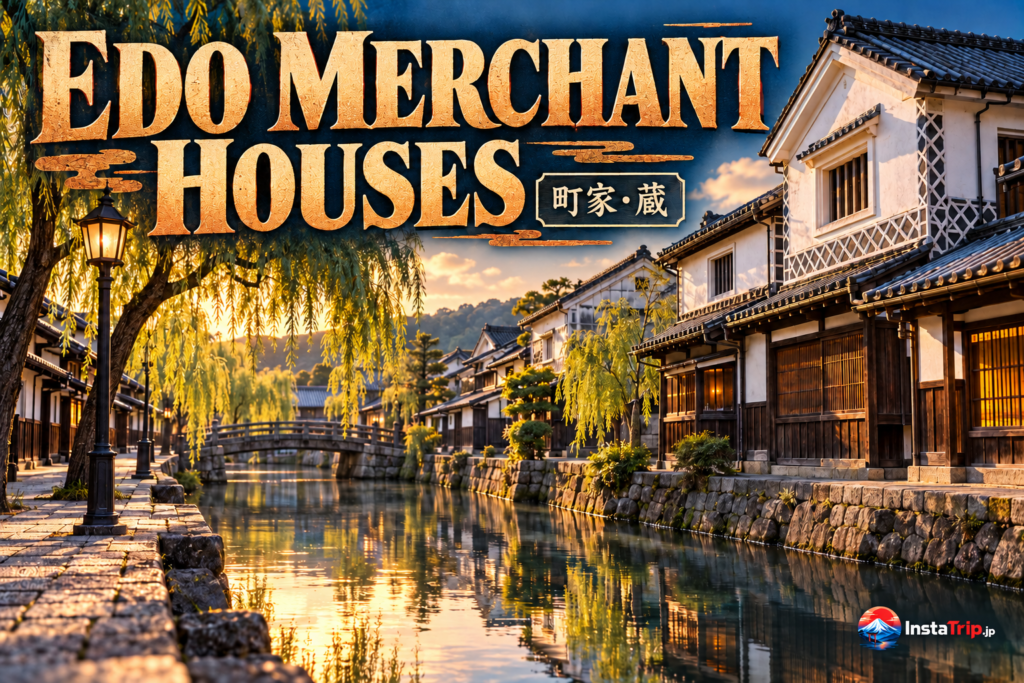
A dark wooden façade, a fabric shop curtain stirring above the entrance, and the faint coolness of an earthen-floored passageway – Edo period merchant houses make Japan’s urban past feel startlingly close. These buildings were not designed as monuments. They were places to sell rice, silk, medicines, sake, candles, paper, and countless necessities, while generations of one family ate, slept, worked, and welcomed guests within the same narrow plot.
For travelers drawn to Japan’s historic atmosphere, a merchant house offers something more intimate than a castle or temple. It reveals the rhythm of ordinary ambition: the careful arrangement of a storefront, the quiet hierarchy of reception rooms, the practical strength of a fire-resistant storehouse, and the artistry hidden in details made for daily use.
What Edo Period Merchant Houses Reveal
The Edo period, from 1603 to 1868, was an age of peace, expanding cities, and energetic domestic trade. Japan’s social order placed merchants beneath warriors, farmers, and artisans in formal status, yet commerce gave successful merchant families considerable influence. In castle towns, port communities, post stations, and growing cities such as Edo, Osaka, and Kyoto, their businesses shaped neighborhoods and supplied the life of the country.
The term machiya is often used for an urban townhouse associated with merchants and artisans, especially in Kyoto. But the buildings travelers encounter across Japan are wonderfully varied. A prosperous sake brewer in a regional town, a wholesaler near a canal, and a shopkeeper on a highway route could all occupy structures adapted to local climate, regulations, materials, and trade.

Their essential idea was remarkably consistent: business faced the street, private life extended behind it, and storage stood nearby or at the rear. The house was both a workplace and a family archive. Account books, goods, heirlooms, customer relationships, and household rituals accumulated under one roof.
From Streetfront Shop to Family Rooms
Many merchant houses have a long, narrow shape, an arrangement sometimes described as an “eel’s bed” in Japanese. Street frontage was valuable, so owners built deep into the plot. The front room, or mise, functioned as a shop or commercial space, often opening directly to passersby. Behind it ran the doma, an earth-floored working area where deliveries could enter, goods could be handled, and fire could be managed more safely.
Raised tatami rooms lay farther inside, away from the dust and noise of the street. These spaces could serve as living quarters, places for bookkeeping, or formal rooms for important visitors. Sliding screens allowed rooms to change function through the day, a practical expression of Japanese spatial flexibility rather than a rigid division of purpose.
Look upward when visiting. The beams, rafters, and latticed ceilings are often as expressive as the exterior. Look downward, too: worn thresholds and polished floorboards record the movement of customers, relatives, apprentices, and staff over decades.

Kura: The Storehouses Built to Survive
A merchant’s most valuable assets needed protection. That is why so many historic commercial districts feature kura, thick-walled storehouses coated in plaster. Their heavy doors, limited openings, and tiled roofs helped shield stock, records, and valuables from fire – a constant threat in dense timber towns.
These structures have become some of the most recognizable silhouettes in historic Japan. In Kawagoe, northwest of Tokyo, broad kura-style façades evoke the commercial confidence of a town that prospered through close connections with Edo. In Kurashiki, white-walled storehouses line a canal once used for moving goods. Both places are visually captivating, but their architecture also tells a practical story about trade, risk, and preservation.
Not every kura is original in every detail, and not every restored district recreates a single moment in time. Some buildings were altered during the Meiji era or later, while others have been carefully adapted for contemporary shops, galleries, cafés, and museums. That layering is part of their appeal. Historic towns remain living places when their buildings can support daily life, not only photography.
Where to Experience Edo Period Merchant Houses
Kyoto’s Nishijin and central historic streets offer some of the most refined examples of machiya culture, including houses shaped by textile production and merchant wealth. Their discreet façades can conceal surprisingly deep interiors, small gardens, and reception rooms with delicate craft details. Because many are private residences or businesses, the most respectful approach is to appreciate what is publicly accessible and avoid treating residential lanes as open-air museums.
For a vivid streetscape, Kawagoe’s Kurazukuri Street is one of the most accessible day trips from Tokyo. Its clay-walled warehouse-style buildings, traditional shops, and bell tower create a dynamic setting where Edo-era commercial architecture is immediately legible. It can be busy, particularly on weekends, so early morning offers a quieter chance to notice the lattices, rooflines, and storehouse doors.
Takayama, in the mountains of Gifu Prefecture, feels more intimate. Its old town preserves rows of dark wooden merchant houses, many connected to the region’s sake trade. Here, the contrast between a humble streetfront and a meticulously ordered interior is especially memorable. Several former merchant homes are open to visitors, giving a clearer sense of how trade, domestic life, and hospitality overlapped.
In Ehime Prefecture, Uchiko presents another compelling perspective. The town developed through wax production, and its historic district includes elegant merchant residences and warehouses that reflect the wealth generated by this once-essential commodity. It is a quieter destination than Japan’s most famous old towns, which makes its preserved architecture feel especially atmospheric.
How to Read the Details
A merchant house becomes more fascinating when you stop looking at it as a single old building. Start with the street. Is the frontage open and welcoming, tightly latticed, or guarded by a thick plaster wall? The answer may hint at the kind of business once conducted there, the need for privacy, or the owner’s resources.
Then notice transitions. A change from stone or packed earth to wood and tatami signaled a move from labor to domestic life, from public commerce to more private space. Small gardens brought light and air into deep plots, while decorative transoms, painted screens, or carefully chosen hardware communicated taste without overwhelming the home’s practical character.
The most impressive merchant houses are not always the grandest. A modest shop with a preserved signboard, a sake ball hung beneath the eaves, or an old measuring tool displayed near the counter can make the past feel immediate. These details connect architecture to the people who negotiated prices, trained apprentices, packed goods, and built trust with a neighborhood.
Four Towns, Four Ways to See Merchant History
Kurashiki (倉敷): its Bikan Historical Quarter (美観地区) has a canal, white-plastered storehouses and merchant buildings from both the Edo and Meiji periods. It is an ideal place to read the relationship between river transport, warehouses and commerce; do not assume every façade dates to the same century.
Kawagoe (川越): the kurazukuri (蔵造り) warehouse street recalls the city’s trade with Edo. Its surviving commercial architecture also reflects later rebuilding, so the streetscape is a record of change as well as preservation.
Takayama (高山): the Sanmachi district (三町) rewards a slow look at wooden shopfronts and sake businesses. The Kusakabe and Yoshijima heritage houses offer a chance to study interiors, subject to current admission and opening arrangements.
Uchiko (内子): Yōkaichi old town (八日市) tells the story of prosperous wax merchants. The Kamihaga Residence is a remarkable example, but its house and workshop are associated with the Meiji era; it should not be presented as an intact Edo-period dwelling.
Check the JNTO Kurashiki guide, Takayama Sanmachi guide, and Uchiko guide when planning. Historic districts contain working shops and private homes; enter only buildings open to visitors.
Map: Kurashiki Bikan Historical Quarter
A Canal-Side Walk
This 4K walk shows the scale of the preserved Kurashiki quarter and its canal-side storehouses.
Paid links
To explore the buildings more deeply, browse a book on Japanese architecture or an Edo history book.
A Respectful Way to Visit Historic Towns
Historic merchant districts are often active communities, not stage sets. Keep voices low on residential streets, do not enter courtyards or photograph inside homes without permission, and support businesses that maintain these buildings. A meal, a local craft purchase, or an admission ticket can contribute to the difficult work of keeping traditional structures in use.
It also helps to allow time beyond the headline attractions. Walk a side street, study a roof tile, pause near a canal or former loading area, and imagine the movement of goods that once animated the town. Many commercial districts are most captivating in the early morning, after rain, or toward evening, when timber, plaster, and stone take on a softer depth.
Edo period merchant houses invite a slower kind of travel. Stand before a weathered lattice, then step inside an open house or museum and follow the path from shop floor to inner rooms. In that gradual passage, Japan’s great urban history becomes personal: not a distant story of rulers and dates, but the enduring texture of work, family, craft, and exchange.