

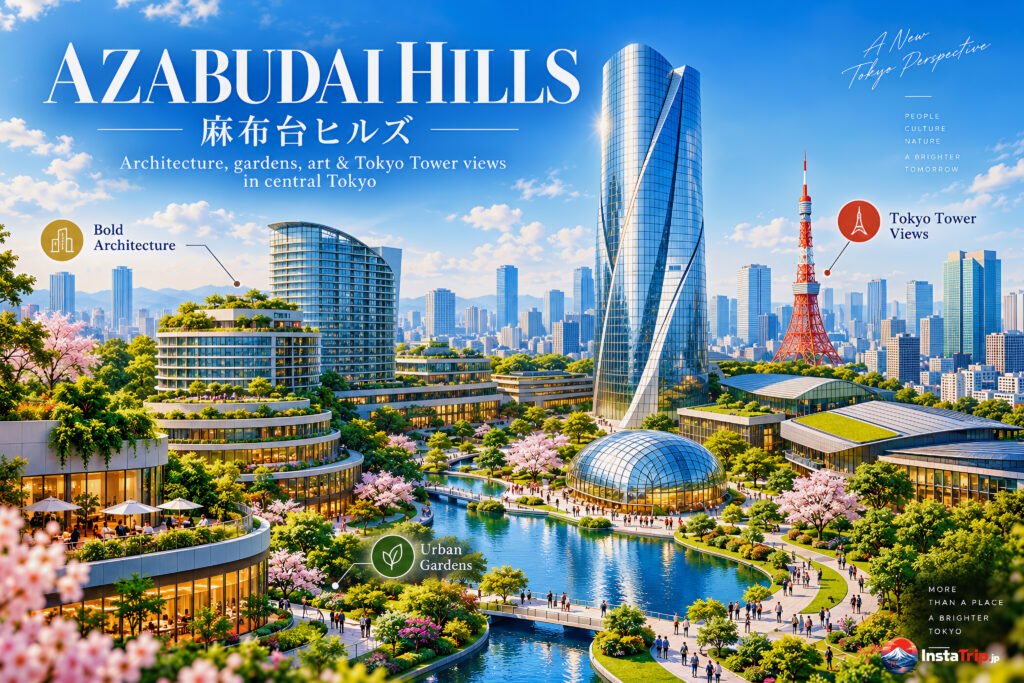
A few minutes from the intense energy of Roppongi, Azabudai Hills (麻布台ヒルズ) rises as a radically different vision of Tokyo: a place where a 330-meter tower, leafy paths, intimate restaurants, public art, and a digital universe all share the same neighborhood. Opened in late 2023, this vast Toranomon-Azabudai development is not simply a shopping complex or a new skyline landmark. It is an ambitious attempt to make one of the world’s densest cities feel more open, green, and connected.
For travelers, its appeal lies in that contrast. You can stand beneath a glittering high-rise, look toward Tokyo Tower, then turn into a garden-lined passage where the pace suddenly softens. Azabudai Hills offers a vivid glimpse of contemporary Tokyo at its most confident – technologically advanced, design-conscious, and still deeply attentive to the experience of moving through a place.
Azabudai Hills and Tokyo’s New Urban Landscape
Developed by Mori Building, the project took decades of discussion and coordination with local landowners before it could take shape. That long process matters. Rather than clearing the area for a single imposing structure, the development combines offices, residences, shops, a school, cultural spaces, and public greenery. Its stated idea is a city within a city, but the more compelling reality is a district designed around everyday movement: people heading to work, families meeting for lunch, gallery visitors, and travelers pausing between neighborhoods.

Mori JP Tower is the defining vertical presence. At 330 meters, it is Japan’s tallest building, and its elegant height changes the view from streets across central Tokyo. Yet the tower is only one part of the composition. Lower buildings curve and fold around it, allowing sunlight, greenery, and pedestrian routes to remain central rather than incidental.
This is a significant departure from the familiar image of Tokyo as a city of tightly packed streets and endless concrete. That image remains true in many districts, and it is part of Tokyo’s magnetic character. Azabudai Hills does not replace it. Instead, it proposes another possibility: density with breathing room, where architecture frames gardens as carefully as it frames retail windows.
Architecture That Makes Room for Nature
The lower-rise architecture, led by Heatherwick Studio, is immediately recognizable for its undulating forms and terraced surfaces. Rather than presenting a hard, uniform wall to the street, the buildings appear to ripple around planted areas. The effect is especially striking when viewed from nearby slopes or from the complex’s central open spaces, where foliage interrupts the usual geometry of the city.
More than 6,000 plants and trees help shape the district’s atmosphere. In spring, fresh green leaves soften the glass and steel; in summer, shaded routes offer a welcome break from Tokyo’s heat; in autumn, changing color brings another layer of texture. The planting is not merely decoration. It is part of the project’s effort to restore a sense of topography to a cityscape that can often feel entirely built over.

The experience works best when you wander rather than treat the site as a checklist. Follow the changing elevations, notice how a quiet courtyard opens beside an active dining area, and look upward from the smaller streets. The architecture reveals different rhythms at ground level than it does from a distance.
There is a trade-off, of course. The district’s immaculate finish can feel more curated than the wonderfully improvised lanes of older Tokyo neighborhoods. Visitors seeking small, weathered izakaya, vintage storefronts, or the loose unpredictability of Shinjuku’s backstreets will find a different mood here. Azabudai Hills is polished by design. Its fascination comes from seeing how Tokyo rethinks urban life on a monumental scale.
Art at the Center of the Experience
Azabudai Hills has quickly become essential for art-minded visitors because it is home to teamLab Borderless. The celebrated digital art museum reopened here in 2024 after leaving Odaiba, bringing its immersive, boundary-free installations into the heart of Tokyo.
Inside, projected flowers bloom across walls, luminous forms drift through darkened rooms, and visitors become part of artworks that change with movement. The experience is captivating precisely because it resists a fixed route. Artworks spill beyond individual rooms, evolve over time, and occasionally seem to disappear before you can fully understand them.
This is not traditional museum-going, and that is the point. teamLab Borderless reflects a major thread in contemporary Japanese art and design: the desire to dissolve borders between observer, artwork, technology, and environment. Reserve ahead if it is a priority, particularly on weekends and during holiday periods. The museum can be intensely popular, and a timed visit allows you to enjoy it without building your entire day around a last-minute wait.
Beyond teamLab, Azabudai Hills Gallery hosts changing exhibitions that add another reason to return. Its program can vary widely, so the experience depends on what is showing, but the gallery helps establish the neighborhood as more than a commercial destination. Art here is woven into the wider environment, from exhibition spaces to the visual drama of the architecture itself.
A Refined Side of Everyday Tokyo
Food and shopping at Azabudai Hills are best approached with curiosity rather than urgency. The complex brings together Japanese and international dining, specialty food counters, cafés, fashion, design, and lifestyle stores. It is a polished setting, but not one limited to formal occasions. On a weekday, you may see office workers carrying coffee, residents picking up groceries, and friends gathering over a relaxed meal.
For travelers, the food halls and restaurants can be especially useful after time spent in nearby cultural districts. The range makes it possible to choose according to your mood, whether that means an elegant dinner, a quick Japanese lunch, or a carefully made dessert. Prices generally reflect the location and the quality of the surroundings, so this is not the place to expect bargain dining. It is, however, a memorable setting for a meal when you want to experience Tokyo’s contemporary culinary culture at a more refined pace.
The neighborhood also rewards a walk after dark. As the offices dim and the gardens become illuminated, the buildings take on a warmer, almost theatrical presence. Tokyo Tower nearby becomes part of the scene, reminding you that this forward-looking district sits within a city shaped by decades of architectural ambition.
How to Visit Azabudai Hills
Azabudai Hills is well placed for a broader central Tokyo itinerary. Kamiyacho Station on the Tokyo Metro Hibiya Line is directly connected, while Roppongi-itchome Station on the Namboku Line is also within easy walking distance. Its position makes it easy to pair with Roppongi, Tokyo Tower, Zojo-ji Temple, or the quieter streets around Toranomon.
Give yourself at least two to three hours if you plan to see the architecture, gardens, and dining areas at an unhurried pace. Add more time for teamLab Borderless, especially if you enjoy photography or want to linger with the installations. Morning is often the calmest time to appreciate the public spaces, while late afternoon and evening offer the most dramatic light and a more vibrant dining atmosphere.
Photography is rewarding throughout the complex, but the strongest images often come from details rather than the obvious tower shot: reflections in glass, a planted terrace against the skyline, Tokyo Tower framed between buildings, or the shift from a crowded interior to a quiet green path. Be considerate of residents, workers, and other visitors when taking photos, particularly in narrower shared areas.
Azabudai Hills is still new enough that its identity is evolving. That is part of the reason to visit. Go with time to wander, choose one experience that genuinely interests you, and let the gardens and changing city views lead you toward your own version of Tokyo.
![[商品価格に関しましては、リンクが作成された時点と現時点で情報が変更されている場合がございます。]](https://hbb.afl.rakuten.co.jp/hgb/574e28ca.9957ca8d.574e28cb.250c0cb0/?me_id=1378156&item_id=10910886&pc=https%3A%2F%2Fthumbnail.image.rakuten.co.jp%2F%400_mall%2Fcocohouse%2Fcabinet%2F20260401-3%2Fb0gnlt9hch.jpg%3F_ex%3D128x128&s=128x128&t=picttext "[商品価格に関しましては、リンクが作成された時点と現時点で情報が変更されている場合がございます。]")