

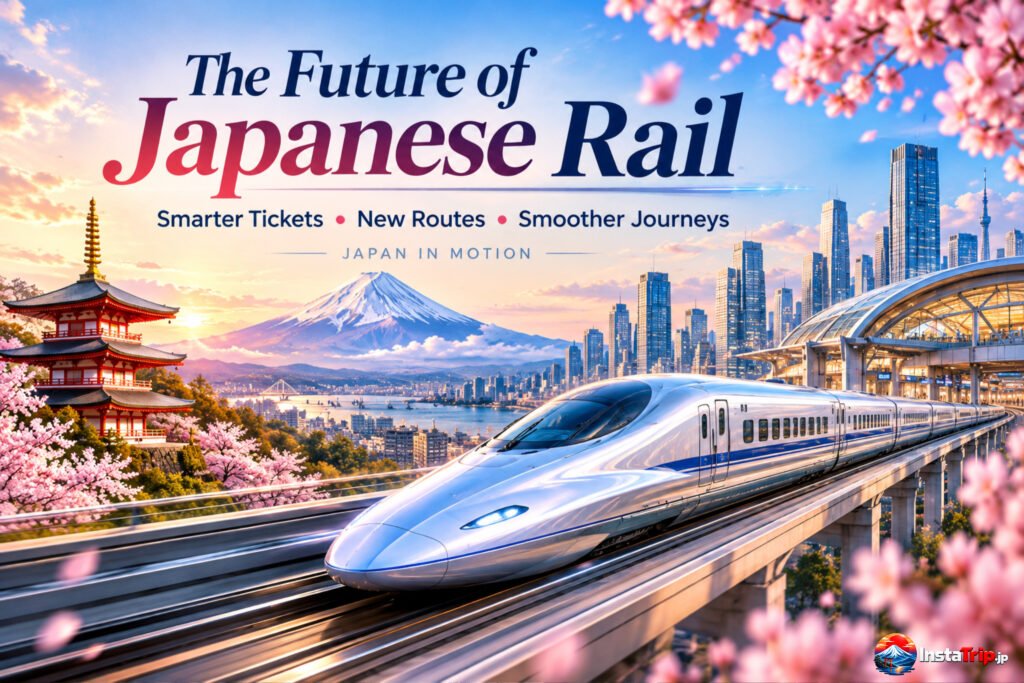
At Tokyo Station (東京駅), a Shinkansen (新幹線) can glide out beneath a web of platforms while commuters stream toward the Yamanote Line (山手線) and travelers study bento (弁当) boxes for the journey ahead. The future of Japanese rail will not abandon this captivating rhythm. It is shaping a network that aims to be cleaner, more accessible, more digital, and more responsive to the very different needs of Tokyo, regional cities, and rural communities.
For visitors, that future matters because trains are not merely a way to get from one landmark to the next. They are part of the experience of Japan: a window onto rice fields and mountain valleys, a pause between the temple lanes of Kyoto (京都) and the vibrant streets of Osaka (大阪), and a daily glimpse of extraordinary coordination in motion. Yet the changes ahead are more complex than a promise of faster journeys.
The Future of Japanese Rail Is About More Than Speed
Japan’s railways have long been admired for punctuality, dense urban networks, and the Shinkansen’s remarkable record of safety. But the next chapter is being written under different pressures. An aging population, labor shortages, rising maintenance costs, climate responsibilities, and changing travel patterns are pushing operators to rethink how trains and stations work.
Speed still carries a powerful appeal. The Hokuriku Shinkansen (北陸新幹線) extension to Tsuruga (敦賀), opened in 2024, made the historic cities and dramatic coastlines of Fukui (福井) more directly connected with Tokyo. Future extensions and upgrades could continue to redraw the mental map of a trip, turning places once treated as detours into natural stops.

The Chuo Shinkansen (中央新幹線) maglev line, now under construction, remains the most spectacular symbol of this ambition. Designed to link Tokyo’s Shinagawa (品川) and Nagoya (名古屋), then eventually Osaka, with magnetically levitated trains, it promises a radically different kind of long-distance travel. But it also shows why the future cannot be reduced to glossy renderings. Construction, environmental questions, costs, and coordination between regions can reshape schedules. For travelers planning the next few years, conventional Shinkansen routes will remain the dependable backbone of the country.
The more immediate transformation may be less dramatic but more meaningful: trains that feel easier to use from the moment a visitor enters a station.
Japanese Rail Projects: What Is Planned and What You Can Ride
Project check: October 6, 2026. Announced targets describe development plans, not a guarantee that a train will be available on your travel dates. Japan’s fiscal year runs from April to March.
| Project | Published plan | Meaning for visitors |
|---|---|---|
| Chuo Shinkansen maglev | Construction toward Shinagawa–Nagoya, with Osaka planned later. | Do not plan a regular passenger journey on this route yet. |
| E10 Shinkansen | Prototype completion from autumn 2027; commercial service targeted for fiscal 2030. | A future Tohoku Shinkansen (東北新幹線) train, not an option to reserve today. |
| Joetsu Shinkansen (上越新幹線) automation | Driver-supervised automation targeted within fiscal 2028; unstaffed depot transfers in fiscal 2029. | The unstaffed phase concerns empty trains, not passenger services. |
| HYBARI hydrogen hybrid | Commercial operation targeted by the end of fiscal 2027. | Initially planned for the Tsurumi Line (鶴見線) and the Shitte (尻手)–Hama-Kawasaki (浜川崎) section of the Nambu Line (南武線). |
E10: Comfort and Accessibility Alongside Speed
JR East’s E10 announcement sets a maximum commercial speed of 320 km/h. Plans include larger luggage areas, power outlets at every seat and wheelchair spaces positioned for enjoying the view. Its expanded TRAIN DESK concept proposes a roomier 2+2 layout. For travelers, these changes could matter as much as headline speed.

Automation: Passenger Trains and Empty Transfers Are Different
The Joetsu Shinkansen (上越新幹線) automation roadmap starts with a driver in the cab between Nagaoka (長岡) and Niigata (新潟)’s depot. Its fiscal 2029 unstaffed stage is limited to empty transfers between Niigata Station and the depot. Later passenger-service automation is a separate phase; “driverless” does not automatically mean no staff aboard.
HYBARI: A Specific Hydrogen Project, Not a Network-Wide Switch
In its July 2026 hydrogen update, JR East announced plans to convert the HYBARI test train for commercial use by the end of fiscal 2027. A separate next-generation hydrogen hybrid targets the end of fiscal 2030. Fuel cells and batteries power these trains; the fuel-cell reaction produces no CO₂, while the wider environmental benefit depends on how hydrogen is produced and supplied.
For maglev construction progress, consult JR Central’s Chuo Shinkansen project site. Build an actual itinerary around services already shown in current timetables.
Stations Becoming More Human-Centered
A major Japanese station can feel like a small city. It may contain department stores, bakeries, art displays, locker banks, underground passages, and platforms serving local, limited express, and bullet trains. This energy is magnificent, but it can also be intimidating after a long flight or with heavy luggage.
The railways of the future are likely to focus more intensely on accessibility and clarity. Expect continued investment in elevators, platform doors, tactile paving, multilingual screens, clearer transfer routes, and real-time service information. Japan has already made significant progress, particularly at major urban stations, though the experience can vary widely by line, operator, and location. Older rural stations and compact historic districts may have physical limits that no redesign can completely erase.
For a traveler, the most useful improvement is not always a new train. It may be a station map that makes sense, an elevator close to the right car, or a notice that explains a disruption in plain English. These details turn a complicated transfer into a calm one.
There is also a cultural dimension. Stations are increasingly being treated as gateways to their neighborhoods rather than anonymous transit points. A carefully restored station building, a local food hall, or displays featuring regional crafts can offer the first hint of a place’s character. In Kanazawa, Hakone, and smaller towns across the country, rail travel can create a gentler arrival than an airport ever could.
Digital Tickets, With Some Familiar Friction
Japan’s transport future is moving toward simpler digital payment, including expanded use of mobile IC cards, contactless bank cards in some systems, and QR-based tickets. For visitors, this should gradually reduce the old puzzle of paper tickets, fare adjustments, and separate machines.
Still, it is wise not to expect one universal system overnight. Japan’s rail landscape includes JR companies, private railways, subways, trams, and local operators, each with its own infrastructure and priorities. IC cards are exceptionally useful, but coverage and payment options can differ in smaller regions. Shinkansen reservations, airport routes, and scenic railways may also follow separate rules.
The practical lesson is simple: use digital tools where they save time, but keep a payment card and a little cash available. The future of rail will be more connected, not magically uniform.
A Greener Journey Across Japan
Rail is already one of the most energy-efficient ways to move through Japan, especially when compared with private car travel on busy intercity routes. As Japan works toward lower emissions, electrified rail networks, regenerative braking, energy-saving station systems, and lighter rolling stock will become even more significant.
Some of the most fascinating work may happen away from the Shinkansen spotlight. Regional lines are testing ways to reduce operating costs and emissions, from battery-powered trains on partly electrified routes to more efficient maintenance technology. These efforts matter because a local line can be far more than transport. It can connect an aging community to medical care, bring students to school, and give travelers access to quiet landscapes beyond the usual circuit.
At the same time, not every lightly used route can be preserved exactly as it is. Declining ridership has placed real strain on rural railways. In some areas, buses or on-demand services may be the more sustainable answer. This is a sensitive trade-off: preserving a beloved train line has emotional and cultural value, but operating it requires people, funding, and long-term demand.
For visitors, supporting regional travel can make a difference. Riding a local line to a hot spring town, staying overnight rather than rushing through, and choosing a station-area restaurant all help spread the benefits of travel beyond the largest cities.
Technology Will Support the Journey, Not Replace Its Soul
Artificial intelligence, automated inspection, and predictive maintenance are likely to become increasingly common behind the scenes. Sensors can identify problems before they cause major delays. Better data can help operators adjust service during crowded holiday periods, storms, or large events. In areas with severe staffing shortages, limited automation may help keep essential services running.
Yet Japanese rail’s most memorable qualities are deeply human. It is the station attendant who gestures you toward the correct platform, the conductor’s precise announcement, the ekiben vendor’s seasonal flavors, and the quiet etiquette that settles over a Shinkansen car once it gathers speed. Technology can make the system more resilient, but it should not erase these rituals of care.
That balance will be especially important as tourism grows. Crowded platforms and oversized luggage have become visible challenges on popular routes between Tokyo, Kyoto, and Osaka. Reservations for luggage space, smarter crowd information, and better distribution of visitors toward other regions can ease pressure. But the answer is not simply to make every station faster. It is to make travel feel considered.
Planning a Rail Trip While the Network Evolves
Choose trains that appear in the operator’s timetable for your dates, then compare the complete journey: station access, transfers, seat reservations and arrival time. Our guide to Shinkansen versus flights in Japan helps with that decision. For several journeys, compare individual tickets with Japan Rail Pass alternatives before buying a pass.
Save booking confirmations and your train, car and seat numbers where you can retrieve them without a connection. Allow time for unfamiliar stations, and check the operator’s luggage and accessibility guidance for your specific service. Innovation will arrive gradually; a well-planned trip can already combine high-speed travel with Japan’s scenic railway journeys.
Watch: Japan’s L0 Maglev on the Test Track
This silent, 56-second video from the Yamanashi Prefectural Maglev Exhibition Center (山梨県立リニア見学センター) shows a 12-car L0 formation undergoing tests in 2014. It is archival test footage, not a newly opened passenger service.
Watch the test-run video on YouTube. To see the technology in person, consult the museum’s official visitor information; test schedules can change.
Frequently Asked Questions About Japan’s Future Trains
Can I book the Chuo Shinkansen maglev for a Tokyo–Nagoya trip?
No. Construction and test runs do not constitute a regular passenger service. Use existing Shinkansen services for your itinerary, and consult JR Central’s official announcements for project updates.
When is the E10 Shinkansen expected to enter service?
JR East targets fiscal 2030, which runs from April 2030 through March 2031. This is a development target following prototype testing, not a currently bookable departure.
Will Japan’s passenger Shinkansen be completely unstaffed in 2029?
That is not what JR East’s cited roadmap says. Its fiscal 2029 GOA4 stage is for empty Niigata Station–depot transfers. Passenger operations and their staffing are separate phases.
Will HYBARI replace trains throughout Japan?
The announced first commercial plan is limited to the Tsurumi Line and the Shitte–Hama-Kawasaki branch of the Nambu Line. It is not an announcement of a nationwide replacement.
Useful Items for a Rail Journey
Keep luggage manageable and your booking details accessible. If you need them, browse compact travel backpacks and portable power banks (paid links). Check dimensions and charging compatibility before buying.
New Routes Can Change What Japan Feels Reachable
Rail development has always influenced where people live, work, and travel. A new connection can bring renewed attention to a castle town, a coastal landscape, or a craft tradition that sits beyond the most familiar itineraries. The impact can be energizing, but it must be handled with care. More visitors can support local businesses, while also putting pressure on small communities and fragile environments.
This is where the future of Japanese rail becomes a story of discovery rather than just infrastructure. The ideal network does not funnel everyone toward the same famous platforms. It gives travelers confidence to follow a quieter route: from a major hub to a pottery town, from a seaside station to a walking trail, or from a snowy Hokkaido city to a remote hot spring village.
For first-time visitors, Japan’s railways will continue to offer a thrilling sense of possibility. For returning travelers, the most exciting changes may reveal themselves in the spaces between headline routes: a revived local station, a more accessible transfer, a newly practical regional journey. Board with a little curiosity, leave room for an unplanned stop, and let the rails show you a Japan still moving forward.