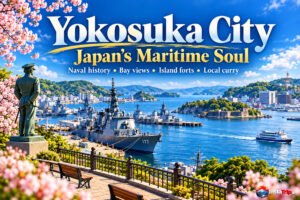

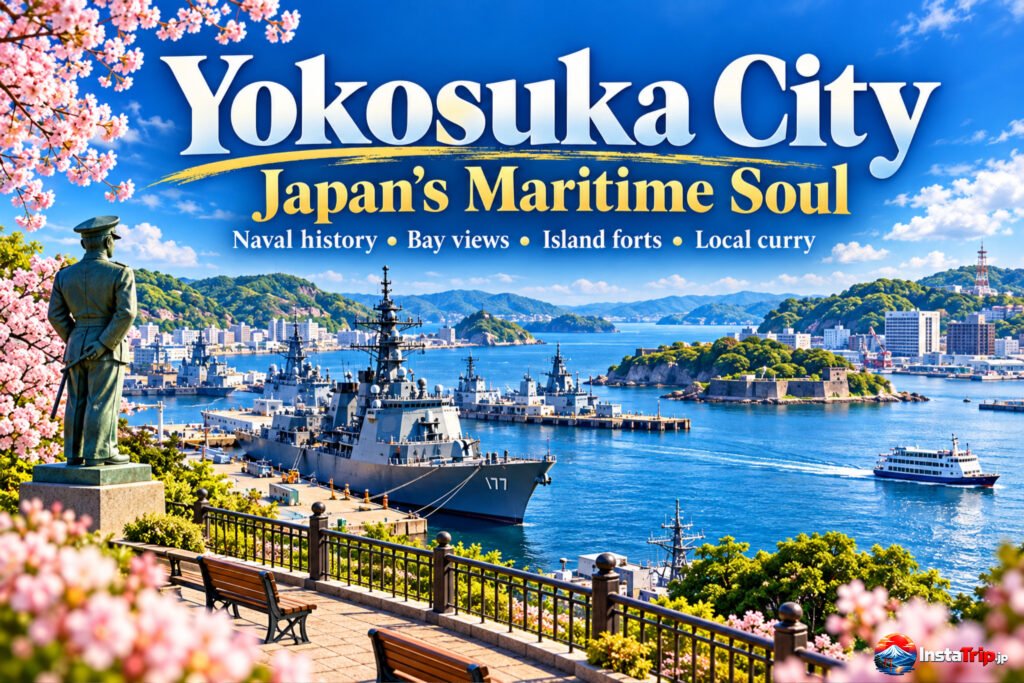
The salty air arrives before the skyline does. In Yokosuka City (横須賀市), south of Yokohama (横浜) on the Miura Peninsula (三浦半島), Tokyo Bay (東京湾) opens wide beside shipyards, waterfront parks, wooded islands, and neighborhoods shaped by centuries of exchange. This is not Kanagawa’s polished port city or Kamakura’s temple-filled retreat. Yokosuka is more candid, more maritime, and wonderfully full of contrasts.
A day here can move from rose gardens and a historic battleship to an art museum facing the ocean, then end with curry in a lively shopping street. For travelers who want to see another side of the greater Tokyo region, Yokosuka offers a captivating mix of Japanese industrial heritage, naval history, coastal nature, and everyday local energy.
Why Yokosuka City (横須賀市) Feels Different
Yokosuka’s identity is inseparable from the sea. Its sheltered position on Tokyo Bay made it strategically significant long before modern tourism, and in the 19th century it became a major center of Japanese shipbuilding. French engineer François Léonce Verny helped establish the Yokosuka Iron Works, an ambitious project that brought Western engineering methods to Japan during a period of immense national transformation.

The city later developed around the Yokosuka Naval Arsenal, and maritime activity still shapes its atmosphere. Japan Maritime Self-Defense Force vessels and the U.S. naval presence are visible around the harbor, while local parks, museums, restaurants, and streets reflect the international currents that have passed through this port. It is a living city, not a historical set piece, and that is precisely its appeal.
Yokosuka also rewards travelers who enjoy places with texture. The waterfront can feel open and serene one moment, then animated and urban a few blocks away. English signage is more common than in many Japanese cities, but the local character remains unmistakably rooted in Kanagawa.
A Waterfront Written by History
Verny Park (ヴェルニー公園) and the industrial age
Begin at Verny Park, a graceful waterfront promenade near JR Yokosuka Station (横須賀駅). Rose beds frame views across the harbor, creating a surprisingly elegant setting for a place so closely tied to heavy industry and naval history. In spring and autumn, the flowers add color to the long lawn and brick-accented walkways; in any season, the sea breeze and passing ships give the park its distinctive rhythm.
The park’s name is a reminder that Yokosuka’s modern story was built through international collaboration as well as Japanese ambition. Nearby, the Verny Commemorative Museum offers context for the shipyard era and the technology that helped transform this stretch of coast. Even travelers who usually skip small local museums may find it valuable: Yokosuka makes more sense once you understand that the harbor was an engine of Japan’s modernization.
Mikasa Park (三笠公園) and a ship with a long memory
A short journey from the central waterfront leads to Mikasa Park, home to the battleship Mikasa (三笠). Built in Britain for the Imperial Japanese Navy, Mikasa served as the flagship of Admiral Togo Heihachiro during the Battle of Tsushima in 1905. Today, preserved as a memorial ship, it offers an unusually direct encounter with an era that changed Japan’s place in the modern world.
The experience is most meaningful when approached with care. The decks, guns, and compact interiors are compelling, but the ship is not simply a photogenic relic. It is part of a complex history of industrialization, military conflict, and national memory. Allow time to read the exhibits, then step outside to the park, where the open bay restores a sense of scale.
The Island Escape Few Visitors Expect
Sarushima (猿島), or Monkey Island, is a small natural, uninhabited island in Tokyo Bay and one of Yokosuka’s most memorable experiences. Ferries depart from the central waterfront when services are operating, carrying visitors across the water in roughly 10 minutes. The crossing itself is part of the pleasure: the city recedes, the bay widens, and a green island rises ahead.
Sarushima is known for its atmospheric brick fortifications, tunnels, and moss-softened paths. Built for coastal defense in the 19th century and later used by the military, the island now feels almost cinematic, with stone walls disappearing into vegetation and shafts of light reaching through the trees. It is easy to understand why photographers and history-minded travelers are drawn here.
There is a trade-off. Sarushima is not a full-scale wilderness hike, and it can be busy on warm weekends. Bring water, wear shoes suitable for uneven paths, and check ferry schedules before setting out, especially outside the peak summer season. On a clear day, though, its combination of sea views and quiet ruins feels worlds away from the capital.
Art, Architecture, and the Kannonzaki Coast (観音崎)
For a more contemplative side of Yokosuka, travel toward Kannonzaki. The coast here is defined by wooded slopes, rocky edges, and broad water views toward the Boso Peninsula (房総半島). It is an excellent counterpoint to the central harbor, revealing the natural landscape that surrounds the city.
The Yokosuka Museum of Art (横須賀美術館) stands near the shore in a striking contemporary building of glass, steel, and white surfaces. Its setting is as important as its exhibitions. Windows frame the changing colors of the bay, while the surrounding grounds invite a slow walk between art and landscape. Programming varies, but the museum is especially rewarding for visitors interested in modern Japanese art, design, and architecture.
Nearby Kannonzaki Park adds coastal paths, lookout points, and traces of old defensive sites. If time allows, continue to Kannonzaki Lighthouse, Japan’s first Western-style lighthouse, first illuminated in 1869. The current structure is a later reconstruction, yet the location retains its historic power. Ships have passed through this narrow gateway of Tokyo Bay for generations, and from the headland, that movement becomes tangible.
Dobuita Street (どぶ板通り) and Yokosuka’s Everyday Energy
No visit is complete without Dobuita Street, the compact shopping area long associated with Yokosuka’s international port culture. Its colorful signs, vintage-inspired shops, casual bars, and music-inflected atmosphere have made it a recognizable stop, but the best way to enjoy it is without expecting a themed attraction. It is a working neighborhood with an evolving personality.
Browse slowly, look for independent storefronts, and notice how Japanese and American influences meet in the food, fashion, and visual language of the street. Some visitors come for souvenir jackets and bold murals; others come simply for the feeling of a place that could only exist in Yokosuka.
Food is another part of that story. Yokosuka naval curry is the city’s signature dish, inspired by the curry served in the historic Japanese navy. You will find versions ranging from straightforward comfort food to more elaborate restaurant interpretations. The city also has a well-known burger culture, though curry offers the deeper connection to local history. Choosing between them depends on your appetite, not on a rule – Yokosuka is a fine place to make room for both.
Choose Your Yokosuka Day-Trip Route
Yokosuka’s sights are spread across the city. Choose a central harbor day, an island visit or a Kannonzaki coastal day rather than filling one itinerary with every location. JR Yokosuka Station (横須賀駅) and Keikyu Yokosuka-Chuo Station (横須賀中央駅) are different stations in different parts of the city; check the arrival station before choosing your first stop.
| Route | Main stops | How to plan it |
|---|---|---|
| Central harbor and streets | Verny Park, Dobuita Street and Mikasa Park | JR Yokosuka or Keikyu Shioiri Station (汐入駅) suits a Verny Park start. Allow time to walk between the western harbor and Mikasa. |
| Sarushima island day | Sarushima and a shorter visit around Mikasa Park or the central streets | Plan around the ferry timetable and return sailing. Keep other stops flexible. |
| Kannonzaki coast and art | Yokosuka Museum of Art and nearby coastal scenery | Allow for bus travel, exhibition time and the return journey; this is a separate focus from an island-heavy day. |
Check the Sarushima Ferry Before You Go
The official Sarushima visitor information places Mikasa Terminal about a 15-minute walk from Keikyu Yokosuka-Chuo Station. The crossing takes approximately 10 minutes each way. Ferry tickets and the island’s park admission are separate charges, and fares vary by operating day.
Weather can cancel sailings, and a departure can fill up. Check the day’s timetable and last return before boarding: the operator lists a 17:00 final island departure for March–October and 16:00 for November–February. Treat the published schedule as something to confirm on your travel date, and leave enough time to reach the boat. Sarushima is a day visit; overnight stays are not permitted.
Getting to Yokosuka Museum of Art
For the Kannonzaki route, the museum’s official access guide describes Kannonzaki-bound buses from Maborikaigan Station (馬堀海岸駅) and JR Yokosuka Station. The stop named for La Vista Yokosuka Kannonzaki Terrace and Yokosuka Museum of Art is approximately a two-minute walk from the museum. Check the exhibition and closure calendar and your return bus before setting out.
Watch: Yokosuka’s Harbor and Coastal Scenery
This official film from the Yokosuka Media Library offers a visual introduction to the city’s harbor, island and coastal sights, without added background music or on-screen captions. It was filmed in 2020, so use it as inspiration rather than a guide to current facility layouts. The city’s video information page specifically notes that the Soleil Hill scenes predate its renovation. The places shown are spread across the city and are not a single short walking route.
Watch the official Yokosuka film on YouTube.
Yokosuka Day-Trip FAQ
Which Yokosuka station should I use?
Choose it to match your route. JR Yokosuka and Keikyu Shioiri work well for starting near Verny Park; Yokosuka-Chuo is convenient for central streets and the walk to Mikasa Terminal. Do not assume the stations are interchangeable.
Can I visit Sarushima and Kannonzaki in one day?
It may be possible with carefully matched transport, but it leaves less time for the island, museum and coast. For a relaxed first visit, choose one of those areas and add nearby stops.
What happens if the Sarushima ferry is cancelled?
Switch to a mainland itinerary around the harbor, parks and central streets. Check opening times before choosing an indoor attraction, and avoid making your entire day depend on an island crossing.
Should I also visit Yokohama?
Give the two cities separate days if you want time to explore. Our one-day Yokohama waterfront itinerary offers another harbor walk with museums, warehouses and evening skyline views.
Useful day-trip items (paid links): Consider a lightweight daypack or compact binoculars for enjoying distant harbor scenery if you need them. Follow local signs about access and photography.
Planning a Day in Yokosuka
Yokosuka is easy to reach from Tokyo or Yokohama, but it is larger and more spread out than first-time visitors often expect. Central sights near Yokosuka-Chuo Station and JR Yokosuka Station work well together on foot, while Kannonzaki and Kurihama are better reached by bus, train, or taxi. A focused day can cover the waterfront, Mikasa, Dobuita Street, and Sarushima if ferry timing cooperates. Add the art museum and Kannonzaki if you can give the city a slower full day.
Kurihama, at the southern end of the city, holds another significant chapter of Japanese history. Perry Park commemorates Commodore Matthew Perry’s 1853 arrival nearby, an event that helped end Japan’s long period of national seclusion. It is a quieter stop than the harbor center, best suited to travelers especially interested in the late Edo period and the forces that reshaped the country.
The most rewarding approach is to resist treating Yokosuka as a checklist. Pause by the water at Verny Park, take the island ferry if the weather is right, and leave room for an unplanned meal or side street. Yokosuka reveals Japan not as a single image, but as a vibrant meeting point of coastline, memory, creativity, and modern life.