
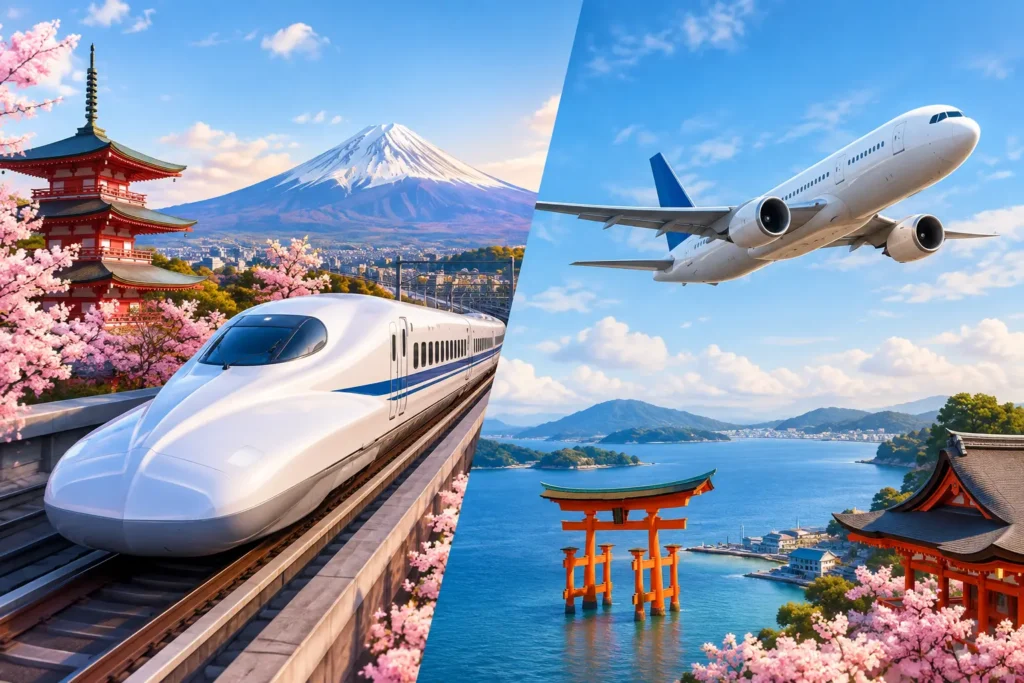
A 7:30 a.m. departure from Tokyo can place you beside Kyoto’s temple gates before lunch, while a flight that looks shorter on paper may still involve an airport train, security line, boarding gate, and a ride into the city. That is the real question behind Shinkansen versus flights in Japan: not simply which vehicle moves faster, but which journey gives you more of the day, and more of the country.
Japan’s transport network makes both options remarkably effective. The Shinkansen turns travel into part of the experience, gliding between vibrant city centers and passing rice fields, industrial towns, mountains, and, on clear days, the magnificent silhouette of Mount Fuji. Flights connect far-flung regions with impressive speed, making northern landscapes and southern islands far more accessible. The better choice depends on distance, itinerary, budget, and the kind of Japan you hope to encounter between destinations.
Shinkansen versus flights: calculate door-to-door time
A flight duration alone rarely tells the whole story. For domestic travel, travelers usually need to reach the airport, arrive before departure, clear security, wait to board, collect baggage if checked, then travel from the arrival airport into town. Japan’s airports are well organized, but they are often outside the historic or commercial centers visitors want to explore.
The Shinkansen’s great advantage is its location. Tokyo Station, Shinagawa Station, Kyoto Station, Shin-Osaka Station, Hiroshima Station, and Hakata Station are directly woven into their cities. You can step off the train and continue by subway, local rail, taxi, or on foot, often without changing the rhythm of your day.

For Tokyo to Kyoto, the fastest Shinkansen services take roughly two hours and change from Tokyo Station, with a slightly shorter trip from Shinagawa. A flight may spend less time in the air, but the full airport-to-hotel journey is usually longer. Tokyo to Osaka follows a similar pattern, especially since Shin-Osaka is connected to central Osaka by local rail.
On longer routes, the balance shifts. Tokyo to Fukuoka can be done by Shinkansen, but it is a long ride of around five hours on the fastest services. Flying often saves meaningful time once the overall journey is considered. For Sapporo, Okinawa, and many smaller regional airports, flights are the practical choice. There is no Shinkansen to Hokkaido’s largest city yet, and the sea separates Okinawa from the main islands entirely.
A useful rule for central Japan
For journeys of roughly three hours or less by Shinkansen, the train is usually the most efficient and enjoyable option. For routes approaching five hours, compare actual schedules, airport transfers, and hotel locations before deciding. For anything farther, flying is often the sensible answer.
The cultural experience of the Shinkansen
The Shinkansen is more than transportation. It is a vivid expression of modern Japan’s attention to timing, engineering, cleanliness, and shared public space. Platforms are precisely marked, seats are turned to face the direction of travel at terminal stations, and the train’s quiet atmosphere feels striking even when every seat is occupied.

There is also a particular pleasure in leaving Tokyo’s dense architecture behind and watching the landscape open. The route west toward Kyoto and Osaka moves through the urban fabric of Yokohama and Nagoya before revealing changing horizons. If the weather cooperates, travelers on the Tokaido Shinkansen can catch a celebrated view of Mount Fuji, particularly from seats on the right side when traveling from Tokyo toward Kyoto and Osaka.
An ekiben, the regional boxed meal sold at stations, adds another layer to the journey. These are not merely snacks for the train. They often reflect local ingredients, seasonal flavors, and the culinary identity of the place you are passing through. Eating one as the scenery slips by can make a transfer day feel like a small travel memory rather than a pause between destinations.
That said, the romance has limits. Shinkansen fares can be high, especially when reserved seats are included. At peak holiday periods, trains become busy, luggage space is more limited than many international visitors expect, and popular departures may require planning ahead.
When flights make more sense
Domestic flights are ideal when Japan’s geography asks you to cover real distance. A morning in Tokyo followed by an evening walk through Fukuoka’s lively food stalls, a snowy escape toward Hokkaido, or a sunlit arrival in Okinawa becomes far more realistic by air.
Flights can also be surprisingly competitive on price. Low-cost carriers and advance-purchase fares sometimes cost less than a long Shinkansen ride, particularly for routes such as Tokyo to Sapporo or Fukuoka. Full-service airlines may include more flexibility or baggage, while lower fares can become less attractive after seat selection, checked luggage, and airport transfer costs are added. Always compare the final total, not the fare displayed first.
Airport choice matters. Haneda is much closer to central Tokyo than Narita and is often the more convenient airport for domestic routes. In Osaka, Kansai International and Itami serve different networks and sit at very different distances from the city. New Chitose Airport is well connected to Sapporo, but the transfer still needs to be included in your schedule.
Flying also gives access to places that lie beyond the Shinkansen’s main corridors. It can connect travelers with the subtropical atmosphere of Okinawa, the broad northern character of Hokkaido, or regional gateways where local trains, buses, and rental cars lead onward to quieter towns, coastal scenery, and mountain landscapes.
Cost, passes, and the value of flexibility
There is no universal cheapest option. Shinkansen fares are generally consistent and transparent, while airfare changes with demand, booking date, route, and airline. A train may cost more than a sale fare but offer far greater freedom to adjust your day. A cheap flight can be excellent value if you are comfortable committing to a fixed schedule.
Rail passes deserve a careful calculation rather than an automatic purchase. Some nationwide and regional passes can be valuable for ambitious itineraries, but their value depends on exactly where you are going, how many long-distance trains you will take, and which services are covered. Restrictions may apply to the fastest Shinkansen categories, and a regional pass may suit a focused journey better than a nationwide one.
For an itinerary centered on Tokyo, Kyoto, Osaka, Nara, and Hiroshima, individual Shinkansen tickets may be simpler than trying to force every day into a pass calculation. For a wider rail-heavy route across several regions, a pass may still be worth considering. The key is to price your actual plan, not an imaginary itinerary packed with train rides just to justify the pass.
Luggage, comfort, and travel style
The Shinkansen usually wins for comfort. Seats are spacious, the ride is smooth, and you can stand, stretch, visit the restroom, or settle in with a book without the constraints of a flight. Wi-Fi availability varies by service and route, but the larger benefit is psychological: there is little friction. Arrive at the station, find the platform, board, and go.
Large suitcases require more thought. Overhead racks suit smaller bags, while oversized luggage may need a reserved storage area on certain routes. Reservations for these spaces can be required, so travelers with large cases should check the current rules when booking. A compact suitcase or backpack makes every transfer easier, whether you choose rail or air.
Flights may be preferable for travelers who value a short, focused transit day and do not mind airport routines. They are also useful when your hotel is near an airport bus stop or when a late arrival still leaves enough time to reach your destination comfortably. The best choice is not always the most scenic one. Sometimes it is the one that gives you an unhurried evening in the place you came to see.
Choose the journey that suits the place
Use the Shinkansen when cities sit along its dynamic spine and you want the journey to feel connected to Japan’s daily life. Choose a flight when distance is the main obstacle, when an island or northern region calls, or when a carefully timed fare makes the numbers work in your favor.
Then leave a little room around the timetable. Japan rewards efficient planning, but some of its most captivating moments happen after you step outside the station: the lantern-lit approach to a temple, steam rising from a bowl of ramen, a quiet neighborhood lane, or an unexpected view of the mountains from a platform. Choose the route that lets you arrive with time to notice it.