
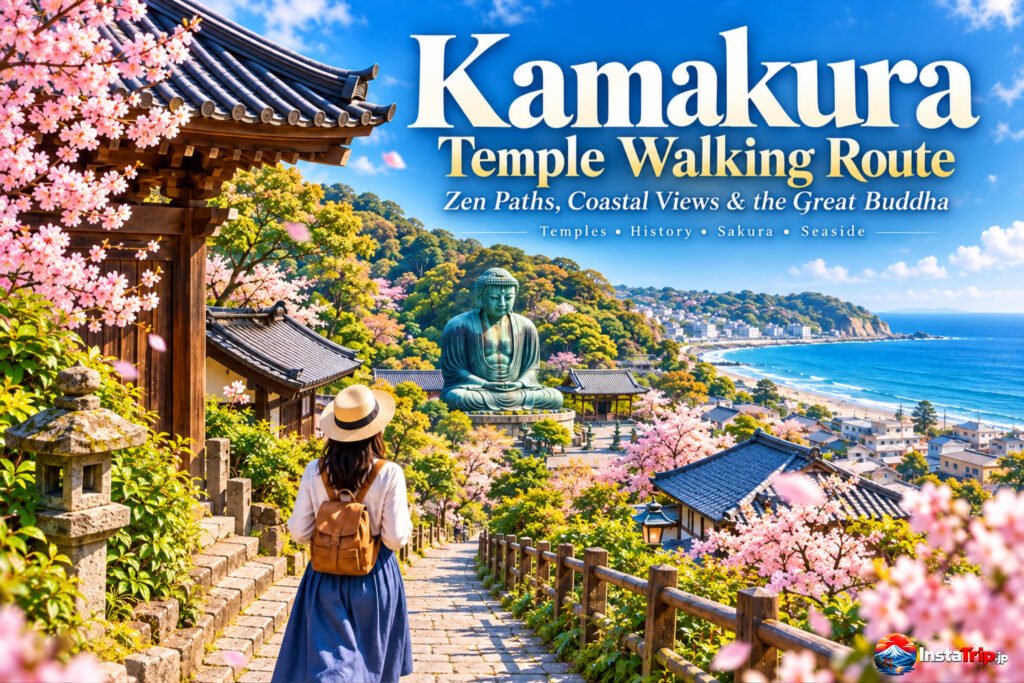
Kamakura (鎌倉) rewards travelers who move at walking pace. A Kamakura temple walking route is not simply a way to check off famous landmarks: it is a passage through former shogunal power, Zen discipline, seasonal gardens, and quiet residential lanes that still hold the atmosphere of an older Japan. Begin beneath the cedar-covered hills of Kita-Kamakura (北鎌倉) and finish near the sea in Hase, where the Great Buddha waits beneath an open sky.
This is a full-day route of roughly 5 to 6 miles, depending on detours and time spent in gardens. It is manageable for active travelers, but its real pleasure comes from slowing down. Allow time to pause at gates, read the temple grounds, and notice how each site changes the mood of the day.
A Kamakura temple walking route from hills to coast
Start at Kita-Kamakura Station, one stop north of Kamakura Station on the JR Yokosuka Line. This small station is an ideal threshold: rather than arriving directly in the busy center, you emerge close to wooded slopes and some of the city’s most important Zen temples.
The route follows this order: Engaku-ji (円覚寺), Meigetsu-in (明月院), Kencho-ji (建長寺), Tsurugaoka Hachimangu (鶴岡八幡宮), central Kamakura, Hase-dera (長谷寺), and Kotoku-in (高徳院). The final two stops can be reached entirely on foot, though taking the short Enoden ride from Kamakura Station to Hase is a smart option if your energy is fading or summer heat is intense.

Engaku-ji: a Zen beginning
Engaku-ji stands just beside Kita-Kamakura Station, making it a wonderfully calm first stop before the crowds gather elsewhere. Founded in 1282 by the regent Hojo Tokimune, the temple is closely tied to the period when Japan faced the Mongol invasions. It was established in part to honor those who died in the conflicts, giving its serene setting a deeper historical gravity.
Walk through the impressive Sanmon gate and let the scale of the precincts unfold gradually. Steps, mossy stone walls, tall cedars, and temple buildings create a composed rhythm rather than a single dramatic reveal. The temple bell, known as Ogane, is a nationally designated treasure and one of Kamakura’s most resonant symbols of Zen heritage.
Engaku-ji is especially rewarding in the morning. The light is softer, the pathways are quieter, and the stillness makes a compelling contrast with the lively streets you will reach later.
Meigetsu-in: Kamakura’s blue hydrangea temple
From Engaku-ji, walk about 15 to 20 minutes to Meigetsu-in. The route is a slight detour, but for many visitors it is worth it. Known as the Hydrangea Temple, Meigetsu-in becomes famously vibrant in June, when blue hydrangeas frame its stone approach in dense waves of color.

Outside hydrangea season, its appeal is more restrained. The temple’s circular window, often called the Window of Enlightenment, frames a garden like a living painting. Its changing view reflects the seasons with remarkable clarity: fresh green in spring, rich foliage in autumn, and a hushed simplicity in winter.
Because Meigetsu-in can become crowded during hydrangea season, visit early if June is your travel month. If you prefer a quieter experience, the rest of the year reveals a more contemplative side of the temple.
Kencho-ji: the scale of Kamakura Zen
Continue south for around 20 to 25 minutes to Kencho-ji, traditionally recognized as Kamakura’s oldest Zen training monastery. Founded in 1253, it was the leading temple of the Five Mountain system, an influential network of Zen institutions supported by the Kamakura shogunate.
Kencho-ji feels grander and more formal than Meigetsu-in. Pass through its vast gate, then follow the central axis through spacious courtyards and historic halls. The arrangement is not accidental: Zen temple architecture often guides the body through a sequence of thresholds, encouraging attention before any formal act of contemplation begins.
Do not rush past the garden behind the main buildings. Designed around a pond and shaped by the surrounding hills, it carries the quiet precision associated with Zen landscapes. Visitors with extra time can also consider the trails behind the temple, but these can be muddy after rain and require sturdy shoes. For a full day of temples, staying on the main route is usually the better choice.
From Zen temples to Kamakura’s sacred center
The walk from Kencho-ji to Tsurugaoka Hachimangu takes about 25 minutes and shifts the atmosphere noticeably. Narrower streets, homes, shops, and everyday life replace the enclosed calm of the temple grounds.
Tsurugaoka Hachimangu is a Shinto shrine, not a Buddhist temple, but it belongs naturally on this route. Relocated to its present site by Minamoto no Yoritomo, the first shogun of the Kamakura shogunate, it became the spiritual and ceremonial heart of his new military capital. Its broad approach, ponds, bright vermilion structures, and elevated main sanctuary express a more public, civic kind of sacred space.
This contrast matters. Kamakura is often described as a temple town, yet its religious landscape has long included both Buddhist and Shinto traditions. Visiting a Zen monastery and Hachimangu on the same day offers a more complete sense of the city’s cultural fabric.
From the shrine, wander down Wakamiya-oji or through Komachi-dori near Kamakura Station. Komachi-dori is lively and undeniably tourist-oriented, but it can be enjoyable for a quick snack or a small local sweet. Keep your lunch light if you plan to climb the stairs at Hase-dera later in the afternoon.
Hase-dera: compassion above the bay
From central Kamakura, walk 30 to 40 minutes west to Hase, or take the Enoden from Kamakura Station to Hase Station in about five minutes. The compact local railway is an experience in itself, threading through neighborhoods toward the coast.
Hase-dera rises on a hillside above the district and is dedicated to Kannon, the bodhisattva of compassion. Its principal image, an imposing wooden eleven-headed Kannon statue, is one of the temple’s great treasures. The interior is often dim and reverent, so allow your eyes a moment to adjust.
Outside, Hase-dera opens into gardens, ponds, small devotional spaces, and a viewpoint over Yuigahama Beach and Sagami Bay. The panorama is magnificent, particularly in late afternoon when the sea light begins to soften. Yet the smaller details can be just as affecting: rows of tiny Jizo figures, seasonal flowers, and the sound of wind moving through the trees.
Kotoku-in and the Great Buddha
A 10-minute walk from Hase-dera brings you to Kotoku-in, home of Kamakura Daibutsu, the Great Buddha. Cast in bronze in the 13th century, the statue has sat outdoors for centuries after the temple hall that once sheltered it was destroyed by storms. This exposure gives the Buddha its unforgettable presence: monumental, weathered, and open to rain, sun, and changing skies.
It is easy to arrive expecting only an iconic photograph. Stay longer. Notice the composed expression, the texture of the bronze, and the surrounding hills beyond the temple grounds. The Great Buddha is not just an emblem of Kamakura. It is a powerful reminder that Japanese sacred architecture and art have often endured through change rather than remaining untouched by it.
A Manageable Kamakura Temple Day
The complete route is ambitious if you want long visits at every stop. Treat the timings below as a suggested pace and cut a stop if queues, heat or stairs slow you down.
| Part of the day | Suggested focus | How to keep it comfortable |
|---|---|---|
| Morning | Kita-Kamakura (北鎌倉), Engaku-ji and either Meigetsu-in or Kencho-ji | Choose two extended temple visits rather than rushing three. |
| Midday | Tsurugaoka Hachimangu and central Kamakura | Allow time for lunch and a rest. |
| Afternoon | Enoden (江ノ電) to Hase (長谷), then Hase-dera and Kotoku-in | Use the train to save energy and watch last admission times. |
Check Closing Times Before Leaving the Center
Hase-dera’s official visitor guide and Kotoku-in’s official information should guide your afternoon. Kotoku-in lists 08:00–17:30 for April–September and 08:00–17:00 for October–March, with last admission 15 minutes before closing. Its general admission is ¥300; statue-interior access has separate hours and an extra fee. Recheck notices for your date.
A late sunset does not mean temple gates stay open until then. If you reach Hase late, choose your priority temple and leave the second for another visit. Stairs and uneven precincts also make this different from a flat city walk. For indoor halls, see our Japanese shoe-removal guide.
Watch: Kamakura Temple Walks
This Video Street View Japan film uses walking footage and binaural sound to show Kotoku-in, Hase-dera and Hokoku-ji (報国寺). It was filmed in 2020, so use the official links above for current fees and hours. Hokoku-ji is an additional eastern temple outside the main route in this article; the video’s sequence is not a timetable for this day.
Kamakura Temple Walking Route FAQ
Can I visit every stop in one day?
It is a full day with brief visits and good pacing. For a more relaxed first trip, choose two northern temples and use the Enoden for Hase.
Is Hachimangu a temple?
It is a Shinto shrine. Its worship customs differ from those of the Buddhist temples, so follow the guidance at each site.
Should I add a mountain hiking trail?
Only after checking access, weather and your remaining time. The main street route already offers a substantial day; a trail detour is not required.
Useful travel items (paid links): If needed, browse comfortable walking shoes or a compact daypack. Use suitable items you already own.
Practical details for a rewarding day
Wear shoes with reliable support. Most of the route is paved, but temple precincts include stone steps, uneven paths, and slopes. In summer, begin as early as possible, carry water, and consider the Enoden between central Kamakura and Hase. In autumn, weekends bring substantial crowds, while rainy days can make the gardens especially atmospheric but less comfortable for long walks.
Temple and shrine opening hours, admission fees, special exhibitions, and access conditions can change by season, so check current details before setting out. Carry some cash for admissions, small offerings, or temple stamps. If you request a goshuin, present the dedicated stamp book respectfully and be patient when staff are busy.
At worship spaces, follow posted guidance. Keep voices low, avoid blocking entrances for photographs, and remember that many sites remain active places of prayer and practice. At a Shinto shrine, the purification fountain and prayer customs differ from Buddhist temple etiquette, so observe what local visitors do or read the instructions nearby.
The finest moment on this route may come after Kotoku-in, when you walk back toward Hase Station with salt in the air and temple bells somewhere behind you. Kamakura makes history feel close enough to touch, not because it is preserved under glass, but because its sacred places continue to shape the pace and spirit of the city.
Kamakura Temple Map and Route Stops
Use this overview to locate the northern temples, central shrine and Hase area. The links follow the article’s suggested order; choose stops to suit your pace and use the Enoden for the Hase section.