

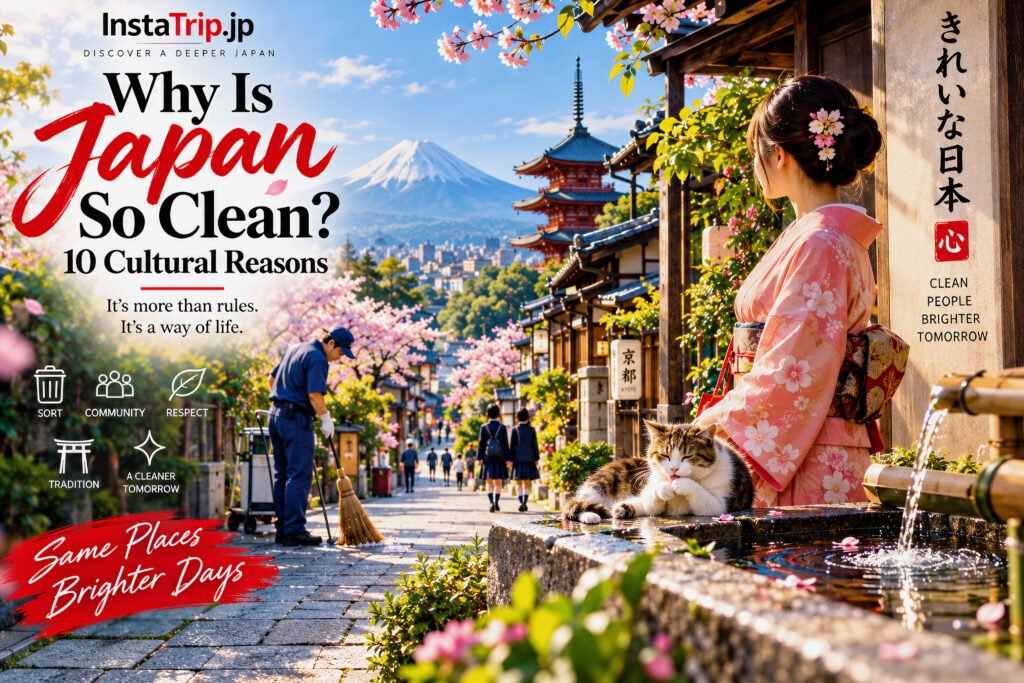
A first walk through Tokyo can make the question feel almost impossible to avoid. Around the lantern-lit approach to Sensō-ji, along the vivid storefronts of Ginza, or on a busy Shinkansen platform, public spaces often appear remarkably orderly even when there are few trash cans in sight. Why is Japan so clean? 10 cultural reasons that explain it begin with a simple idea: cleanliness is not only a service provided by someone else. It is a shared, learned form of consideration.
That does not mean every street in Japan is spotless or that every resident follows the same habits. Dense entertainment areas can be messy after a long night, and municipal cleaning crews work hard everywhere. Yet the everyday expectation to avoid burdening others gives Japan’s streets, stations, homes, schools, and sacred places their distinctive sense of care.
Why Japan’s Cleanliness Is a Cultural Practice
Japan’s reputation for cleanliness comes from overlapping customs rather than one national rule. School routines, religious traditions, neighborhood responsibility, careful waste sorting, and social awareness all reinforce one another. Visitors notice the visible result – calm, clean public environments – but the deeper story is about how daily actions shape shared space.

1. Cleaning Is Part of Education
In many Japanese elementary and middle schools, students participate in sōji, a regular cleaning period. Children may sweep classrooms, wipe desks, clean hallways, and help maintain common areas alongside teachers and staff.
The purpose is larger than saving labor. Sōji teaches that a classroom is not simply a place to use and leave behind. It belongs to everyone in it. This early routine can nurture practical habits while connecting responsibility to community life. Schools vary, and professional staff also play roles, but the cultural lesson is enduring: cleaning is ordinary participation, not a punishment reserved for someone else.
2. Shared Spaces Are Treated as Shared Responsibility
A train platform, park bench, apartment entrance, and neighborhood sidewalk may be public, but they are not thought of as nobody’s concern. The Japanese concept of meiwaku, causing inconvenience or trouble to others, helps explain why many people carry wrappers until they can dispose of them properly.
This is not a magical national instinct. It is a social norm, reinforced in countless small moments. Leaving a drink cup on a seat means another person must deal with it. Dropping litter changes the experience of the next passerby. The cleanest streets are often created by people who assume their choices remain connected to others.

3. Shrines and Temples Keep Purity in View
Japan’s spiritual traditions have also shaped its visual language of cleanliness. At Shinto shrines, visitors commonly rinse their hands and mouth at a temizuya purification fountain before approaching the main sanctuary. The gesture is ritual rather than a general hygiene instruction, but it expresses a meaningful relationship between preparation, respect, and sacred space.
Buddhist temples, from tranquil Kyoto compounds to the magnificent precincts of Nara, likewise emphasize mindful care for their surroundings. These practices should not be reduced to a single explanation for modern public cleanliness. Still, they have helped make tidiness, order, and attentiveness feel culturally resonant in places of worship and beyond.
4. Removing Shoes Changes How a Space Feels
At homes, traditional inns, some restaurants, and many temples, shoes come off at the entrance. The genkan, or entryway, creates a clear boundary between the outdoors and the interior. Slippers may be provided, and footwear is arranged neatly rather than kicked aside.
For travelers, this small transition is memorable. It makes a room feel protected and cared for, and it encourages awareness of what one brings in from outside. Not every building follows the custom, especially in modern commercial spaces, but the habit remains one of Japan’s most familiar daily rituals of respect.
5. Waste Sorting Makes Disposal Deliberate
Japan does not simply have a reputation for recycling. Many cities and towns require residents to separate waste into detailed categories, often including burnable trash, non-burnable trash, paper, cans, bottles, PET plastic, and bulky items. Collection calendars and bag rules can vary sharply by municipality.
This system can be demanding, especially for newcomers. It also reveals that cleanliness has an administrative side: residents must learn local procedures and make room for them in ordinary life. Sorting does not eliminate Japan’s environmental challenges, including packaging waste, but it makes throwing something away a more conscious act than tossing everything into a single bin.
6. Neighborhoods Organize Around Local Care
In residential areas, neighborhood associations and volunteer groups may coordinate seasonal cleanups, maintain small parks, or clear leaves from shared paths. Outside many homes and storefronts, it is common to see someone sweeping the area just beyond their own door.
These gestures are rarely dramatic, yet they give streets an inviting, lived-in polish. A quiet lane in Kamakura or a compact shopping street in Osaka can feel cared for because responsibility extends a little beyond private property. Participation differs by community, age, and schedule, but local upkeep remains a visible part of everyday life.
7. Hospitality Encourages Care Before Someone Arrives
The spirit of omotenashi is often described as wholehearted hospitality. In practice, it can appear in the polished counter of a small café, the carefully prepared room of a ryokan, or the immaculate presentation of a department store food hall.
Cleanliness here is part of welcome. Preparing a space for another person says, without words, that their comfort matters. Visitors can see this in the dynamic precision of Tokyo’s rail system and in the timeless calm of a countryside inn. It is not perfection, and service workers should not be romanticized or overburdened by unrealistic expectations, but the ideal of considerate preparation has real cultural influence.
8. Social Awareness Favors Small Acts of Restraint
Japanese social life often values reading the atmosphere, sometimes called kuuki o yomu. The phrase is not specifically about cleanliness, yet it helps illuminate the attention many people give to context: Is this behavior disruptive? Will it make a shared setting less pleasant?
That awareness can show up in quiet train cars, orderly queues, and the decision to take litter home when bins are unavailable. It can also create pressure, since no social norm is cost-free. But at its best, it supports a public culture where people notice how their actions affect the atmosphere around them.
9. Events Turn Cleanup Into Collective Pride
One striking example appears after major sports events, when Japanese supporters have been seen collecting trash from their seating areas. The practice attracts global attention because it reverses an assumption many people carry: that cleanup should begin only after the crowd has gone.
Festival communities offer another example. Matsuri can be exuberant, colorful, noisy, and wonderfully crowded, yet organizers and local participants often work carefully to restore streets once the celebration ends. The point is not that every event leaves no trace. It is that restoring the place is understood as part of hosting the event itself.
10. Cleanliness Is Linked to Aesthetics and Daily Ritual
From a precisely arranged bento to the raked gravel of a garden, Japanese aesthetics often celebrate care, balance, and intentional placement. This does not mean Japan is uniformly minimalist – walk through Akihabara or Dotonbori and you will find a magnificent explosion of color, signage, sound, and energy. Order can exist inside visual abundance.
The key is attention. A shopkeeper straightens a display, a commuter lines up at a platform marker, and a household maintains the entryway. These repeated rituals create an environment that feels composed rather than accidental.
What Visitors Can Learn From Japan’s Clean Streets
For travelers, the most respectful response is not to expect Japan to clean up after you. Carry a small bag for wrappers, sort waste when bins are available, follow signs at temples and shrines, and avoid eating while walking in places where it may inconvenience others. If you cannot find a public trash can, keep your waste until you return to your hotel or find an appropriate disposal point.
Japan’s clean streets are not a tourist attraction separate from daily life. They are the visible outcome of millions of modest decisions, shaped by education, etiquette, faith, community, and pride in place. Notice those decisions on your journey, then add one of your own: leave each captivating corner of Japan as welcoming as you found it.
![[商品価格に関しましては、リンクが作成された時点と現時点で情報が変更されている場合がございます。]](https://hbb.afl.rakuten.co.jp/hgb/574e2132.47e6b7eb.574e2133.4456a8ff/?me_id=1385906&item_id=10003915&pc=https%3A%2F%2Fthumbnail.image.rakuten.co.jp%2F%400_mall%2Ff261009-kyoto%2Fcabinet%2Fr_travel_cp%2F2412rtc003.jpg%3F_ex%3D128x128&s=128x128&t=picttext "[商品価格に関しましては、リンクが作成された時点と現時点で情報が変更されている場合がございます。]")