
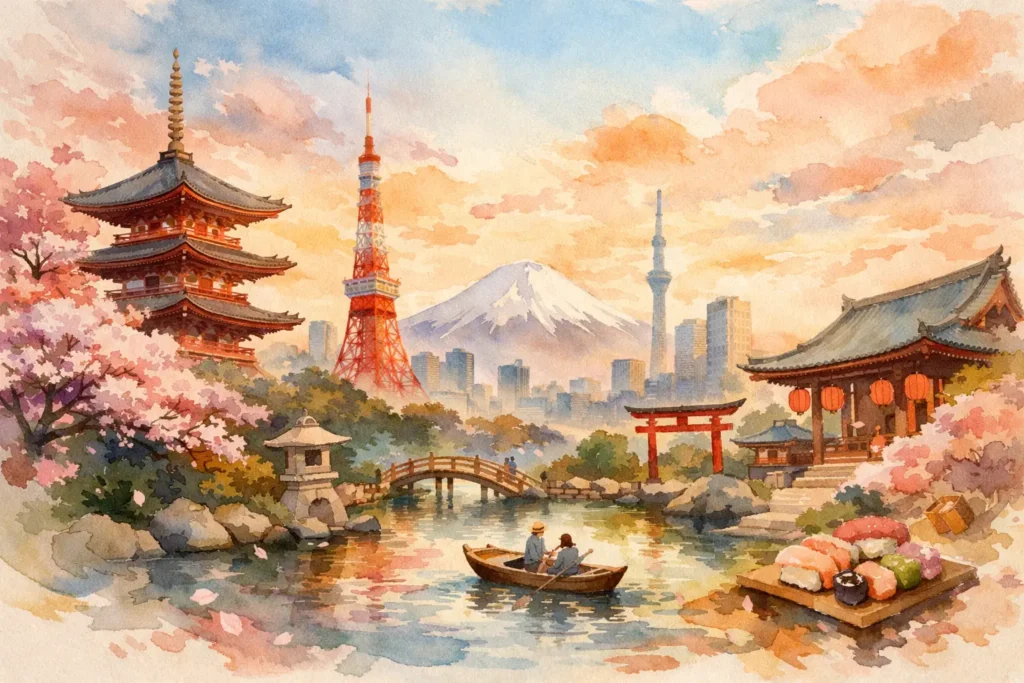
Tokyo announces itself in fragments: incense curling above Sensō-ji, a commuter train gliding past tiny neighborhood shrines, a giant screen flashing over Shibuya Crossing. The most memorable Tokyo attractions are not simply landmarks to check off. Together, they reveal how the city holds centuries of spiritual tradition, extraordinary creative energy, and daily life within the same fast-moving frame.
For a first visit, the challenge is not finding things to do. It is choosing experiences that show Tokyo from more than one angle. A temple district at dawn, a museum afternoon, a night view above the towers, and an unplanned stroll through a local shopping street can tell a far richer story than a rushed itinerary of famous names.
Tokyo Attractions That Show Its Many Lives
Sensō-ji and Asakusa: Tokyo’s Timeless Beginning
Sensō-ji is Tokyo’s oldest temple, and its approach remains one of the city’s most captivating ceremonial spaces. Pass beneath the immense red lantern of Kaminarimon Gate, then follow Nakamise-dori, where stalls sell traditional snacks, crafts, and small souvenirs, toward the temple’s vermilion main hall. The scene can be lively, but its spiritual purpose is unmistakable: visitors pause to offer prayers, draw fortunes, and breathe incense smoke toward themselves in a familiar gesture of hoped-for well-being.

Arrive early if you want to feel the quieter rhythm of Asakusa. Before the shopping street fills, the temple grounds offer a more reflective encounter with a place that has endured fires, war, reconstruction, and constant change. Afterward, wander the side streets instead of leaving immediately. You may find old-style eateries, craft shops, and the Sumida River, where Tokyo Skytree rises across the water in striking contrast.
Ueno Park: Art, Nature, and Public Life
Ueno Park is one of Tokyo’s great cultural crossroads. In spring, its cherry blossoms draw enormous crowds, but the park deserves time in every season for its museums, ponds, temple grounds, and broad pathways filled with families, students, and artists. It is a reminder that Tokyo’s cultural life is not confined to hushed galleries or formal historic districts.
The Tokyo National Museum is especially rewarding for travelers who want context for what they see elsewhere in Japan. Its collections bring together Japanese painting, ceramics, sculpture, textiles, armor, and archaeological objects, creating a vivid introduction to the artistry behind familiar forms. Give yourself room to focus rather than trying to see every gallery. One carefully chosen exhibition can deepen a visit to temples, gardens, and historic towns across the country.
Meiji Jingu: A Forest at the City’s Center
A short walk from the fashion-forward energy of Harajuku, Meiji Jingu feels almost improbably calm. The shrine is dedicated to Emperor Meiji and Empress Shoken, figures associated with Japan’s transformative Meiji era. Its approach leads through a vast forest planted and nurtured around the shrine, making the journey inward as meaningful as the destination itself.

Observe the atmosphere with care. This is an active Shinto shrine, not a theatrical backdrop. Visitors can admire the architecture, purification fountains, wooden prayer tablets, and seasonal rituals while keeping voices low and following posted guidance. The contrast with nearby Takeshita Street is part of the experience: Tokyo does not separate sacred quiet from contemporary style as neatly as visitors may expect.
Shinjuku: The Dynamic City After Dark
Shinjuku captures Tokyo at its most kinetic. The station area is a maze of rail lines, department stores, restaurants, office towers, and entertainment streets, where the pace can feel exhilarating or overwhelming depending on the hour. Rather than trying to conquer it all, choose a perspective.
For open views, the Tokyo Metropolitan Government Building offers a chance to look across the city’s astonishing scale. At street level, Shinjuku Gyoen provides the opposite feeling: a spacious garden shaped by Japanese, English landscape, and French formal design traditions. The garden is particularly beautiful during cherry blossom season, but its broad lawns and carefully composed landscapes offer relief from the surrounding density year-round.
At night, explore with intention. Omoide Yokocho’s narrow lanes and Golden Gai’s compact bars are famous for their intimate atmosphere, yet they are best appreciated with courtesy toward the small businesses and residents who keep these places alive. Shinjuku’s nightlife is not one single scene. It ranges from quiet ramen counters to jazz basements, high-rise cocktail lounges, and glowing late-night streets.
Akihabara: Pop Culture With a Living History
Akihabara is often introduced through anime, manga, gaming, and electronics, and those worlds are certainly central to its appeal. Look closer, though, and the district also reflects Tokyo’s postwar commercial history and its enduring fascination with technology. Specialty stores can be wonderfully specific, whether your interest is retro game consoles, cameras, model kits, records, or newly released character goods.
The best approach is curiosity, not speed. Browse a few floors of one store, notice the extraordinary care given to niche interests, then stop for coffee or a casual meal. Akihabara rewards travelers who understand that pop culture here is not a side attraction. It is a creative ecosystem with collectors, artists, fans, and makers at its center.
Ginza and Roppongi: Tokyo Through Design and Art
Ginza offers a polished view of Tokyo’s design culture. Its avenues combine landmark department stores, dramatic contemporary architecture, galleries, and refined cafés. Even if luxury shopping is not part of your plans, the district is worth visiting for the visual experience: carefully presented storefronts, seasonal displays, and an attention to detail that extends from packaging to pastries.
Roppongi brings a different kind of cultural intensity. The neighborhood’s major art institutions and evolving skyline make it an excellent choice for travelers drawn to contemporary art, architecture, and nighttime city views. Exhibition schedules change, so it pays to choose based on what is showing during your visit. Art lovers may prefer a longer afternoon here, while others can pair a gallery visit with dinner and a walk through the illuminated complex around Tokyo Midtown or Roppongi Hills.
Odaiba and Tokyo Skytree: Future-Facing Views
Across Tokyo Bay, Odaiba presents the city’s futuristic imagination in large-scale form. Wide promenades, waterfront views, striking buildings, and entertainment spaces create an atmosphere unlike the older, tighter streets of central Tokyo. It is especially appealing near sunset, when the bay reflects the city lights and Rainbow Bridge becomes part of the evening landscape.
Tokyo Skytree, meanwhile, rises beside the older character of Sumida. Its observation decks reveal the vastness of the metropolis, but the surrounding area matters too. Pair the tower with Asakusa or a walk along the river, and the view becomes more than a photograph. You can see how historic temple rooftops, dense residential neighborhoods, rail lines, and distant towers form one immense urban composition.
How to Experience Tokyo Attractions Without Rushing
Tokyo is efficient, but an itinerary can still become exhausting when every hour involves crossing the city. Group nearby places together: Sensō-ji and Tokyo Skytree make sense on the same day, as do Meiji Jingu, Harajuku, and Shibuya. Ueno can lead naturally into Yanaka, while Ginza and Roppongi are better treated as separate experiences unless you enjoy a long, art-focused day.
Build in time for the moments between attractions. A basement food hall, a neighborhood kissaten coffee shop, a train platform melody, or an evening stroll beneath lanterns may become the memory you carry home. Tokyo’s precision makes ambitious planning possible, but its atmosphere reveals itself most generously when there is space to notice it.
Start with the landmarks that genuinely excite you, then leave one part of each day unplanned. That is often where Tokyo shifts from a magnificent city on an itinerary into a place that feels unexpectedly personal.
![[商品価格に関しましては、リンクが作成された時点と現時点で情報が変更されている場合がございます。]](https://hbb.afl.rakuten.co.jp/hgb/574e2d21.68018f32.574e2d23.1f3ff379/?me_id=1386620&item_id=10000562&pc=https%3A%2F%2Fthumbnail.image.rakuten.co.jp%2F%400_mall%2Ff131130-shibuya%2Fcabinet%2F08827103%2Fs082008_re_s.jpg%3F_ex%3D128x128&s=128x128&t=picttext "[商品価格に関しましては、リンクが作成された時点と現時点で情報が変更されている場合がございます。]")