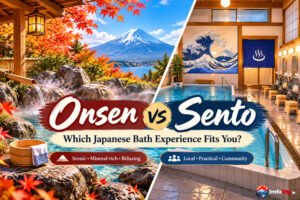

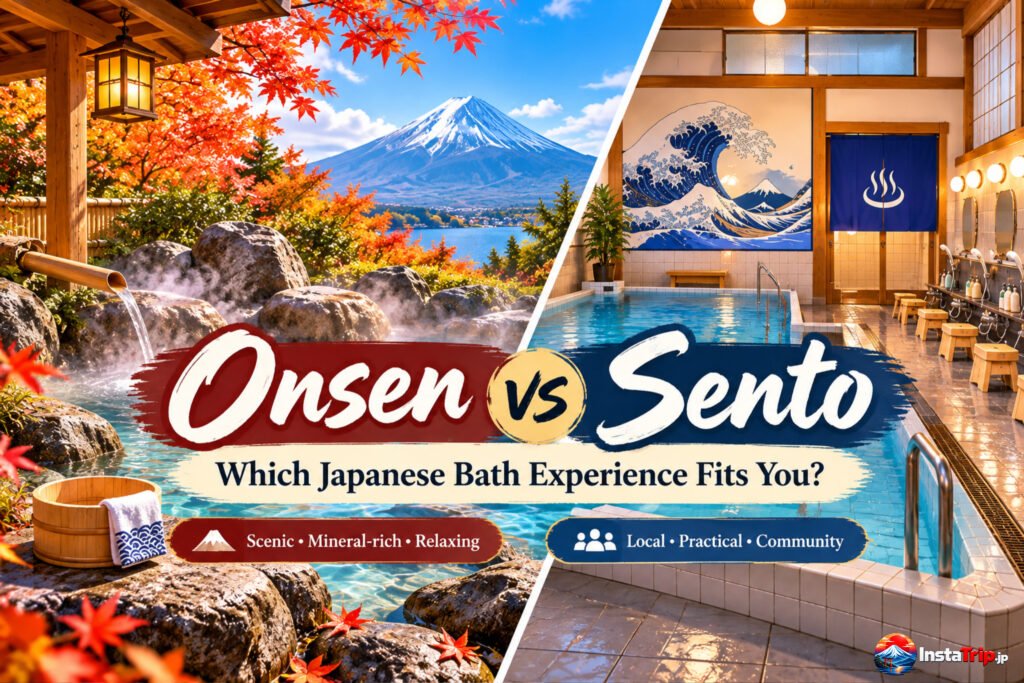
A cedar-scented bath beneath mountain air and a tiled neighborhood bathhouse lit by afternoon sun can both be deeply Japanese experiences. Yet onsen versus sento — onsen (温泉) and sentō (銭湯) is not simply a choice between a scenic escape and a city soak. One is defined by its water; the other by its role in daily community life. Understanding that distinction makes the first visit feel far less mysterious – and far more memorable.
Onsen Versus Sento: The Essential Difference
An onsen (温泉) uses naturally occurring underground spring water that meets Japan’s Hot Springs Act criteria. At its source, the water must be at least 25°C (77°F), or meet specified substance-content thresholds. A qualifying cooler spring may therefore be heated for bathing; the definition does not describe the temperature of the bath you enter. Its character may be sulfurous, iron-rich, silky alkaline, lightly salty, or almost clear and neutral. Bathing is often linked to the water itself: its warmth, fragrance, color, and the long tradition of seeking restoration in volcanic landscapes.
A sentō (銭湯) is a public bathhouse. Historically, sento gave urban residents a place to wash when homes lacked private bathrooms. Today, they remain affordable local institutions, especially in dense neighborhoods of Tokyo (東京), Osaka (大阪), Kyoto (京都), and other cities. A sento usually heats regular water, although some draw from natural hot springs. That is where the categories can overlap: an establishment can be both a sento and an onsen.
The simplest way to remember it is this: onsen describes the source of the water, while sento describes the kind of public bathing facility. The atmosphere, location, price, and purpose often differ, but neither is a lesser version of the other.

Onsen vs Sento at a Glance
| Question | Onsen (温泉) | Sentō (銭湯) |
|---|---|---|
| What defines it? | Qualifying natural spring water | A public bathhouse |
| Where can I find it? | Hot-spring towns, hotels and urban facilities | Neighborhoods and larger bathing complexes |
| Can the categories overlap? | Yes: a sentō may use onsen water. | |
| Is it always outdoors? | No; indoor baths are common too | No; some also have outdoor baths |
| What should I budget for? | Day admission or accommodation, plus any extras | Bath admission, plus optional sauna or rentals |
| Are tattoos accepted? | Ask the individual facility; neither label guarantees acceptance. | |
The legal distinction concerns the spring source, not a mountain view or a particular bath temperature. See the Ministry of the Environment’s onsen definition for the underlying criteria.
What an Onsen Feels Like
An onsen is often part of a larger journey. Reaching one may mean passing through Hakone (箱根)’s forested valleys, seeing steam rise near Beppu (別府)’s volcanic ground, or arriving at a ryokan in the mountains of Hokkaido (北海道). The bathing experience is shaped by place: open-air rotenburo (露天風呂) pools, stone edges, distant ridgelines, rainfall on leaves, and the unhurried rhythm of an overnight stay.
Many onsen are attached to ryokan (旅館), where guests change into yukata (浴衣), enjoy a seasonal multi-course dinner, and soak before bed and again at daybreak. Others are day-use facilities, making them possible as part of a wider itinerary. A hot spring visit can be a magnificent pause between temple walks, museum visits, or hikes, especially when Japan’s colder months make warm water feel almost ceremonial.
The mineral content is more than decoration. It can affect how the water feels on the skin and can leave a distinctive scent or tint on the bath. Still, visitors should treat health claims with care. Different springs have long been associated with particular benefits in Japanese bathing culture, but an onsen is best approached as relaxation, not medical treatment.
Not every onsen is remote or rustic. Tokyo and Yokohama have facilities using naturally sourced spring water, while resort towns such as Hakone combine dramatic scenery with easy access from the capital. The trade-off is simple: famous onsen destinations can offer an immersive, timeless setting, but may require more time, planning, and a larger budget than a local bathhouse.
What Makes a Sento Special
A sento is woven into ordinary life. You might find one on a quiet side street, behind a noren (暖簾) curtain and beneath a tall chimney. Inside, the entrance may be compact and practical, with shoe lockers, a reception desk, vending machines, and a small lounge where regulars linger after their bath.
The bathing room itself can be unexpectedly captivating. Some older sento feature high ceilings, painted murals of Mount Fuji, colorful tile mosaics, or windows that fill the room with soft daylight. Newer bathhouses may add outdoor tubs, cold plunges, electric baths, saunas, herbal baths, and reclining pools. These are not necessarily luxury spaces. Their appeal lies in craft, continuity, and a sense of neighborhood belonging.
For travelers, sento can be the more spontaneous choice. After a long day around Asakusa, Ueno, or Shinjuku, a local bathhouse offers a chance to slow down without leaving the city. Admission is generally much less expensive than a resort onsen or ryokan stay, though sauna access, towels, and toiletries may cost extra.
Sento also reveal a quieter side of Japan. The experience is not about checking off an attraction. It is about joining a familiar local rhythm: wash, soak, cool down, get dressed, perhaps drink milk or tea in the lobby, then return to the evening streets feeling renewed.
The Etiquette Is Shared, and It Matters
Whether you choose an onsen or a sento, the core rule is non-negotiable: wash thoroughly before entering the communal bath. The stools, hand showers, soap, and basins in the washing area are for cleaning your body first. The bath is for soaking afterward.
Most facilities separate bathing areas by gender, marked with signs or curtains. You enter nude, leaving clothes and large towels in the changing room. A small modesty towel may be carried into the bathing area, but it should not go into the water. Many guests place it on the side of the bath or fold it on top of their head.
Keep your hair out of the bath, speak softly, and avoid swimming, splashing, or taking photos. Rinse again after soaking only if you wish. With certain mineral-heavy waters, some guests prefer to leave the water on their skin, but follow any posted guidance and consider your own comfort.
Tattoo policies vary widely. Traditionally, tattoos could be associated with organized crime, and some facilities still prohibit them. Others welcome tattooed guests, accept small tattoos covered with patches, or offer private baths. Check a facility’s rules in advance rather than assuming. Private onsen baths, called kashikiri (貸切) or family baths, can be an excellent option for couples, families, or visitors who prefer more privacy.
A final practical point: hot water can be intense. Ease in gradually, hydrate, and step out if you feel lightheaded. Pregnant travelers and anyone with a health condition should seek appropriate medical guidance before prolonged soaking.
Planning Your First Onsen or Sento Visit
Check the Full Cost and What Is Provided
As checked on October 12, 2026, the Tokyo Sento Association lists regulated public-bath admission at ¥600 for ages 12 and older, ¥200 for ages 6–11 and ¥100 for under-sixes, effective August 1, 2026. This is a Tokyo public-bath rate, not a nationwide onsen or super-sentō price. See the official fee notice and the individual facility’s page for extras.
Ask whether a towel, soap and shampoo are included or available to buy or rent. Do not assume that a neighborhood sentō provides the same amenities as a hotel. Check its closing day, last admission, accepted payment methods and any separate sauna fee before setting out. The Tokyo Sento Association’s English guide is a useful starting point for local bathing culture.
A Simple Bathing Sequence
- Remove shoes at the designated entrance and pay or present your ticket.
- Follow the signs to the correct changing area; put clothes, your phone and valuables in a locker.
- Wash and rinse thoroughly at the showers before soaking.
- Keep your small towel and long hair out of the bathwater.
- Dry off before returning to the changing room.
For more background, consult JNTO’s Japanese bathing guide. Posted rules at the facility take priority over general travel advice.
Private Baths: Ask What You Are Booking
A reservable private bath and a bath inside your room are different arrangements. Ask about availability, time limits, extra charges, tattoo rules and whether the water is natural onsen water. A room with a bath does not automatically mean a room with an onsen. Our ryokan booking guide can help you compare accommodation options.
Watch: Japanese Sento Bathing Manners
This short Japanese animation, published by the official Tokyo Sento channel and linked from the association’s animation guide, illustrates manners before entering the bath. It uses animated characters rather than a travel presenter. Treat it as an introduction, then follow the instructions at your chosen bathhouse.
Watch the official sento animation on YouTube.
Onsen Versus Sento FAQ
Can a sento also be an onsen?
Yes. The words describe different things: the bathing facility and the water source. Check the facility’s water information rather than judging by its size or appearance.
Are swimsuits allowed?
Ordinary communal bathing is usually nude. Special swimsuit areas can have different rules; check the specific bath before entering.
Are tattoos always allowed at a sento?
No blanket rule applies to every facility. Confirm directly, including whether covering a tattoo is accepted. Private bathing also requires checking the operator’s policy.
Which is better for a short city trip?
A nearby sentō may fit an evening between other plans. Choose an onsen when its water, setting or accommodation is a main reason for the visit. Check travel time and facilities rather than assuming one type is always cheaper or easier.
Useful bathing items (paid links): If your chosen facility does not provide them, consider a small cotton washing towel and a toiletry pouch. Keep the towel out of the shared water and use suitable items you already own.
Choosing the Right Bath for Your Trip
Choose an onsen when the water and setting are central to the experience. It is ideal for a restorative overnight in a ryokan, a rural detour, a winter escape, or a day when you want Japan’s volcanic geography to become something you can feel rather than merely see. If you are traveling through Hakone, Kusatsu, Kinosaki, Beppu, or Noboribetsu, an onsen can become one of the defining memories of the journey.
Choose a sento when you want a genuine slice of urban daily life. It works beautifully after sightseeing, during a longer city stay, or when you are curious about Japanese bathing without committing to a resort experience. A sento may lack mountain vistas, but its tilework, steam, and gentle neighborhood hum offer a different kind of intimacy.
There is also no need to choose only one. A sento can introduce the customs in an accessible setting, while an onsen can turn those customs into a destination experience. Travelers who only seek dramatic outdoor pools may miss the quiet charm of the neighborhood bathhouse; those who only visit a sento may miss how profoundly landscape shapes Japan’s hot spring culture.
The best bath is the one that matches the moment: a mineral-rich soak after a mountain walk, a familiar local tub after a day in the city, or a private bath shared in peaceful silence. In Japan, bathing is not a detour from the journey. Sometimes, it is where the journey becomes most vividly felt.