
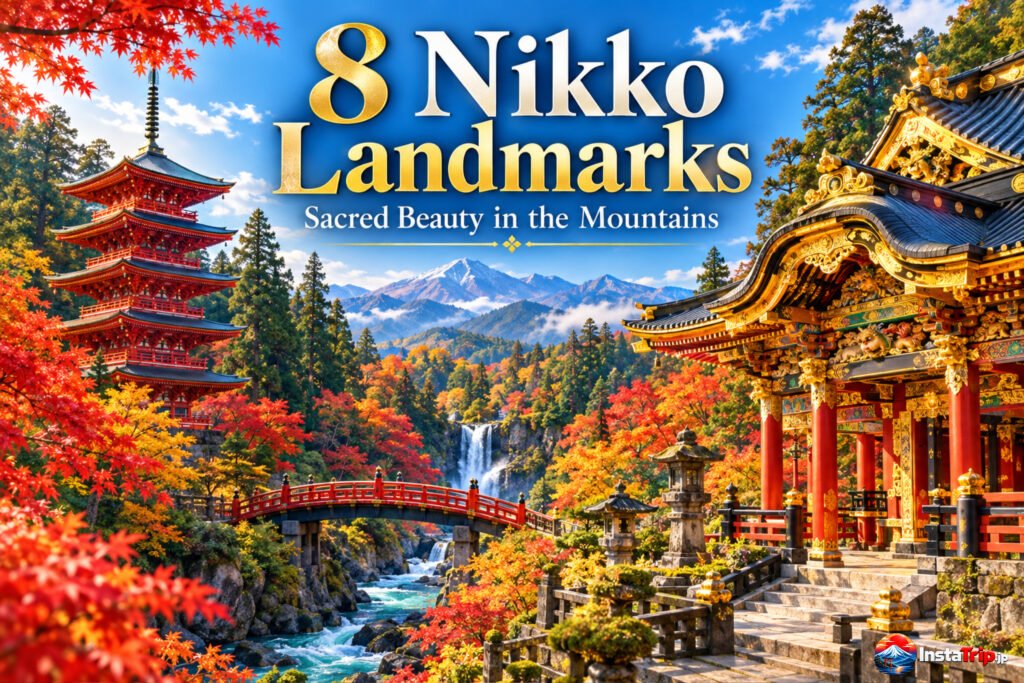
A vermilion bridge appears between cedar-covered slopes, temple bells drift through crisp mountain air, and intricate carvings flash with gold beneath the trees. Nikko (日光) landmarks are not simply beautiful stops on a day trip from Tokyo (東京). Together, they reveal a mountain landscape shaped by centuries of Buddhist practice, Shinto devotion, political power, and a deep reverence for nature.
The historic shrine and temple area is compact enough to explore on foot, but Nikko’s wider landmarks stretch toward Lake Chuzenji (中禅寺湖), waterfalls, wetlands, and volcanic highlands. Give the city more than a rushed afternoon if you can. Its most captivating experiences emerge when you slow down, look closely, and let the forest set the pace.
Nikko Landmarks in the Sacred Shrine District
1. Shinkyo Bridge (神橋)
Shinkyo Bridge is the visual threshold to Nikko’s sacred world. Its graceful red arch spans the Daiya River (大谷川) below the forested approach to the shrines and temples, creating one of Japan’s most recognizable scenes in every season. Autumn gives it a fiery frame of maple leaves, while winter can turn the surroundings into a quiet landscape of snow and dark cedar.
The bridge belongs to Futarasan Shrine (二荒山神社) and holds religious significance beyond its photogenic form. According to tradition, the priest Shodo Shonin (勝道上人) crossed this river with the aid of two serpents sent by a deity, represented in the bridge’s legendary origin. View it from the roadside for the classic composition, or check whether seasonal access allows visitors to walk across part of it. Either way, pause before continuing uphill. This is an entrance, not merely a backdrop.

2. Nikko Toshogu Shrine (日光東照宮)
Toshogu is Nikko’s magnificent centerpiece and the mausoleum of Tokugawa Ieyasu (徳川家康), founder of the Tokugawa shogunate. The shogunate governed Japan for more than 250 years, and the shrine’s lavish decoration makes clear how profoundly Ieyasu was honored after death. Against Nikko’s ancient woodland, the complex feels startlingly theatrical: gold leaf, lacquered surfaces, carved creatures, gates layered with color, and details that reward patient attention.
The Yomeimon Gate (陽明門) is the most celebrated example of this abundance. Hundreds of carvings cover its surface, portraying sages, animals, children, mythical figures, and ornamental patterns. It is often called the Sunset Gate because one could supposedly look at it until sunset without growing tired of its details.
Do not rush past the three wise monkeys (三猿, sanzaru) near the sacred stable. Their familiar hear-no-evil, speak-no-evil, see-no-evil poses are part of a larger sequence depicting the stages of human life. Nearby, the sleeping cat (眠り猫, nemurineko) carving traditionally attributed to Hidari Jingoro (左甚五郎) appears deceptively simple. It signals peace within the shrine grounds, yet guards a passage leading toward Ieyasu’s tomb. Toshogu’s artistry is never only decorative. It communicates ideas about harmony, protection, and authority.
3. The Mausoleum of Tokugawa Ieyasu
Beyond Toshogu’s crowded ornamental buildings, a long stairway rises beneath towering Japanese cedars toward Ieyasu’s mausoleum. The climb is modest but changes the atmosphere. Voices soften, elaborate color gives way to stone and green shadow, and the mountain’s presence becomes more immediate.

The circular bronze urn containing Ieyasu’s remains rests within a restrained enclosure. Its simplicity is deliberate. After the brilliant visual energy below, this final destination feels contemplative rather than triumphant. It is one of the best places to understand Nikko’s contrast: grandeur and stillness, political history and spiritual landscape, held in the same complex.
4. Rinnoji Temple (輪王寺) and Sanbutsudo Hall (三仏堂)
Rinnoji represents Nikko’s long Buddhist heritage. Its vast Sanbutsudo Hall enshrines three monumental gilded Buddhist figures associated with Nikko’s sacred mountains: Amida Buddha (阿弥陀如来), Senju Kannon (千手観音), and Bato Kannon (馬頭観音). Their scale and calm presence offer a striking counterpoint to Toshogu’s dense ornament.
Nikko’s religious sites reflect shinbutsu-shugo (神仏習合), the historical interweaving of Buddhist and Shinto traditions in Japan. Although government policy separated the two in the late 19th century, the spiritual relationship between mountain worship, shrines, and temples remains deeply legible here. Rinnoji helps visitors see Nikko as more than the story of one shogun. It is a religious landscape with roots reaching far earlier.
If time allows, visit the temple garden, Shoyoen (逍遥園), especially in autumn. Its pond, stone lanterns, and maples create a quieter rhythm after the major halls. Evening illuminations are sometimes held during the fall foliage season, but timing varies, so treat them as a possible bonus rather than the foundation of your itinerary.
5. Futarasan Shrine
Futarasan Shrine honors the deities connected with Nikko’s three sacred mountains: Mount Nantai (男体山), Mount Nyoho (女峰山), and Mount Taro (太郎山). Founded by Shodo Shonin in the eighth century, it is central to understanding why this region became a destination for pilgrimage and mountain ascetic practice.
Its grounds feel more understated than Toshogu, which is precisely part of their appeal. Stone lanterns, moss, wooden buildings, and old trees create an atmosphere of quiet continuity. Look for the sacred cedar and the numerous smaller structures across the precincts, but avoid treating the shrine as a checklist. This remains an active place of worship. Walk calmly, observe posted etiquette, and keep photography respectful where restrictions are indicated.
More Sacred Sites and Highland Landscapes
6. Taiyuin Mausoleum (大猷院)
Taiyuin is the mausoleum of Tokugawa Iemitsu (徳川家光), the third shogun and Ieyasu’s grandson. It is often overlooked by visitors focused on Toshogu, yet it offers some of Nikko’s most compelling architecture and a noticeably calmer experience. Iemitsu requested that his mausoleum not outshine that of his grandfather, so the complex is richly decorated but conceived with a more restrained, inward-looking character.
Its route through gates, stairways, and forest creates a sense of gradual arrival. Details such as dragons, peonies, and brilliantly colored carvings are everywhere, but the site rarely feels as overwhelming as Toshogu. For travelers drawn to architecture, craftsmanship, and photography without the largest crowds, Taiyuin may become the most memorable landmark in the central area.
7. Kegon Falls (華厳の滝) and Lake Chuzenji
A bus ride up the winding Irohazaka (いろは坂) road leads to a different face of Nikko. At Kegon Falls, water from Lake Chuzenji plunges nearly 320 feet over a volcanic cliff. The main viewing area gives a powerful full view of the waterfall, while an elevator-operated observation platform, when open, brings visitors closer to the spray and roar below.
Kegon Falls is spectacular in every season, though the experience changes dramatically. Summer brings lush green slopes, autumn draws major crowds for its vivid foliage, and winter reveals icy formations along the rock face. If your schedule is flexible, arrive early in the day during peak leaf season. The road and viewpoints can become very busy.
Nearby Lake Chuzenji sits at the base of Mount Nantai, the volcano regarded as sacred by Futarasan Shrine. Its broad, blue surface brings a welcome sense of space after the enclosed forest of the shrine district. Walk the lakeshore, take in the mountain views, or continue toward quieter corners of the Okunikko area. This is where Nikko’s sacred geography becomes tangible: the lake, waterfall, and mountain are not separate attractions but part of one powerful landscape.
8. Senjogahara Marshland (戦場ヶ原)
Senjogahara is a highland marshland north of Lake Chuzenji, crossed by a boardwalk and surrounded by mountain scenery. Its name means “battlefield plain,” linked to a legend of deities fighting for control of the region. Today, the mood is peaceful: open skies, grasses moving in the wind, distant peaks, and a remarkable sense of calm.
This landmark is ideal for travelers who want to experience Nikko beyond monumental architecture. The walking route is generally approachable, but conditions vary with weather and season. Wear suitable shoes, carry water, and allow more time than the map may suggest. Birdlife, changing light, and the wide seasonal palette invite an unhurried walk rather than a race to a viewpoint.
Plan Your Nikko Landmarks Route
The UNESCO-listed Shrines and Temples of Nikko, inscribed in 1999, belong to the historic religious area. Lake Chuzenji, Kegon Falls and Senjogahara are in the higher Okunikko (奥日光) area. They are not extra stops within the same temple walking circuit.
| Time available | Suggested focus | Planning priority |
|---|---|---|
| One day from Tokyo | Shinkyo, Toshogu and a choice of Rinnoji, Futarasan or Taiyuin | Allow time for travel, ticket queues, stairs and lunch; avoid rushing every paid site. |
| Two days | Historic shrines and temples first, then Lake Chuzenji and Kegon Falls | Check uphill bus services and return times; consider an overnight stay. |
| An additional nature day | Senjogahara and the Okunikko landscape | Choose a walking route for the weather, daylight and current trail conditions. |
Tickets, Rail Passes and Opening Times
Budget for each attraction rather than assuming one ticket covers the whole district. The official Nikko tourism guide currently lists Toshogu’s entry-only ticket at ¥1,600. Museum combinations are separate options. For online vouchers covered by that guide, exchange is at the Tobu-Nikko Station Tourist Center, not the shrine entrance; follow the instructions for the actual ticket you buy. Check current admission and last-entry times before departure.
Tobu’s NIKKO PASS all area is a transport product: shrine and temple admission is excluded, and limited-express travel requires a separate limited-express ticket. Compare its covered bus area with your itinerary before buying, especially if you want to reach Okunikko.
Season, Stairs and Respectful Visits
Autumn foliage can make the uphill road busy, so leave room for delayed buses. Higher Okunikko can feel colder than the shrine district; in winter, check snow, ice and access conditions before walking. The climb to Ieyasu’s mausoleum and Taiyuin’s stepped approach deserve realistic time and mobility planning.
These are active religious sites. Follow local photography notices, avoid blocking worshippers and keep voices low in sacred spaces. Our guide to praying at Japanese shrines explains basic etiquette. For an overnight visit, use our ryokan booking guide to check meals, bath access and arrival requirements.
Watch: A 4K Walk Through Nikko Toshogu
This walking film by Walking Tokyo | 東京散歩 explores Nikko Toshogu in 4K HDR, with natural sound and no narration or music. It offers a closer look at the setting and architectural details before your visit.
Watch the Nikko Toshogu walking film on YouTube.
Nikko Landmarks: Frequently Asked Questions
Can I see all eight landmarks on a day trip from Tokyo?
A focused shrine-and-temple day is more practical. The lake, waterfall and marshland add separate travel and walking time; spread the two areas over an overnight stay if you want to explore at a comfortable pace.
Is Ieyasu’s mausoleum separate from Toshogu?
It is within the Toshogu complex, reached by the stepped route behind the sleeping-cat carving. Listing it separately highlights its quieter atmosphere; it does not make it a different town or sightseeing district.
Does the NIKKO PASS include shrine and temple admission?
No. Tobu excludes those admission fees from the all-area pass, and limited-express supplements are separate. Check the exact product and transport coverage before booking.
Are Kegon Falls and Senjogahara near Toshogu?
They are in higher Okunikko, reached by road beyond the historic district. Plan the bus journey and return service rather than treating them as neighboring temple stops.
Useful Items for Exploring Nikko
Choose comfortable footwear and carry a layer for the higher areas. If needed, compare lightweight daypacks and compact rain jackets (paid links). Check fit, weather protection and what you already own before buying.
How to Experience Nikko With More Meaning
Nikko rewards a layered itinerary. On a first visit, begin with Shinkyo Bridge and the UNESCO-listed shrine and temple area, then choose either the mausoleums or Rinnoji for a deeper look. With a full second day, travel into Okunikko for Kegon Falls, Lake Chuzenji, and Senjogahara. Trying to fit every landmark into a single day is possible only in the most superficial sense.
Season matters. Autumn is dazzling but crowded, spring is fresh and cool, summer brings greener trails and welcome elevation, and winter offers a more hushed version of the city. Religious buildings may have areas where photography is limited, and mountain weather can change quickly, particularly around the lake and marsh. A little flexibility will make the trip feel far more generous.
The lasting power of Nikko lies in its ability to make artistry, faith, and landscape feel inseparable. Stand before a carved gate, then follow the sound of water into the mountains. The same sacred imagination runs through both, waiting for you to notice it.