
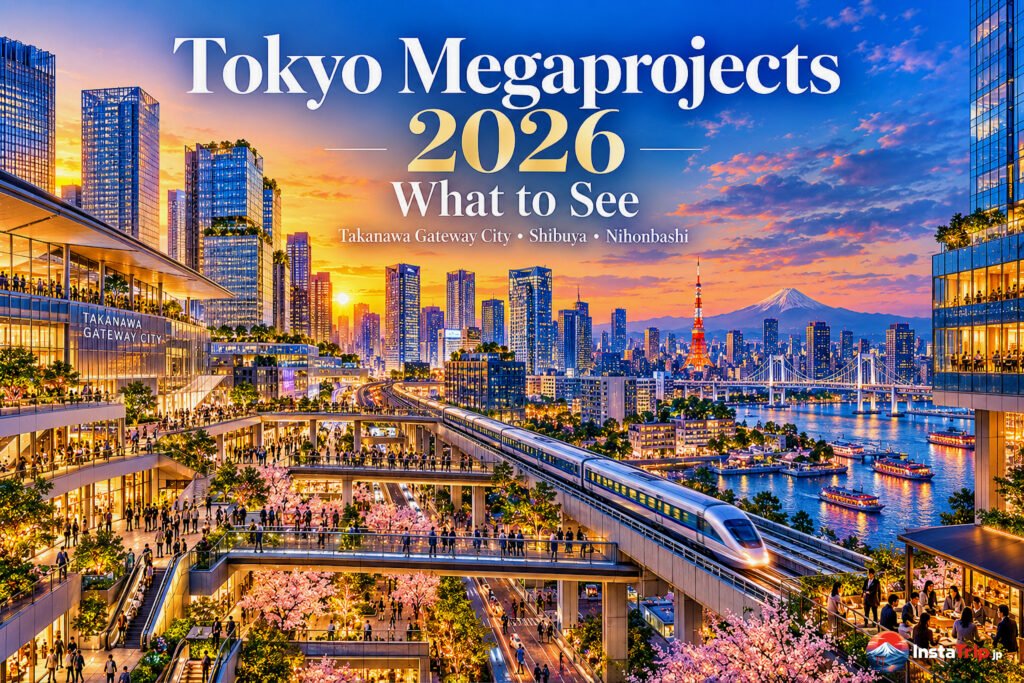
Tokyo megaprojects in 2026 are changing more than the city’s skyline. They are reshaping how visitors arrive, walk, shop, rest, encounter art, and understand Tokyo’s enduring talent for renewal. Between historic temple neighborhoods, neon crossroads, intimate alleyways, and calm gardens, a new generation of districts is taking form – ambitious, vertical, and distinctly connected to daily life.
For travelers, these vast developments are not simply places to photograph from afar. They offer a revealing way to experience contemporary Tokyo: a city that builds for movement, mixed-use living, public gathering, and the unexpected pleasure of finding a quiet terrace several stories above one of the world’s busiest stations.
Takanawa Gateway City: Tokyo’s New Arrival Point
The most compelling of the Tokyo megaprojects 2026 is Takanawa Gateway City, a major redevelopment beside Takanawa Gateway Station on the former rail yard between Shinagawa and Tamachi. Its setting matters. This is the southern gateway to central Tokyo and a strategic point for travelers continuing toward Yokohama, Kyoto, Osaka, or other destinations on the Tokaido Shinkansen.

The district’s futuristic architecture and station-centered layout make it feel like an introduction to the next chapter of the capital. Glass towers, offices, residences, hotels, retail, event spaces, and cultural venues are intended to create an entire neighborhood rather than a single landmark. The result is less about one dramatic observation deck than about watching a new urban rhythm emerge around the tracks.
In 2026, visitors should approach Takanawa with curiosity rather than a rigid checklist. Some facilities and cultural spaces may open in phases, and the atmosphere will continue to evolve as tenants, exhibitions, and public programming settle in. That sense of incompleteness is part of the appeal. Tokyo’s construction sites are often remarkably visible, offering a close look at the city’s patience, precision, and appetite for reinvention.
Give yourself time to explore the station area on foot, then continue toward Shinagawa. This broader zone is becoming increasingly important for international arrivals and business travelers, yet it still rewards those who slow down long enough to notice the contrast between polished new plazas and older local streets.
Shibuya’s Vertical Reinvention

Shibuya has long been a symbol of Tokyo’s youthful, high-energy character. Its famous crossing remains a captivating spectacle, but the district now extends far beyond street level. Recent towers, elevated walkways, rooftop spaces, hotels, offices, and cultural facilities have turned the area into a layered city where the experience changes dramatically depending on your floor.
Shibuya Sakura Stage, near the station’s southwest side, is part of this transformation. Its arrival has helped connect an area once defined by steep slopes, backstreets, and railway barriers with a more continuous pedestrian network. The development is polished and contemporary, but it is most rewarding when paired with the surrounding neighborhood: the small bars of Sakuragaokacho, the music culture of Dogenzaka, and the independent atmosphere that still survives in pockets away from the main crossing.
More projects around Shibuya Station remain underway into the later 2020s. Travelers should expect changing routes, construction barriers, and station exits that can feel different from one visit to the next. This can be inconvenient, especially when carrying luggage or navigating during rain. Yet it also reflects the scale of the undertaking: Shibuya is being redesigned not as a finished monument, but as a denser and more walkable urban center.
For the best experience, visit in the late afternoon. Watch the city brighten from an elevated public space, then return to ground level for dinner or a live music venue. Shibuya’s megaprojects make the district more dramatic, but its human energy still comes from the streets below.
Nihonbashi and Yaesu: A New Face for Old Tokyo Commerce
East of Tokyo Station, the redevelopment of Yaesu and Nihonbashi is creating another powerful contrast. Yaesu has traditionally been Tokyo Station’s practical side – a place of offices, department stores, buses, restaurants, and swift departures. New high-rise projects are giving it a more contemporary silhouette, with hotels, dining, workspaces, and improved pedestrian connections added to the dense fabric around the station.
The experience is especially meaningful because Tokyo Station itself carries the weight of history. Its red-brick Marunouchi facade, restored to its early 20th-century appearance, faces a business district of broad avenues and prestigious headquarters. Across the tracks, Yaesu points toward a different Tokyo: fast-moving, commercial, and increasingly vertical.
Nihonbashi, a short distance north, adds deeper historical texture. For centuries, this area was a vital starting point for Japan’s great roads, as well as a center of merchants, finance, and craftsmanship. Redevelopment here must negotiate a delicate balance. Modern towers and new public spaces can make the district easier to explore, but Nihonbashi’s character also rests in its smaller details – long-established shops, regional food traditions, historic bridges, and the traces of Edo-period commerce.
This is one of the best areas for travelers who enjoy architecture with context. Start around Tokyo Station, move through Yaesu’s new streetscape, then walk toward Nihonbashi rather than taking the train. The transition reveals how Tokyo’s grand projects are often stitched into neighborhoods that have been economically and culturally important for generations.
Tokyo Torch and the Changing Marunouchi Skyline
Near Tokyo Station, the Tokyo Torch district represents another major change to the city’s central business core. Its centerpiece, Torch Tower, is expected to become Japan’s tallest building when completed, with opening plans reaching beyond 2026. Even before the tower is finished, the area is worth watching as a statement of Tokyo’s confidence in the future of its historic center.
A project of this size naturally invites mixed feelings. Tower districts can offer remarkable views, galleries, restaurants, gardens, and weather-protected routes. They can also feel more curated than the older streets that draw many visitors to Tokyo in the first place. The strongest approach is to enjoy both. Pair the sleek new architecture around Otemachi and Marunouchi with an early walk through the Imperial Palace East Gardens, or continue to the quieter lanes near Kanda and Jimbocho.
Tokyo is at its most fascinating when monumental development and everyday life remain in conversation. A towering new landmark may change the horizon, but a small kissaten, a stationery shop, or a neighborhood shrine can still define the memory of an afternoon.
How to Experience Tokyo’s Megaprojects Well
These developments are easiest to enjoy when treated as neighborhoods, not attractions to rush through. Visit on weekdays if you want to see their working-city character, or on weekends for a more relaxed look at retail spaces and public terraces. Morning is ideal for photography around Tokyo Station and Takanawa, while dusk suits Shibuya’s illuminated canyons of glass and steel.
Wear comfortable shoes and leave room in your plans for detours. Major construction can alter familiar routes, particularly around large stations, and the most interesting discovery may be an overlooked passage, a seasonal art installation, or a new café overlooking the rail lines. Check opening hours for individual venues close to your visit, since phased developments can change quickly.
Most of all, do not let the scale of these projects pull you away from Tokyo’s older layers. Follow a morning in the future-facing architecture of Takanawa with an afternoon at Sensō-ji in Asakusa. Balance Shibuya’s new towers with the wooded paths of Meiji Jingu, or combine Tokyo Station’s evolving skyline with Nihonbashi’s historic merchant spirit.
The city is never finished, and that is precisely what makes it magnificent. In 2026, let Tokyo’s new districts inspire you to look upward – then keep walking until the next small, timeless detail brings the city back to street level.
![[商品価格に関しましては、リンクが作成された時点と現時点で情報が変更されている場合がございます。]](https://hbb.afl.rakuten.co.jp/hgb/574e2500.a2b8df34.574e2501.cd642176/?me_id=1430209&item_id=10000077&pc=https%3A%2F%2Fthumbnail.image.rakuten.co.jp%2F%400_mall%2Ff131091-shinagawa%2Fcabinet%2Fsi000%2Fsi000-013.jpg%3F_ex%3D128x128&s=128x128&t=picttext "[商品価格に関しましては、リンクが作成された時点と現時点で情報が変更されている場合がございます。]")