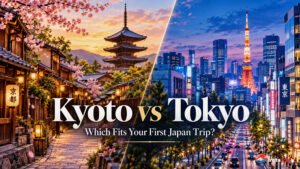

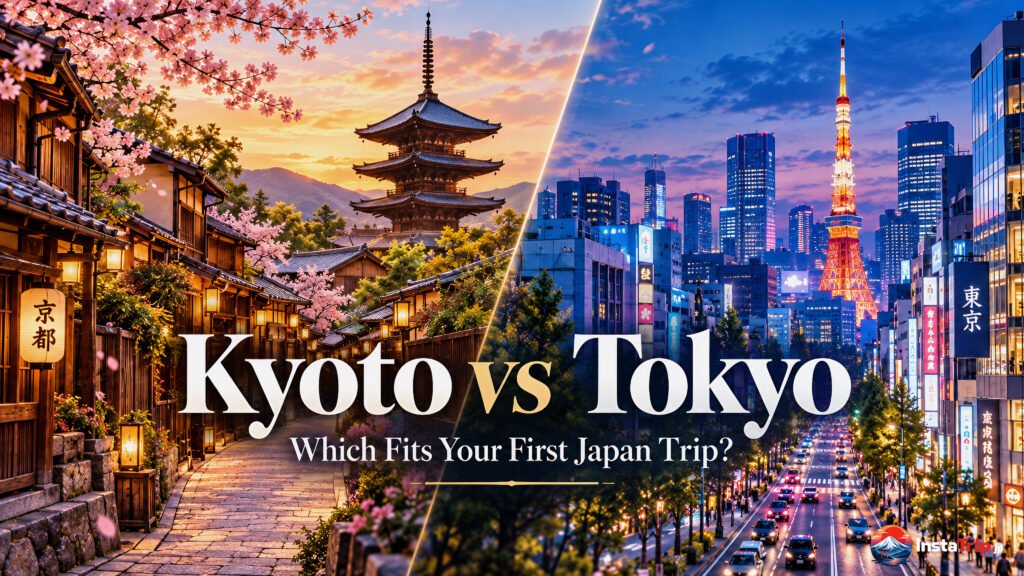
The choice between Kyoto versus Tokyo is not a contest between old Japan and new Japan. Both cities hold centuries of history, extraordinary food, inventive design, and daily rituals shaped by care and precision. The real question is what you want your first hours in Japan to feel like: the electric momentum of train platforms and neon-lit avenues, or the quiet anticipation of a stone path leading toward a temple gate.
Tokyo is vast, dynamic, and constantly changing from one neighborhood to the next. Kyoto feels more concentrated, shaped by mountains, rivers, wooden townhouses, and a remarkable concentration of temples and shrines. One can fill a week without repeating itself; the other rewards slowing down enough to notice a garden wall, a seasonal sweet, or the sound of water beneath a small bridge.
Kyoto versus Tokyo: two rhythms of Japan
Tokyo is a city of scale. Shinjuku rises in towers and train lines, Ginza glows with refined storefronts and architecture, and Akihabara hums with pop culture and electronics. Yet Tokyo’s fascination lies as much in its intimate corners as its famous landmarks. A neighborhood kissaten, a small sento, a shrine tucked between office buildings, or an evening stroll through Yanaka can feel wonderfully local within the world’s largest metropolitan area.

Kyoto offers a different kind of density: not primarily vertical, but cultural and historical. It was Japan’s imperial capital for more than a thousand years, and its streets still contain layers of courtly culture, Buddhist heritage, Shinto traditions, craft, tea culture, and seasonal customs. In Higashiyama, tiled roofs and preserved lanes lead toward Kiyomizu-dera. Near Arashiyama, bamboo groves, riverside scenery, and temple grounds invite a more spacious pace.
That contrast matters, but it should not become a cliché. Kyoto is not a frozen museum, and Tokyo is not merely futuristic. Kyoto has lively university districts, contemporary galleries, stylish cafes, and animated evenings around Kawaramachi. Tokyo has venerable temples such as Sensō-ji, traditional gardens, sumo culture, and neighborhoods where older shopping streets remain central to daily life. Each city is a living expression of Japan’s ability to hold continuity and change together.
Choose Tokyo for energy, variety, and urban discovery
Tokyo suits travelers who want every day to offer a completely different atmosphere. Spend the morning in Asakusa beneath the red lantern of Sensō-ji, then cross the city for contemporary art, fashion, or a view from Tokyo Skytree. Wander Ueno’s museums and parkland, taste ramen in a station-side counter restaurant, and end the night among the lights of Shibuya or Shinjuku. The variety can feel almost limitless.

It is also the stronger choice for travelers interested in contemporary Japanese culture. Tokyo brings together fashion, design, anime, gaming, music, architecture, nightlife, and food at a remarkable scale. Odaiba presents a futuristic waterfront vision, while Roppongi and Ginza reveal different sides of the city’s international art and design scene. Even a simple train ride becomes part of the experience, moving quickly between distinct worlds.
Tokyo is easier than its size suggests once you learn the rail network. Signs are widely available in English, stations are exceptionally connected, and major districts are linked by frequent trains. The trade-off is that the first day can be overwhelming. A station may have many exits, transfers can involve long walks, and trying to cover too much territory creates unnecessary fatigue.
The best Tokyo itinerary is rarely a checklist. Group your days by area and let each district unfold. Give Asakusa and Ueno time together; pair Shibuya with Harajuku or Daikanyama; explore Shinjuku at both daylight and after dark. Tokyo becomes more human when you leave room for detours.
Choose Kyoto for heritage, atmosphere, and unhurried moments
Kyoto is ideal for travelers drawn to architecture, gardens, spirituality, craft, and the visual language of the seasons. The city invites close looking. At a temple, the placement of a gate, the curve of a roof, the texture of moss, and the framed view from a hall may be as meaningful as the famous landmark itself.
Its spiritual sites deserve more than a hurried photograph. Visitors may encounter worshippers, monks, or local residents carrying out familiar routines. Speak softly, follow posted guidance, and treat temple and shrine grounds as active places of practice rather than sets for a vacation portrait. This approach makes the visit more respectful and usually more memorable.
Kyoto’s celebrated sights are magnificent, but they can be busy. Fushimi Inari Taisha, Kinkaku-ji, Kiyomizu-dera, and Arashiyama attract visitors from around the world, especially during cherry blossom and autumn foliage seasons. Go early, stay later than the main crowds, or balance these landmarks with quieter places such as a neighborhood temple, a canal walk, or a traditional shopping street.
The city rewards walking, particularly in Higashiyama, Gion, and the area around the Philosopher’s Path. Still, Kyoto is more spread out than many visitors expect. Its subway system is useful but limited compared with Tokyo’s, and popular buses can become crowded. Taxis can make sense for a few strategically timed journeys, while bicycles are enjoyable in suitable areas when you ride carefully and follow local rules.
Food tells a different story in each city
Tokyo offers exhilarating culinary range. You can seek out carefully made sushi, soba, tempura, yakitori, curry rice, regional specialties, elegant dessert shops, and late-night noodle counters. The city is particularly rewarding for travelers who enjoy comparing styles: a polished meal in Ginza, a lively izakaya in Shinjuku, and a humble neighborhood restaurant can all be excellent in completely different ways.
Kyoto’s food culture often feels more seasonal and quietly expressive. Kaiseki cuisine is the best-known example, presenting ingredients, ceramics, color, and composition with extraordinary attention. But Kyoto is not only for formal dining. Look for tofu dishes, yuba, matcha sweets, Kyoto-style pickles, noodles, and small wagashi shops whose offerings shift with the calendar. A cup of tea in a calm garden setting can become as vivid a memory as a major landmark.
Neither city needs to be expensive to eat well. In both, lunch sets, basement food halls, market stalls, and compact family-run restaurants can offer memorable meals. Reservations are wise for highly sought-after restaurants, but some of Japan’s most satisfying food arrives without ceremony at a counter seat.
How much time should you give each city?
If your trip is short, choosing one city is better than racing through both. Three full days in Tokyo can introduce its great districts, while three full days in Kyoto allow time for major heritage sites without turning every morning into a rush. With seven to ten days in Japan, combining them is often a rewarding answer to the Kyoto versus Tokyo question.
The high-speed train connects the two in roughly two hours and fifteen minutes, making the journey itself remarkably simple. Even so, resist treating Kyoto as a day trip from Tokyo. Kyoto’s atmosphere emerges early in the morning and after the day visitors have gone, when lantern-lit lanes, riverside walks, and quiet temple approaches feel most intimate.
For a first visit, Tokyo can be the thrilling arrival: a vivid introduction to the scale and contemporary pulse of Japan. Kyoto can be the pause that reveals another rhythm. Starting in Tokyo and ending in Kyoto often works beautifully, especially if you want your trip to move from high-energy discovery toward reflection.
Seasons can change the answer
Spring and fall make Kyoto especially captivating. Cherry blossoms soften canals and temple grounds, while autumn leaves bring luminous color to gardens and mountainsides. Those seasons also bring heavier crowds and higher demand for accommodations. Winter is colder but often calmer, with crisp light and a more contemplative mood. Summer can be hot and humid, though Kyoto’s Gion Matsuri in July offers a powerful encounter with one of Japan’s great traditional festivals.
Tokyo is compelling in every season because its indoor culture is so rich: museums, shopping arcades, restaurants, theaters, observation decks, and neighborhood cafes all provide refuge from rain or heat. Spring blossoms and autumn color are beautiful there too, but Tokyo’s appeal does not depend on a single scenic moment. It thrives on movement, contrast, and the pleasure of finding your own corner of the metropolis.
Whichever city you choose first, make space for a morning without a fixed destination. In Tokyo, follow the scent of coffee down a side street or linger at a neighborhood shrine. In Kyoto, take the long way beside a canal or through a quiet lane before the shops open. Japan often becomes most captivating just beyond the place everyone came to see.
|
![[商品価格に関しましては、リンクが作成された時点と現時点で情報が変更されている場合がございます。]](https://hbb.afl.rakuten.co.jp/hgb/574e3107.38c21b6e.574e3108.03167e3d/?me_id=1402903&item_id=10000191&pc=https%3A%2F%2Fthumbnail.image.rakuten.co.jp%2F%400_mall%2Ff131067-taito%2Fcabinet%2Fhenrei%2Ftravel%2F8000-003-t03.jpg%3F_ex%3D128x128&s=128x128&t=picttext "[商品価格に関しましては、リンクが作成された時点と現時点で情報が変更されている場合がございます。]")