
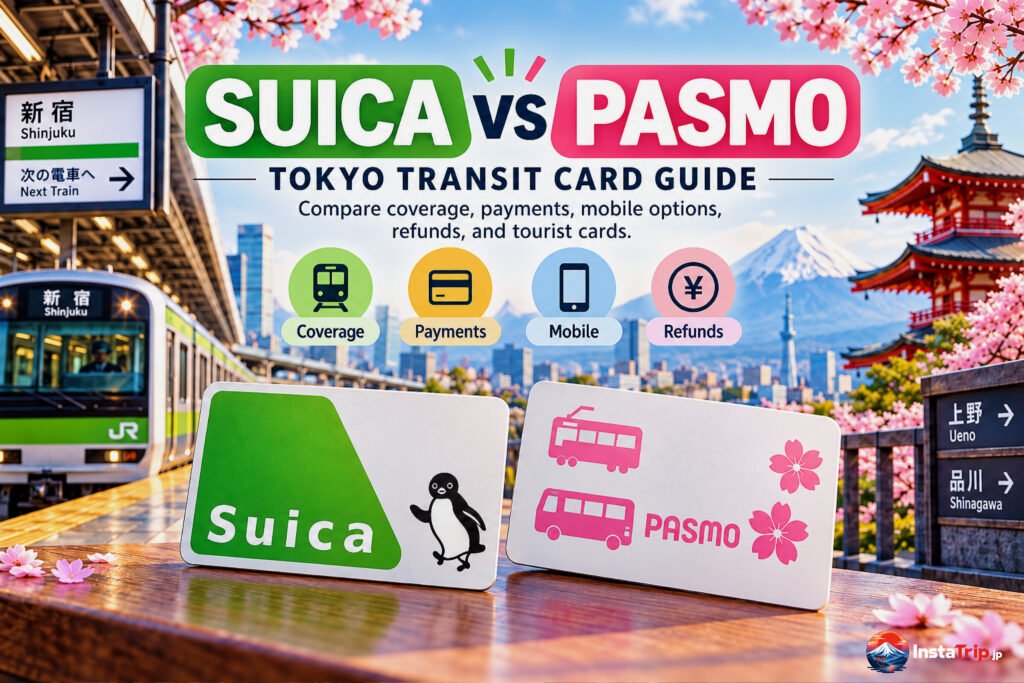
A Tokyo station at rush hour can feel like a captivating choreography of platforms, signs, vending machines, and arriving trains. One small tap turns that apparent complexity into motion. In the question of Suica versus Pasmo, the reassuring answer for most visitors is that both cards make exploring Japan remarkably easy. The more useful answer is that the best choice depends on where you buy it, how you plan to pay, and whether you want a physical card or your phone to become your travel companion.
These are not simply subway tickets. Suica and PASMO are rechargeable IC cards, designed for contactless fares but woven deeply into everyday urban life. They can carry you from the lantern-lit approach to Asakusa’s Sensō-ji to Shibuya’s bright crossings, then pay for a cold drink, a convenience-store breakfast, or a quick meal between discoveries.
Suica versus Pasmo: the essential difference
Suica is issued by JR East, the railway company behind much of eastern Japan’s JR network. Its green penguin mascot is instantly recognizable around Tokyo. PASMO is issued by a group of private railways, subways, and bus operators, and is especially associated with Tokyo’s extensive non-JR transport network.

That origin sounds like it should determine your choice. In daily use, it usually does not. Thanks to nationwide IC card interoperability, a Suica can be used on most PASMO-compatible trains, subways, and buses, while a PASMO works on JR East services and many other participating networks. Both are accepted far beyond Tokyo, including in cities such as Kyoto, Osaka, Fukuoka, Sapporo, and Hiroshima, where compatible local transport systems operate.
For a typical visitor, neither card offers a meaningful advantage in Tokyo fare coverage. A Suica will not trap you on JR lines, and a PASMO will not leave you unable to enter the Tokyo Metro or ride the Yamanote Line. The gate simply reads the card, deducts the correct fare, and lets the city unfold.
Their shared convenience also extends into daily purchases. Look for the IC symbol at convenience stores, many vending machines, station lockers, cafés, select restaurants, and some taxis. Acceptance varies by business, particularly outside major cities, so cash remains useful for smaller shops, temple admission donations, rural buses, and places where tradition still favors coins and bills.
What each card cannot do
The broad compatibility of Suica and PASMO is impressive, but it is not unlimited. An IC card is ideal for local and regional travel, not a universal rail pass.
Most importantly, you generally cannot tap through Shinkansen gates using an ordinary card balance alone. Some routes offer separate linked services or ticketless systems, but these require advance setup and are not the same as casually using Suica or PASMO for a local train. For long-distance journeys, buy the appropriate Shinkansen ticket or use a rail pass that suits your itinerary.
You should also check before assuming every bus, remote station, or local railway accepts the cards. Japan’s transport systems are wonderfully interconnected in metropolitan areas, yet smaller regions can have their own rules. If your itinerary moves from Tokyo’s dynamic neighborhoods into quieter corners of the countryside, keep enough cash and allow a little flexibility.
Physical card, tourist card, or mobile wallet?
This is where the Suica versus PASMO decision becomes more personal. The card you can obtain most easily may be the right card, especially because sales of physical IC cards have occasionally changed in response to supply conditions. Availability can differ by station, airport, card type, and date, so check current information at the point of purchase rather than building an itinerary around one specific card.
A standard physical card is a good choice for travelers who prefer something tangible, are traveling with children or family members, or do not want to depend on phone battery life. Standard cards typically require a refundable deposit, often 500 yen, alongside the amount you initially load. Keep the card in a separate pocket from other contactless cards to avoid a missed tap at the gate.
A visitor-oriented Suica option, commonly known as Welcome Suica, has been designed for short stays. It does not require a deposit, but it is generally valid for a limited period, commonly 28 days, and any remaining balance is not refundable after it expires. This can be convenient if you want to avoid the refund process, but it is less appealing if you load far more money than you can realistically spend.
PASMO formerly offered its own tourist-focused card, PASMO PASSPORT, but that product has been discontinued. Standard PASMO availability and any visitor alternatives can change, so treat current station guidance as the final word. Do not choose PASMO only because you read that a particular tourist version exists.
For iPhone users, Mobile Suica and Mobile PASMO in Apple Wallet can be exceptionally convenient. You can tap at gates with your phone or Apple Watch, monitor your balance, and add funds without finding a ticket machine. Overseas payment-card compatibility for reloading can vary, however, and bank authentication sometimes causes surprises. Set it up before a busy transfer, and carry another payment method if you are relying on it throughout the trip.
Android is less straightforward for international visitors. Mobile IC cards generally depend on FeliCa compatibility and, in many cases, Japanese-market devices or account setups. A physical card is often the simpler and more dependable choice unless you have already confirmed that your device supports the service.
Which card works best for different Japan trips?
If you arrive in Tokyo and find either standard Suica or PASMO available, choose the one in front of you. This is the most practical advice because their everyday value is almost identical. Do not spend an hour crossing the city in search of a particular logo when either card would have had you on your way to Ueno, Ginza, or Yokohama.
Choose Suica when you want the familiar JR East card, find a Welcome Suica that fits your travel dates, or prefer the Mobile Suica setup available to you. It can feel especially intuitive for an itinerary centered on JR lines, such as rides on the Yamanote Line between Shinjuku, Harajuku, Tokyo Station, and Akihabara. Still, that familiarity is a matter of association, not superior access.
Choose PASMO when it is easier to obtain, when you are already using its mobile version, or when you simply like its connection to Tokyo’s private railways and subway world. Travelers staying along lines run by Tokyu, Odakyu, Keio, Seibu, or Tobu may encounter PASMO branding often, but the card itself works just as happily across JR stations.
The only time network differences deserve more attention is when you buy a specialized sightseeing ticket or rail pass. Some are tied to a particular operator or route, such as lines toward Hakone, Kamakura, Enoshima, or Nikko. Those passes are separate products from your IC card. Think of Suica or PASMO as your flexible everyday wallet, while a regional pass can be a carefully chosen tool for a specific excursion.
Loading, fares, and the small rituals of travel
Add enough value for a day or two rather than loading a very large amount immediately. Tokyo’s rail fares are reasonable, but transfers, airport rides, and spontaneous detours add up. Ticket machines typically offer an English-language option, and convenience-store cashiers can often reload physical cards as well.
Tap in once at the entry gate and tap out at your destination. The system calculates the fare based on the journey. If your balance is too low at the exit, do not worry: fare adjustment machines and station staff can help you settle the difference. These brief, efficient interactions are part of the everyday rhythm of Japanese rail travel.
One useful habit is to glance at your balance after paying at a vending machine or convenience store. It prevents the slightly awkward moment of reaching an exit gate with just a few yen too little. Also remember that an IC card balance is held in yen. It is not a substitute for a credit card, and it should not be the only money you carry.
Refunds and the better way to finish your trip
For standard physical cards, refunds are normally handled by the issuing operator and may involve a processing fee deducted from the remaining balance, while the original deposit is returned under the applicable conditions. Procedures can be limited to certain service areas or stations. Suica refunds are generally handled through JR East, while PASMO refunds are handled through participating PASMO operators. If recovering a small remaining balance matters to you, plan ahead rather than waiting until you are already through airport security.
Many travelers find it easier to use down the last portion of their balance on snacks, drinks, or convenience-store supplies before departure. A final tap for a bottled tea or a neatly packed onigiri is a modest but fitting farewell to a country where even the smallest daily transactions are shaped by care and efficiency.
Choose the card that is available, keep it charged with enough yen for your next detour, and let it free you to follow Japan’s most rewarding impulse: stepping off at a station simply because the neighborhood beyond the gates looks fascinating.
![[商品価格に関しましては、リンクが作成された時点と現時点で情報が変更されている場合がございます。]](https://hbb.afl.rakuten.co.jp/hgb/574e4ebe.b55a6785.574e4ebf.4b040b74/?me_id=1422081&item_id=10000003&pc=https%3A%2F%2Fthumbnail.image.rakuten.co.jp%2F%400_mall%2Ff141003-yokohama%2Fcabinet%2Frtc%2Frtc010_s.jpg%3F_ex%3D128x128&s=128x128&t=picttext "[商品価格に関しましては、リンクが作成された時点と現時点で情報が変更されている場合がございます。]")