

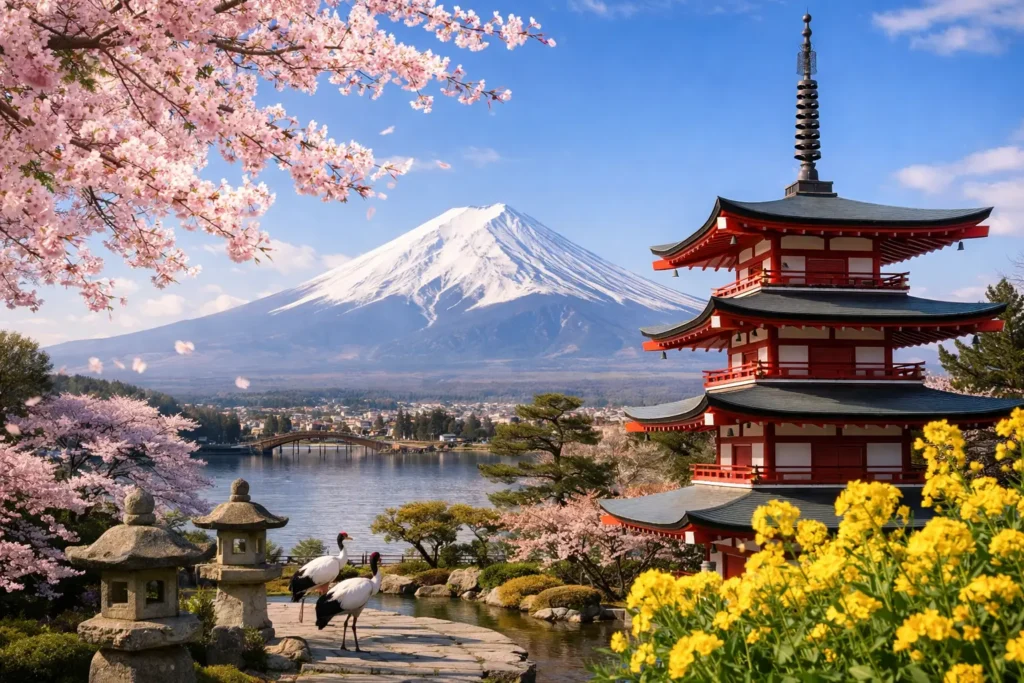
At the threshold of spring, Japan pauses for a holiday shaped by sunlight, memory, and the first delicate signs of renewal. Shunbun no Hi (春分の日), or Vernal Equinox Day, arrives when day and night are nearly equal in length, usually on March 20 or 21. For travelers, it can feel less like a spectacle and more like an invitation to notice Japan closely: plum blossoms lingering in temple gardens, early cherry buds on city branches, family bouquets at gravesites, and a season turning before your eyes.
This is a national holiday, but its atmosphere is quietly personal. Shunbun no Hi connects an astronomical moment to longstanding customs of honoring ancestors and appreciating the natural world. Understanding that connection adds depth to a spring journey through Japan, whether you are walking Kyoto’s temple lanes, exploring Tokyo’s gardens, or watching mountain landscapes slowly lose their winter color.
What Is Shunbun no Hi (春分の日)?
Shunbun no Hi is Japan’s official Vernal Equinox Day. Its date is not permanently fixed because it follows the actual astronomical equinox, calculated each year by the National Astronomical Observatory of Japan and announced in advance. Most years, it falls on March 20 or March 21.

Since 1948, the holiday’s official purpose has been to “praise nature and cherish living things.” That simple wording reveals why the day still resonates beyond a day off from work or school. Japan’s seasonal awareness is visible throughout the year, from autumn moon viewing to winter solstice customs, but the spring equinox carries a special emotional weight. It arrives at a moment when light begins to feel more abundant and the landscape is poised for its most famous transformation.
The holiday also has deeper historical roots. Before World War II, the day was associated with Shunki Kōrei-sai, an imperial rite honoring ancestral spirits. The postwar public holiday changed the official framework, yet the season’s connection with remembrance remained deeply embedded in family and Buddhist practices.
The Higan Season: A Time for Ancestors
Shunbun no Hi falls in the middle of haru no higan, the spring Higan period. Higan lasts seven days, centered on the equinox, with three days before and three days after. It has Buddhist associations and is observed again around the autumn equinox.
In Japanese Buddhist thought, the world of enlightenment is traditionally imagined beyond the western horizon, while the human world lies in the east. At the equinox, when the sun rises due east and sets due west, the two realms are symbolically aligned. For many people, this makes Higan an especially meaningful time to reflect on impermanence, gratitude, and those who came before.

Families may visit graves to clean headstones, offer flowers, light incense, and join their hands in prayer. This practice is known as ohakamairi. It is not an event staged for visitors, nor is every family’s observance the same. Some travel home for a formal visit, while others make a quiet stop at a local cemetery or Buddhist temple. The essential gesture is one of care and continuity.
For travelers, a temple or cemetery during Higan can offer a moving glimpse of everyday devotion, but it calls for respectful distance. Avoid photographing people praying or tending graves without clear permission. A calm walk through a temple precinct, however, can be a beautiful way to appreciate the season’s contemplative character.
Ohagi and the Taste of Early Spring
Seasonal food gives Higan another warm, familiar dimension. A classic treat is ohagi: a soft rice cake, often made with glutinous rice and coated in sweet red bean paste. It is commonly offered to ancestors and shared among family members.
You may also hear the autumn version called botamochi. The recipes are closely related, but the names evoke different seasonal flowers. Ohagi is associated with hagi, or bush clover, while botamochi refers to botan, the peony. The distinction is a small but fascinating example of Japan’s affection for seasonal language, where even a humble sweet can carry a sense of time and place.
Neighborhood wagashi shops and supermarkets may sell ohagi around the equinox. Buying one is an easy, delicious way to connect with the holiday, though it is best appreciated as a seasonal custom rather than a novelty.
A Spring Holiday, Not a Cherry Blossom Festival
Because Shunbun no Hi occurs around the start of the cherry blossom season in many parts of Japan, the two are often blended together in travel imagination. They are connected by timing, not by purpose. The holiday is about the equinox, nature, and remembrance; hanami is the social tradition of enjoying cherry blossoms.
Some years, Tokyo’s first blossoms have already opened by the holiday. In other years, the trees are still mostly bare, their buds only beginning to swell. Kyoto, Osaka, Kanazawa, and much of the Pacific side of central Japan may be approaching blossom season, while Hokkaido remains much colder and Okinawa has usually moved well beyond its earlier bloom. Weather determines the experience, so travelers should resist treating the equinox as a guaranteed peak-sakura date.
That uncertainty can be part of the magic. In Tokyo, early spring may reveal magnolia flowers in a garden, yellow nanohana blossoms along a riverbank, and the first pale pink sakura in a sheltered corner. In Kamakura or Nara, temple grounds can feel especially captivating at this in-between moment, when winter’s restraint gives way to color without the full crowds of peak bloom.
How Travelers Can Experience the Day Respectfully
There is no single Shunbun no Hi event that everyone attends. A meaningful experience often comes from choosing a place where Japan’s relationship with the seasons is already vivid. Visit a historic temple in the morning, wander a public garden in the afternoon, or seek out a traditional confectionery shop for ohagi. Let the day unfold at a gentler pace than a checklist-driven itinerary.
If you are in a major city, expect many offices and government services to close for the national holiday. Shops, restaurants, museums, and major attractions often remain open, but individual schedules vary, and popular places may be busier because residents are also enjoying time off. Reserve timed entries where available, confirm opening hours in advance, and allow extra room in your schedule for trains and station crowds.
The day can also be ideal for less obvious seasonal experiences. In Tokyo, stroll through Yanaka’s old neighborhood streets or find a quiet green space beyond the busiest sakura viewpoints. In Kyoto, the approach to a temple at opening time can be more rewarding than a midday rush. In smaller cities and rural areas, look for local flower gardens, riverside paths, and temple towns where the changing light is part of the experience.
Respect matters most in sacred and memorial settings. Keep voices low, follow posted photography rules, dress neatly when entering temple areas, and do not treat graveyards as scenic backdrops. These are living places of remembrance, particularly during Higan.
Why the Equinox Matters in Japan
Shunbun no Hi reveals a striking quality of Japanese seasonal culture: a vast celestial event is understood through intimate acts. The equal balance of day and night becomes a reason to sweep a family grave, share a sweet rice cake, arrange fresh flowers, or simply look carefully at the first growth of spring.
That perspective makes the holiday compelling for anyone trying to understand Japan beyond headline attractions. It is neither wholly religious nor merely recreational. It lives in the space between public calendar and private ritual, where older traditions continue to shape ordinary life in subtle, meaningful ways.
If your visit overlaps with Shunbun no Hi, leave time for an unhurried morning outdoors. Watch the light reach a temple roof, notice what has begun to bloom, and let Japan’s spring equinox offer something rarer than a perfect photo: a brief, thoughtful sense of renewal.
![[商品価格に関しましては、リンクが作成された時点と現時点で情報が変更されている場合がございます。]](https://hbb.afl.rakuten.co.jp/hgb/574e49fa.09960d7b.574e49fb.d1745de0/?me_id=1365302&item_id=10000959&pc=https%3A%2F%2Fthumbnail.image.rakuten.co.jp%2F%400_mall%2Ff192091-hokuto%2Fcabinet%2F08800830%2Fh1000-005-s-r-c.jpg%3F_ex%3D128x128&s=128x128&t=picttext "[商品価格に関しましては、リンクが作成された時点と現時点で情報が変更されている場合がございます。]")