

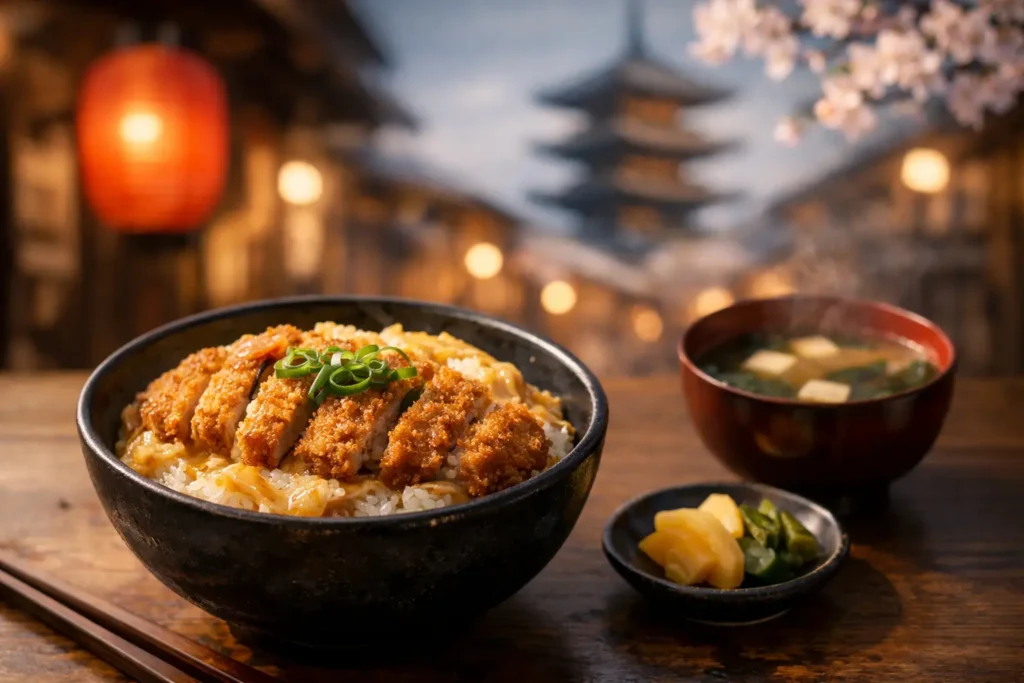
A katsudon (カツ丼) arrives with a kind of quiet drama: a lacquered bowl of rice hidden beneath a golden pork cutlet, soft-set egg, sweet onion, and fragrant broth. The cutlet may have begun crisp and crackling, but its edges now absorb the savory-sweet sauce, creating the contrast that makes this dish so memorable. It is filling, fast, humble, and deeply satisfying – the sort of meal that can turn a rainy afternoon in Tokyo or a long train journey through the countryside into a small, delicious occasion.
More than a bowl of pork over rice, katsudon reveals something essential about Japanese everyday food culture. It brings together Western-influenced cooking, the enduring importance of rice, and a talent for transforming simple ingredients into a balanced, emotionally resonant meal.
What Is Katsudon (カツ丼)?
Katsudon is one of Japan’s beloved donburi, or rice bowl, dishes. Its name is wonderfully direct: katsu refers to a breaded, deep-fried cutlet, usually pork, while don is short for donburi, a bowl of rice. In its most familiar form, a tonkatsu pork cutlet is sliced, gently simmered with onion in a seasoned dashi broth, then finished with beaten egg and served over steaming rice.

The flavor is not just salty or sweet. Dashi gives the broth a deep, savory foundation; soy sauce brings color and depth; mirin and sugar add a gentle sweetness; and onions soften into the mixture with a mellow brightness. The egg is usually cooked only until tender, rather than fully firm. It gathers the broth around the cutlet and rice, making each bite feel comforting without becoming heavy.
That final point matters. Katsudon is certainly substantial, but a well-made bowl has movement: crunchy crumbs at the cutlet’s center, yielding egg, tender onion, and rice that catches every drop of broth. The best versions feel composed rather than merely piled high.
From Western-Style Cutlet to Japanese Classic
Katsudon belongs to the captivating story of yōshoku, Japanese dishes shaped by Western culinary influences and reimagined through local ingredients and tastes. Tonkatsu itself developed from European-style cutlets in the late 19th and early 20th centuries, during a period when Japanese dining culture was actively adapting new techniques and ingredients.
Japan did not simply copy the idea of a fried cutlet. Cooks gave it panko breading, paired it with shredded cabbage and sauce, and made it at home in forms that suited Japanese meals. Adding the cutlet to a bowl of rice with dashi, egg, and onion was a natural next step. The result became something unmistakably Japanese: a dish where a modern, foreign-influenced element sits comfortably within the older rhythm of rice, broth, and shared everyday flavors.

This is why katsudon has such lasting appeal. It is neither formal cuisine nor a novelty. It belongs to neighborhood restaurants, station-area diners, university towns, family kitchens, and the menus of small shokudō, casual eateries where regulars come for generous, familiar food.
Why Katsudon Became a Symbol of Encouragement
In Japanese, katsu sounds like the verb for “to win.” That small linguistic connection has given katsudon a lively cultural role as a pre-exam or pre-competition meal. Students may eat it before important tests, athletes before a big event, and families before moments when a little encouragement feels welcome.
No bowl of rice can guarantee success, of course, and many people enjoy katsudon simply because they love it. Still, the association gives the dish an extra warmth. Ordering it can feel like a culinary gesture of resolve, a modest wish for good fortune delivered in crispy pork and silky egg.
Katsudon is also familiar to many viewers of Japanese film, television, and manga as a fictional symbol of police interrogation. The image of a detective offering a suspect a bowl and asking whether they miss home is part of pop-culture shorthand, not a standard real-life police practice. Yet it reflects the dish’s reputation as a comforting, everyday meal – recognizable enough to carry instant emotional meaning.
The Bowl’s Essential Elements
A memorable katsudon depends less on luxury ingredients than on timing. The pork cutlet should be properly fried before it meets the broth. If it is too thin or overcooked, it can become dry; if it sits too long in the liquid, the breading loses all character. Some cooks prefer a more brothy, tender finish, while others preserve a little crunch. Neither approach is automatically better. It depends on whether you want the cutlet to be the star or the bowl to feel fully unified.
The rice should be freshly cooked and pleasantly sticky, but not wet. It acts as the quiet foundation, taking on broth while retaining enough structure to support the toppings. Rice that is too soft can make the dish feel dense, while rice that is too dry cannot absorb the sauce’s flavor.
Then there is the egg. In many of the most satisfying bowls, it is barely set, with soft curds and a glossy surface. This may be unfamiliar to travelers accustomed to firmer eggs, but it is central to the dish’s texture. If you prefer it well done, it is perfectly reasonable to ask, though the result will be less delicate.
Regional and Restaurant Variations Worth Seeking Out
The classic egg-and-onion style is widespread, but katsudon changes character across Japan. These regional versions are not just curiosities. They show how one foundational idea can absorb local preferences and still remain unmistakably katsudon.
In Fukui Prefecture, sauce katsudon is a celebrated specialty. Thin pork cutlets are dipped in a tangy Worcestershire-style sauce and laid over rice, typically without egg. The effect is sharper and more direct, with the crisp cutlet and sauce taking center stage.
In Okayama, demikatsu-don features a cutlet covered in a rich demi-glace sauce. Its darker, Western-style profile offers another expression of Japan’s yōshoku tradition. Elsewhere, you may encounter miso katsudon, chicken katsudon, or bowls that use a thicker sauce rather than dashi. Nagoya, famous for its bold red miso food culture, is an especially rewarding place to seek out miso-centered cutlet dishes.
Even within one city, the experience can vary. A long-running tonkatsu specialist may use premium pork and a carefully prepared dashi, while a compact train-station restaurant may serve a quicker, more rustic bowl that hits the spot between connections. The former may be more refined; the latter can be just as evocative of daily life in Japan.
How to Order and Enjoy Katsudon in Japan
Katsudon is easy to order, but a few details can make the experience more rewarding. On a menu, look for カツ丼, かつ丼, or sometimes とんかつ丼. The last version makes the pork element especially explicit. A katsudon set meal may come with miso soup, pickles, and perhaps shredded cabbage, creating a fuller lunch or dinner.
If you do not eat pork, check carefully before ordering. Katsu can refer to other cutlets, but katsudon most often means pork. Chicken versions may be listed as chicken katsudon or oyako-katsu-style bowls, depending on the restaurant. Vegetarian versions are less common, though some modern cafes and plant-based restaurants create their own interpretations.
There is no complicated etiquette. Eat it while it is hot, and do not worry about making every bite perfectly symmetrical. Some diners begin with the cutlet, while others mix a little egg and broth into the rice first. A spoon may be offered, but chopsticks are common. If pickles arrive alongside the bowl, their tartness is especially welcome between richer bites.
For travelers, katsudon is also a useful entry point into the generous, unpretentious side of Japanese dining. It is widely available, usually approachable in price, and easy to enjoy without a deep knowledge of regional cuisine. At the same time, it rewards attention. Notice the broth, the rice, the cutlet’s texture, and the way a local restaurant makes the bowl its own.
When you find a katsudon that feels just right, let the meal linger for a moment before returning to the city outside. In a single bowl, you can taste Japan’s talent for turning comfort into culture – warm rice, careful craft, and an everyday dish with a remarkably enduring story.
![[商品価格に関しましては、リンクが作成された時点と現時点で情報が変更されている場合がございます。]](https://hbb.afl.rakuten.co.jp/hgb/574e78cf.9e073e07.574e78d0.ea3bcc5f/?me_id=1427214&item_id=10000004&pc=https%3A%2F%2Fthumbnail.image.rakuten.co.jp%2F%400_mall%2Ftotteokiya%2Fcabinet%2F11907759%2Fkatu10.jpg%3F_ex%3D128x128&s=128x128&t=picttext "[商品価格に関しましては、リンクが作成された時点と現時点で情報が変更されている場合がございます。]")