
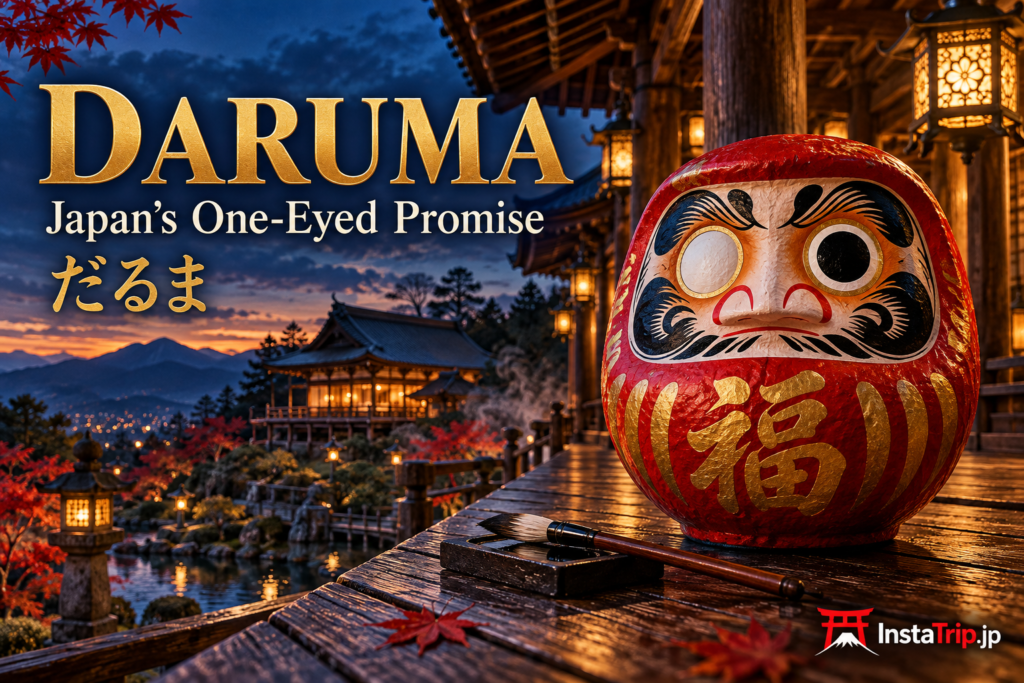
One eye looks back at you. The other is still white.
On a shelf, a daruma (だるま・達磨) can look like a small unfinished object. But that empty circle gives it an unusual presence: it holds space for something that has not happened yet. An examination. A new business. A project you keep postponing. A beginning you are not ready to abandon.
Japan’s round red doll is often called a good-luck charm. Its more compelling story lies in the relationship between a wish and the effort that follows. What happens when the second eye stays blank for years?
Quick answer: Daruma are Japanese figures associated with Bodhidharma, good fortune and perseverance. A familiar practice is to paint one pupil while setting an intention, then complete the other in gratitude. Eye order and timing vary: follow the temple or maker associated with your doll.

The monk behind the red silhouette
The figure’s name refers to Bodhidharma, or Daruma Daishi (達磨大師), associated with the beginnings of the Zen tradition. Gunma’s official tourism guide connects the doll’s limbless appearance with the legend of prolonged meditation. Stories about losing limbs through meditation belong to religious legend, not a literal medical or historical account.
The same guide relates the rounded form to self-righting figures: pushed over, they rise again. This makes perseverance visible. The familiar expression 七転び八起き (nanakorobi yaoki) conveys the idea of falling repeatedly and getting back up.
There is something quietly demanding about choosing that symbol. A daruma cannot make the phone call, learn the vocabulary or finish the work. It can, however, occupy the place where your intention might otherwise disappear beneath daily distractions. That is an interpretation of its appeal, not a promise of results.

The animals hidden in a daruma’s face
Look closely at a Takasaki daruma before painting it. What first appears to be an exaggerated face also carries auspicious imagery.
The Gunma Daruma Manufacturers’ Cooperative describes cranes in the eyebrows and turtles in the nose-and-moustache design. These details make the face worth studying slowly; the brushwork is part of the object’s identity.
The cooperative also connects the local craft with the dry, windy climate and the region’s farming history. A doll that accompanies someone’s hopes is itself the result of material, weather and skilled work.
Do different colours have fixed meanings?
Red is the familiar choice for general good fortune. Gunma’s guide also describes other colour associations while warning that meanings vary. Avoid treating an online colour chart as a rule shared by every temple and workshop. Ask the maker what a particular design means.
Which eye do you paint first? A detail many guides miss
“Always start with the left eye” is not a universal instruction. Here are two temple-specific practices, with left and right defined clearly:
| Temple tradition | First pupil | Completion |
|---|---|---|
| Shōrinzan Daruma-ji, Takasaki | The doll’s left eye: on your right when facing it | The other eye in gratitude when the wish is fulfilled or a year has passed safely |
| Katsuo-ji’s kachi-daruma, Osaka | The doll’s right eye: on your left when facing it | The doll’s left eye when the goal is achieved |
Shōrinzan’s own instructions describe making the wish calmly and adding the first pupil. Its 開眼 (kaigen) ceremony can begin with a monk’s initial mark, which the recipient later enlarges.
Katsuo-ji’s official instructions begin with a different eye and explicitly connect the act with a commitment to personal effort. The cooperative, meanwhile, says there is no single correct order. The useful lesson is to keep the instructions that come with your own daruma.
What if your daruma has been waiting for years?
Perhaps the goal changed. Perhaps you made progress nobody else can see. Perhaps you bought the doll during a hopeful afternoon and then life became complicated.
An unfinished pupil is not evidence that you have been cursed. Nor do the practices above establish a universal deadline after which misfortune begins. Shōrinzan’s guidance includes gratitude for passing a year safely, rather than only the successful completion of a wish.
For a daruma received through a temple, ask that institution how to conclude or renew the practice. For your own reflection, separate two questions: “What did I hope would happen?” and “What can I reasonably do now?” The second may lead to a different goal.
Our reading of the daruma’s appeal is that starting again need not erase the first attempt. A smaller, clearer intention can still deserve a place on the shelf.
Returning a daruma: gratitude rather than a countdown
Shōrinzan provides だるま供養 (daruma kuyō), a memorial observance that includes ritual burning. Its official return guidance directs visitors to hand items to reception between the main hall and Daruma Hall, and asks them to take bags and boxes home.
If you want to send a daruma, contact the temple first. Its page asks people to inquire about postal arrangements; this is not automatic approval for an international parcel. Check current reception details and accepted items before travelling.
Do not burn the doll yourself or leave it in an unattended collection box without checking. A meaningful conclusion can begin with a simple question to the institution that issued it.
Visit Shōrinzan Daruma-ji: where the promise becomes a place
少林山達磨寺 (Shōrinzan Daruma-ji) stands in Takasaki, Gunma. Its account of the local craft describes helping farmers through daruma-making during hardship. That makes the doll’s association with persistence feel particularly fitting.
For a first visit, allow time to look beyond the rows of red faces. Compare expressions, notice brush marks and read the information provided by the temple. This is a Buddhist place of worship; our guide to temples versus shrines explains why the distinction matters.
Getting there from Tokyo
Gunma’s official access guide routes visitors through Takasaki Station, served by the Jōetsu and Hokuriku Shinkansen. From there, it describes a bus to Shōrinzan Iriguchi and a short walk. Check current train and bus schedules when planning; the temple is not immediately outside Takasaki Station.
Temple address: 296 Hanadakamachi, Takasaki, Gunma. Take the temple’s Japanese name with you to avoid confusing it with another Daruma-ji.
Paint your own daruma
The temple offers a daruma-painting experience. Check current reservations, sizes and fees directly. Its instructions distinguish arrival at the parking area from arrival at the workshop, and note stairs on the approach from the coach parking area. If steps are a concern, ask about access in advance.
A workshop gives the souvenir a second story: not only where you found it, but what you noticed while making its face.
Maps: plan your Takasaki visit
Shōrinzan Daruma-ji Temple
Takasaki Station
Watch: how a daruma is made
JST Science Channel’s THE MAKING (250) follows daruma production, including forming, painting and finishing. This 2008 craft film provides a closer look at the work behind the object; it is not current visitor information.
Watch the craft film on YouTube.
Choose a daruma or explore its cultural background
Browse these related Amazon.com selections (paid links):
- Japanese daruma dolls — check origin, size, material and whether the pupils are blank.
- Books about Japanese folk art — explore the craft traditions behind familiar souvenirs.
- Books about Bodhidharma and Zen — compare authors, translations and reading levels.
Retail dolls are not automatically temple-blessed or handmade in Takasaki. For an object connected specifically with Shōrinzan, consult the temple’s own distribution information.
A small face, a personal question
Our omamori guide explores wishes carried close. Our kitsune stories follow the uncertain boundary between appearances and identity. A daruma brings the journey back to something more immediate: the intention you choose to live with.
Before painting the first eye, pause. Not to find the grandest possible wish, but to choose one you can recognise as your own.
The blank eye leaves the story open. What happens between the first brushstroke and the second is where your part begins.
Research note: Sources include the temple’s own guidance, the daruma manufacturers’ cooperative, official Gunma tourism information and JST Science Channel. Customs differ by institution. Reflective passages are editorial interpretations, not promises of supernatural results. Any AI-created cover is an editorial illustration.