

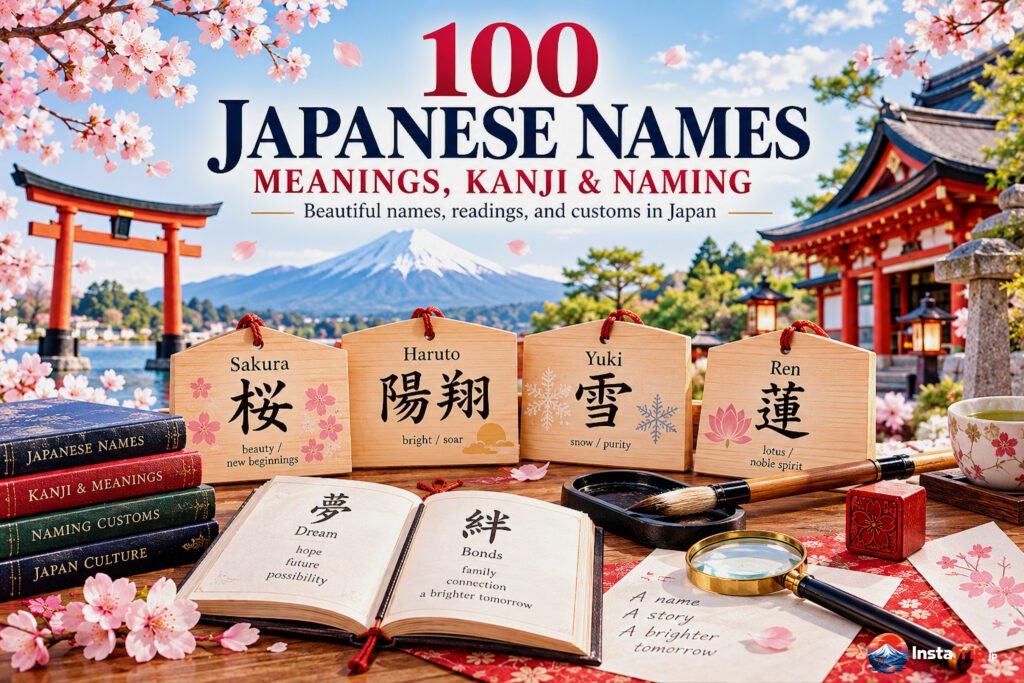
A name can carry the quiet beauty of a cherry blossom, the brightness of morning light, or the enduring strength of a great tree. This guide to Japanese names and their meanings: 100 beautiful names, kanji & how naming works in Japan offers a captivating starting point for travelers, culture lovers, and anyone drawn to Japan’s expressive language.
The most fascinating detail is that a Japanese name is not fixed by sound alone. The same spoken name may be written with entirely different kanji, creating a different shade of meaning each time. A name heard in Tokyo, Kyoto, or a small coastal town may sound familiar, yet its written form can reveal a family’s particular hope, aesthetic, or personal story.
How Japanese names work in Japan
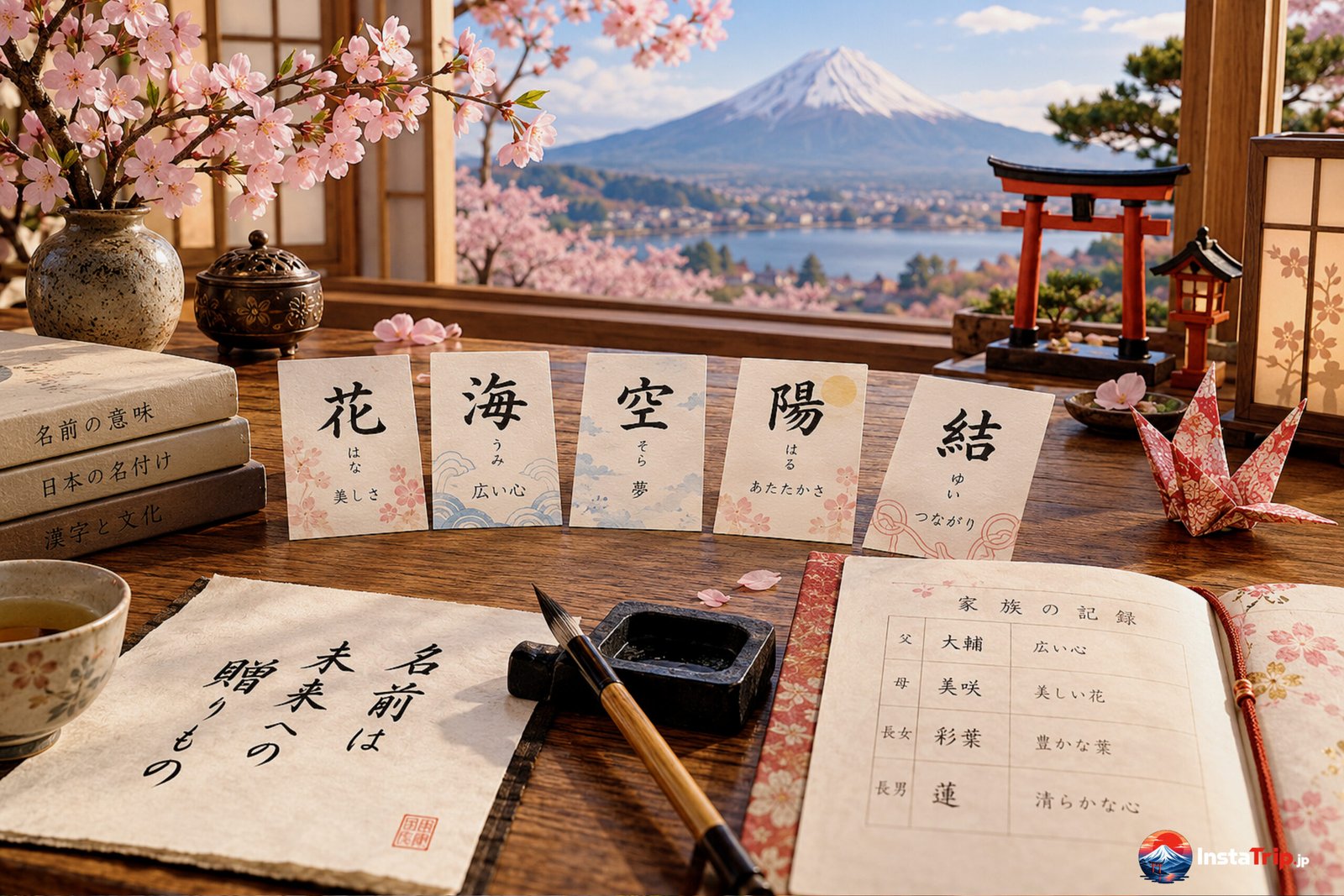
Japanese names are usually written with the family name first, followed by the given name. For example, in the name Tanaka Haru, Tanaka is the family name and Haru is the given name. In English-language settings, Japanese people may reverse that order for convenience, but the family-name-first format remains the traditional Japanese convention.
Most family names are written in kanji and often connect to the landscape: Tanaka means middle of the rice field, Yamamoto means base of the mountain, and Kobayashi means small forest. These names offer a beautiful reminder of how deeply fields, rivers, mountains, and seasons have shaped daily life and imagination in Japan.
Kanji give names their visual and emotional texture
Kanji are characters with meanings, and parents can select different kanji for the same pronunciation. Haruka, for instance, may be written as 遥, meaning distant or far-reaching, while Hikari can be 光, meaning light. Some names are written in hiragana, the soft phonetic script often associated with a gentle visual feeling, or in katakana, which has a sharper, more contemporary appearance.
Pronunciation can be wonderfully complex. A single kanji may have several possible readings, and names sometimes use readings that are less predictable than everyday vocabulary. That is why the kanji and the spoken name should be understood together. Romanized spellings also vary: Yūki may appear as Yuki or Yuuki, while Sōta may be written as Sota or Souta.
Naming is personal, but not random
Parents often choose a name for its sound, its kanji, its seasonal atmosphere, or a quality they hope will accompany their child, such as kindness, sincerity, brightness, or resilience. There are legal rules around the characters that can be registered for names, but within those boundaries there is significant creative range.
Meanings below refer to the specific kanji shown, not to every person with that name. Gender associations are also flexible. Some names are more commonly used for girls or boys, while others move naturally between both, especially as naming fashions change.
100 beautiful Japanese names and their meanings
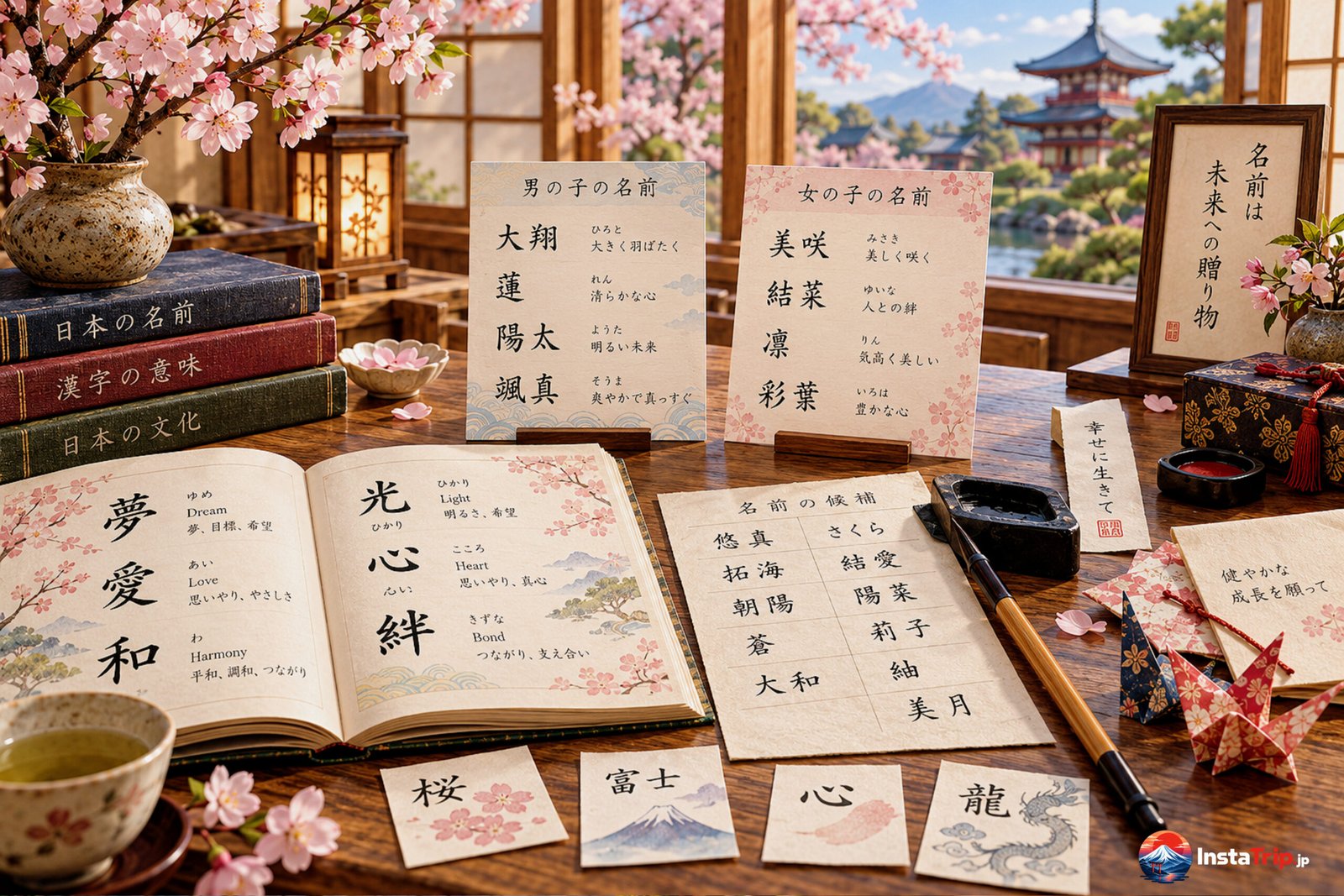
These names are a window into the poetic vocabulary of Japan: moonlight over a temple garden, maple leaves in Nikko, sea breezes around Enoshima, and spring color in a neighborhood park. They are not a list of rules for choosing a Japanese name, but an invitation to notice how much imagery can live within a few characters.
Names often associated with girls
| Name | Kanji | Meaning of the kanji shown |
|---|---|---|
| Aiko | 愛子 | Beloved child |
| Airi | 愛莉 | Love and jasmine |
| Akari | 明里 | Bright village |
| Asuka | 明日香 | Tomorrow and fragrance |
| Aya | 彩 | Color, brilliance |
| Ayaka | 彩花 | Colorful flower |
| Chihiro | 千尋 | A thousand fathoms |
| Emi | 恵美 | Blessing and beauty |
| Hana | 花 | Flower |
| Haruka | 遥 | Distant, far-reaching |
| Hikari | 光 | Light |
| Himari | 陽葵 | Sunlight and hollyhock |
| Hina | 陽菜 | Sunlight and greens |
| Honoka | 穂花 | Grain ear and flower |
| Ichika | 一花 | One flower |
| Kaede | 楓 | Maple |
| Kana | 奏 | To play music |
| Koharu | 小春 | Little spring |
| Kokoro | 心 | Heart |
| Mai | 舞 | Dance |
| Manami | 愛美 | Love and beauty |
| Miku | 美久 | Beauty and lasting |
| Mio | 美桜 | Beauty and cherry blossom |
| Misaki | 美咲 | Beautiful bloom |
| Nanami | 七海 | Seven seas |
| Riko | 莉子 | Jasmine and child |
| Rin | 凛 | Dignified, poised |
| Sakura | 桜 | Cherry blossom |
| Shiori | 栞 | Bookmark, guide |
| Sumire | 菫 | Violet |
| Tsukiko | 月子 | Moon child |
| Wakana | 和奏 | Harmony and music |
| Yui | 結衣 | Binding and garment |
| Yuna | 優奈 | Gentleness; 奈 is used here as a name character |
Names often associated with boys
| Name | Kanji | Meaning of the kanji shown |
|---|---|---|
| Akira | 明 | Bright, clear |
| Arata | 新 | New, fresh |
| Daiki | 大輝 | Great radiance |
| Eita | 瑛太 | Jewel-like brilliance and greatness |
| Haruki | 陽輝 | Sunlight and radiance |
| Haruto | 陽翔 | Sunlight and soaring flight |
| Hayato | 隼人 | Falcon and person |
| Hiroto | 大翔 | Great soaring flight |
| Itsuki | 樹 | Tree |
| Kaito | 海斗 | Sea and the Big Dipper |
| Kazuki | 和希 | Harmony and hope |
| Kenji | 健二 | Healthy second son |
| Kenta | 健太 | Healthy and great |
| Kōta | 康太 | Health, peace, and greatness |
| Masato | 真人 | True person |
| Minato | 湊 | Harbor |
| Naoki | 直樹 | Honest tree |
| Ren | 蓮 | Lotus |
| Riku | 陸 | Land |
| Ryōta | 涼太 | Refreshing and great |
| Shin | 真 | Truth, genuine |
| Sōta | 蒼太 | Deep blue-green and great |
| Taiga | 大河 | Great river |
| Takeru | 武 | Martial strength, bravery |
| Takumi | 匠 | Artisan, craftsperson |
| Tatsuya | 達也 | Accomplished; 也 is a traditional name ending |
| Tōma | 冬真 | Winter and truth |
| Yamato | 大和 | Great harmony |
| Yoshiki | 佳樹 | Excellence and tree |
| Yūto | 悠斗 | Calm endurance and the Big Dipper |
| Yūki | 勇気 | Courage |
| Yūma | 悠真 | Calm endurance and truth |
| Zen | 善 | Goodness, virtue |
Names used across genders
| Name | Kanji | Meaning of the kanji shown |
|---|---|---|
| Aoi | 葵 | Hollyhock |
| Asahi | 朝日 | Morning sun |
| Amane | 天音 | Heavenly sound |
| Haru | 春 | Spring |
| Hibiki | 響 | Echo, resonance |
| Hikaru | 光 | Light, radiance |
| Hinata | 日向 | Sunny place |
| Hotaru | 蛍 | Firefly |
| Izumi | 泉 | Spring, fountain |
| Jun | 純 | Pure |
| Kanata | 彼方 | Beyond, faraway |
| Kaoru | 薫 | Fragrance |
| Kazumi | 和美 | Harmony and beauty |
| Kei | 恵 | Blessing |
| Makoto | 誠 | Sincerity |
| Mao | 真央 | Truth and center |
| Masami | 正美 | Rightness and beauty |
| Michi | 道 | Way, path |
| Mikoto | 尊 | Precious, noble |
| Mizuki | 美月 | Beautiful moon |
| Nagi | 凪 | Calm sea |
| Nagisa | 渚 | Shore, water’s edge |
| Nao | 直 | Honest, direct |
| Nozomi | 希 | Hope, wish |
| Rei | 玲 | Clear sound of a jewel |
| Ritsu | 律 | Rhythm, order |
| Shinobu | 忍 | Endurance, perseverance |
| Sora | 空 | Sky |
| Tsubasa | 翼 | Wing |
| Tsukasa | 司 | To lead, administer |
| Yū | 悠 | Calm, enduring |
| Yuki | 雪 | Snow |
| Yuzuki | 柚月 | Yuzu and moon |
Reading names with cultural respect
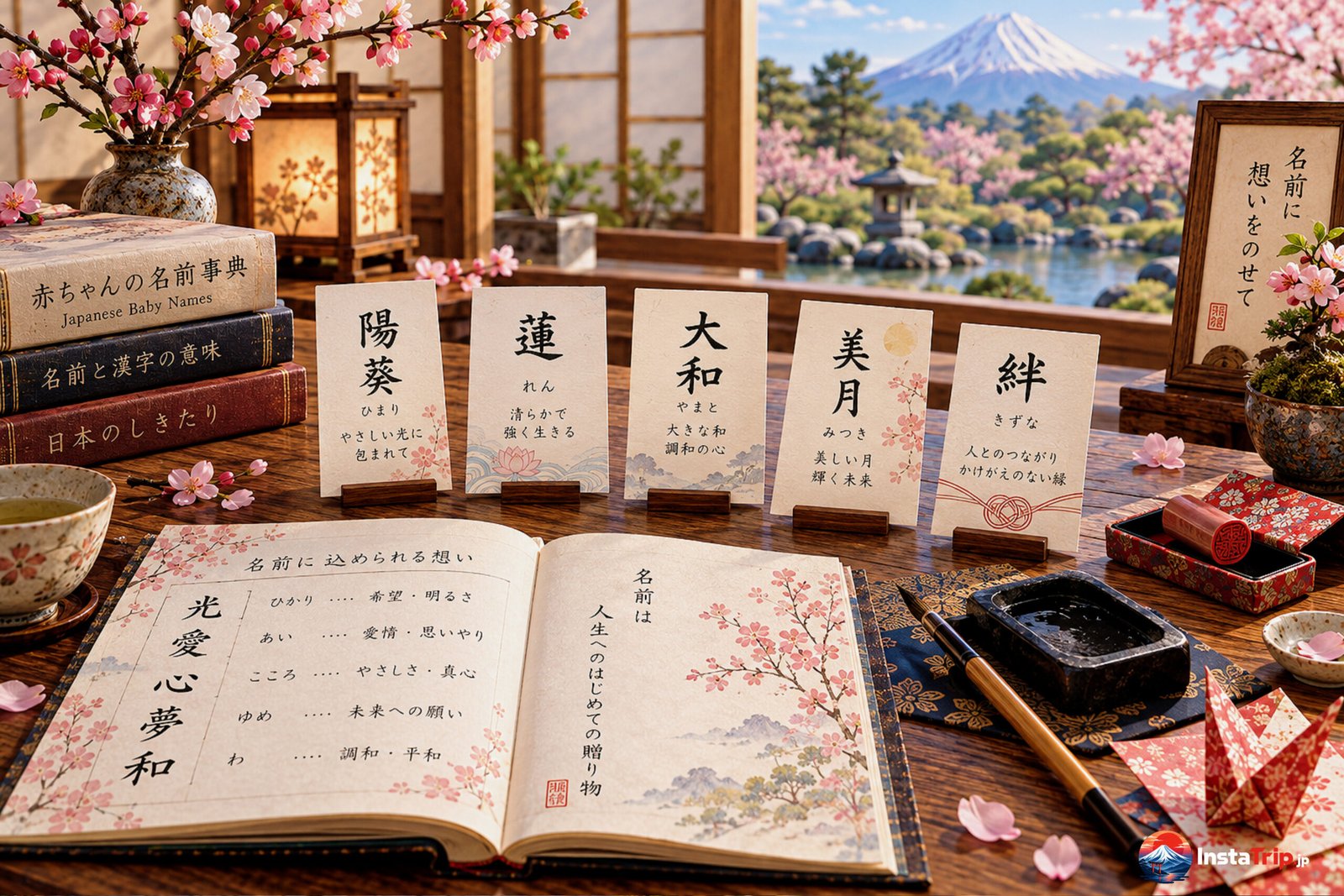
A name’s translated meaning is only one layer of its identity. A kanji combination that looks dramatic in English may simply have been chosen for its sound, balance on the page, or connection to a beloved relative. Conversely, a very simple character such as 花, flower, can hold a timeless elegance that needs no elaborate explanation.
When meeting someone from Japan, the most considerate approach is also the simplest: ask how they write and pronounce their name, then follow their preference. This is especially valuable with kanji names, where a confident guess can easily be wrong.
Learning Japanese names adds a more intimate dimension to travel and cultural discovery. On an ema plaque at a shrine or temple, a museum label, a train-station poster, or a shopkeeper’s name card, kanji begin to feel less like distant symbols and more like small, vivid stories waiting to be read.
![[商品価格に関しましては、リンクが作成された時点と現時点で情報が変更されている場合がございます。]](https://hbb.afl.rakuten.co.jp/hgb/0489ec49.ec8e1d52.0489ec4a.0edbe10a/?me_id=1213310&item_id=13180877&pc=https%3A%2F%2Fthumbnail.image.rakuten.co.jp%2F%400_mall%2Fbook%2Fcabinet%2F3499%2F9784789013499.jpg%3F_ex%3D128x128&s=128x128&t=picttext "[商品価格に関しましては、リンクが作成された時点と現時点で情報が変更されている場合がございます。]")