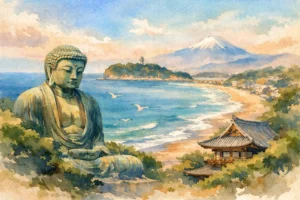

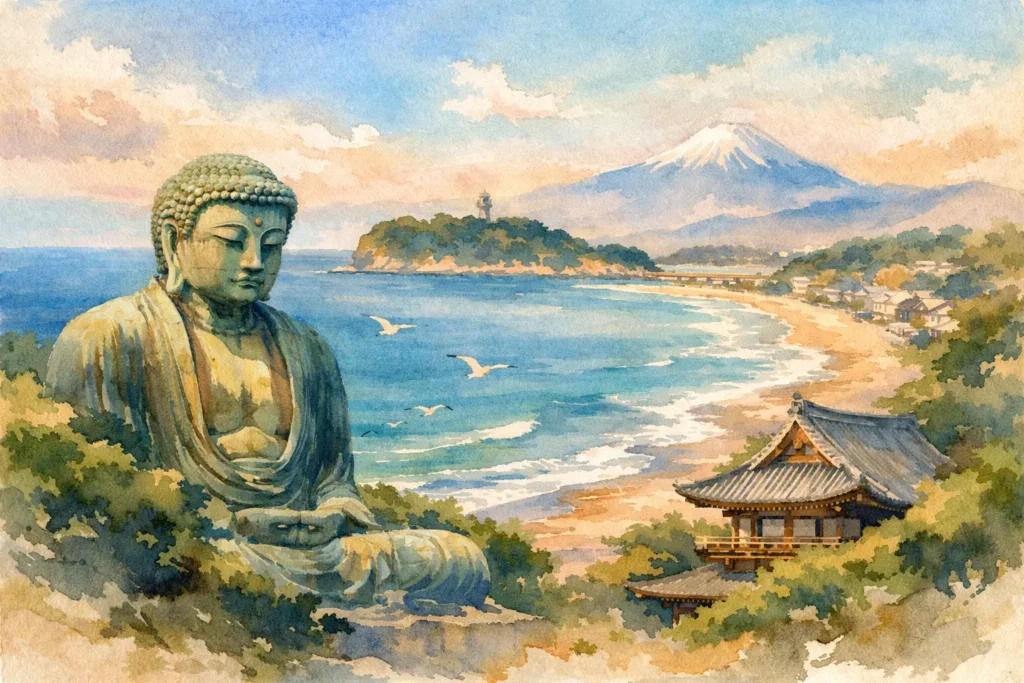
A bronze Buddha sits beneath an open sky. Incense drifts through temple gates framed by forested hills. A few stops away, the Pacific rolls onto a sandy shore while the charming Enoden train rattles past neighborhoods and sea views. Kamakura is one of Japan’s most captivating contrasts: a former seat of military power where sacred stillness, creative energy, and coastal life meet within easy reach of Tokyo.
For travelers who want more than a quick photo stop, this historic city offers a vivid encounter with the layers of Japanese culture. Its temples are not simply beautiful landmarks. They are living religious spaces shaped by centuries of worship, changing seasons, natural disasters, and quiet daily rituals.
Why Kamakura Feels So Distinctive
Kamakura rose to national prominence in the late 12th century, when Minamoto no Yoritomo established his military government here. Sheltered on three sides by steep, wooded hills and facing Sagami Bay, the city was strategically defensible while remaining connected to the sea. The Kamakura shogunate changed the course of Japanese history, shifting political authority away from Kyoto’s imperial court toward the warrior class.

That legacy still gives the city a remarkable sense of presence. Kamakura does not feel like an open-air museum arranged around one historic monument. Temples, shrines, homes, cafés, small shops, and train crossings all occupy the same compact landscape. You may spend the morning beneath towering cedar trees and the afternoon watching surfers from Yuigahama Beach.
Its atmosphere also changes dramatically by neighborhood. Around Kamakura Station, Komachi-dori is lively, fragrant, and crowded with snack stalls and souvenir shops. A short walk away, narrow lanes become calm and residential. North Kamakura, with its celebrated Zen temples, feels especially contemplative, while the coast has a bright, relaxed energy that can feel almost Mediterranean in summer – though unmistakably Japanese in its rhythms and details.
The Great Buddha of Kamakura
The Daibutsu, or Great Buddha, at Kotoku-in is Kamakura’s most recognizable image for good reason. Cast in bronze in the 13th century, this monumental figure of Amida Buddha sits at more than 43 feet tall, serene and powerful against the changing sky. Its outdoor setting is part of the experience.
The statue was originally housed inside a large temple hall. Storms and disasters destroyed the structure over the centuries, leaving the Buddha exposed to rain, wind, sunlight, and clouds. What might have been a loss has become one of the site’s defining qualities. The open air makes every visit different: luminous on a clear morning, deeply atmospheric in mist, and especially striking when autumn color appears in the surrounding grounds.
Visitors can enter the statue for a small additional fee when it is open. The interior is brief rather than elaborate, but it offers a fascinating glimpse into the construction of this immense work. More importantly, take time to step back after the photograph. The Daibutsu’s enduring calm is the reason people continue to return.
Temples and Shrines That Reveal Kamakura’s Spirit
Kamakura rewards travelers who choose a few sites and experience them slowly instead of trying to collect every temple in a single afternoon. Each has a different spiritual character, architectural language, and relationship with the landscape.
Tsurugaoka Hachimangu
At the center of the city, Tsurugaoka Hachimangu is Kamakura’s most important Shinto shrine. It was closely associated with the Minamoto family and the warrior culture that shaped the city. Its wide approach, known as Dankazura, leads from the waterfront direction toward a vivid vermilion gateway and elevated main sanctuary.
The shrine is active throughout the year, especially during New Year visits, weddings, and seasonal festivals. Visitors should remember that it is a place of worship, not a stage set. Pause before entering the gate, avoid walking in the center of the approach, and observe the simple purification customs at the water pavilion if you wish.
Hasedera and Its Ocean View
Hasedera is a magnificent choice for travelers drawn to gardens, Buddhist art, and coastal panoramas. The temple is known for its tall wooden statue of Kannon, the bodhisattva of compassion, as well as its hillside paths, small caves, ponds, and seasonal flowers.
From the upper grounds, the view opens across Kamakura’s rooftops toward Sagami Bay. Hydrangeas make Hasedera especially popular in early summer, while spring blossoms and autumn leaves bring their own color. It can become busy, so an early arrival is worth the effort. The temple’s beauty lies as much in its details as in its views: rows of small Jizo statues, the sound of water, and the scent of incense lingering near the halls.
North Kamakura’s Zen World
North Kamakura Station is the gateway to a more restrained, meditative side of the city. Kencho-ji, founded in 1253, is regarded as Kamakura’s oldest major Zen training monastery. Its spacious gate, formal temple layout, and forested setting reflect the discipline and aesthetic influence of Zen Buddhism.
Nearby Engaku-ji was founded after the Mongol invasions of Japan and remains an important Rinzai Zen temple. Its grounds are especially beautiful in autumn, when maple leaves bring brilliant color to the quiet pathways. These temples invite a slower pace. Rather than rushing from hall to hall, listen to the gravel underfoot, notice the woodwork, and appreciate how architecture directs the eye toward mountains and trees.
From Temple Paths to the Sea
One of Kamakura’s great pleasures is how quickly a day can move between sacred spaces and ordinary local life. From Hase Station, the small Enoden railway connects temple districts with seaside neighborhoods and the route toward Enoshima. The train is practical, but it is also part of the atmosphere, threading closely past homes, shops, and stretches of coast.
Yuigahama Beach is a welcome change of scenery after hours of temple grounds. In summer, it becomes lively with swimmers and beachgoers. During cooler months, it is ideal for a reflective walk, with broad views, sea birds, and often a glimpse of Mount Fuji on exceptionally clear days. The coastline is not Kamakura’s hidden secret, and that is part of its appeal. It shows the city as a place people live in, not only a destination people visit.
For a more active experience, Kamakura’s wooded hills have hiking routes linking temple areas and viewpoints. Conditions can change after heavy rain or maintenance work, so check locally before setting out and wear shoes with reliable grip. These trails are best treated as part of the landscape, not a shortcut between famous sights.
How to Shape a Meaningful Day in Kamakura
A first visit works best when organized around geography. Begin at Kamakura Station and visit Tsurugaoka Hachimangu before the busiest hours. Continue through Komachi-dori for a snack or a casual lunch, then travel to Hase for Hasedera and the Great Buddha. Finish near Yuigahama as the afternoon light reaches the water.
This route is satisfying, but it is not the only right choice. Travelers interested in Zen architecture may prefer North Kamakura and spend most of the day at Kencho-ji, Engaku-ji, and nearby temple lanes. Photographers may want the Enoden, Hase’s hillside views, and the coast. Those visiting during hydrangea season should expect crowds and build in extra time rather than forcing an ambitious itinerary.
Kamakura is reachable from central Tokyo in roughly an hour by train, making it an excellent day trip. Still, an overnight stay changes the experience. Early morning and evening reveal a quieter city, when temple approaches are less crowded, shop shutters are down, and the sea air softens the edges of the day.
Food here deserves the same curiosity as the landmarks. Try shirasu, tiny whitebait often served over rice when in season, or seek out a simple bowl of soba after a temple visit. Along Komachi-dori, matcha sweets and local snacks are easy to find, though the most crowded street is not always where the most memorable meal waits. A side street can offer a calmer, more personal pause.
Visiting With Care
Kamakura’s spiritual sites are generous places to visit, but their atmosphere depends on shared consideration. Keep voices low inside temple halls, follow photography notices, and do not step into restricted areas for a better image. At shrines, basic etiquette such as bowing lightly at the gate and keeping to the side of the approach shows respect without requiring perfection.
Season matters, too. Spring and autumn bring comfortable weather and spectacular color, but also high visitor numbers. Early summer has lush gardens and hydrangeas, while summer pairs naturally with the beach but can be hot and humid. Winter is quieter, crisp, and often rewarding for travelers who value space and clear light over flowers.
Leave room in your Kamakura plans for the unplanned moment: a temple bell in the distance, a rain-darkened stone path, a train passing beside the sea, or a view of the Great Buddha that feels unexpectedly personal. That is where this timeless coastal city becomes more than a day trip from Tokyo and begins to stay with you.