

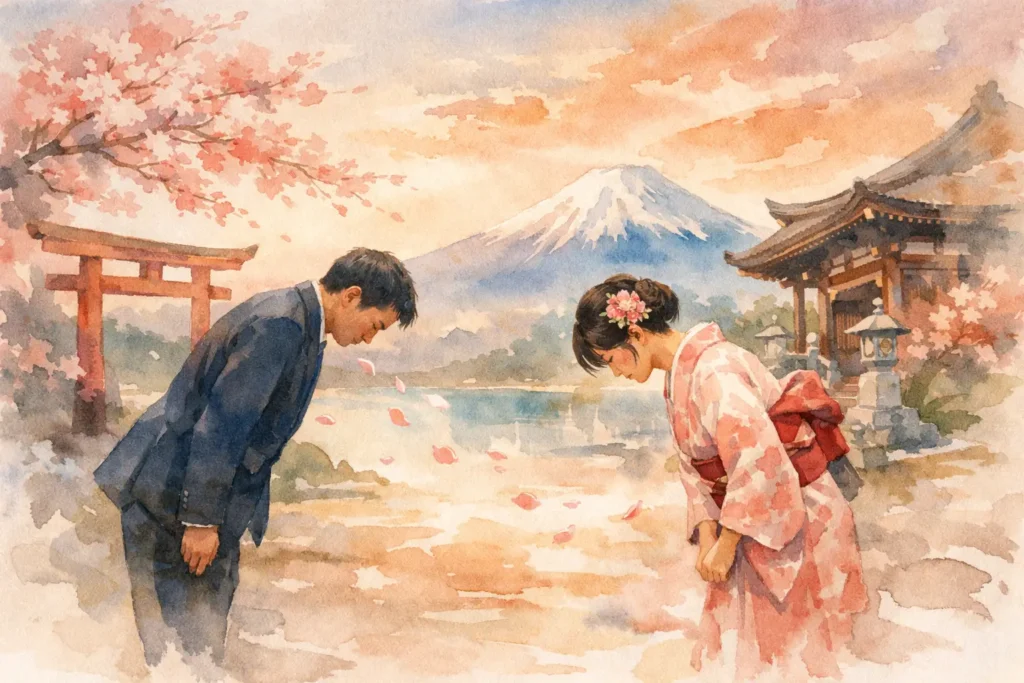
A bow can last only a second, yet it can communicate welcome, gratitude, apology, respect, and farewell without a word. So, why do Japanese bow? The gesture, known as ojigi, is one of Japan’s most recognizable customs, but it is far more nuanced than a simple substitute for a handshake. It is a quiet, expressive language shaped by relationships, setting, and intention.
For travelers, noticing bows adds another layer to Japan’s captivating everyday rhythm. You may see a station attendant bow toward a departing train, a shop employee greet customers from behind a counter, or visitors incline their heads before entering a shrine. Each moment reveals a culture in which consideration for others is made visible.
Why Do Japanese Bow? Respect Made Visible
At its heart, bowing expresses respect and awareness of another person. It acknowledges that an encounter matters, whether that encounter is between friends, coworkers, customers, strangers, or the sacred presence honored at a shrine or temple.

Japan has never had one fixed meaning for every bow. Context changes everything. A light nod exchanged between neighbors is relaxed and familiar. A deeper, more measured bow may convey formal thanks, a serious apology, or deference in a business setting. What remains consistent is the underlying idea: the bower briefly places the other person and the shared moment at the center of their attention.
This does not mean Japanese society is uniformly formal or that every person bows constantly. Friends may use a casual nod, wave, or verbal greeting. Younger people in relaxed settings can be especially informal. Still, bowing remains a vivid thread connecting daily life, professional etiquette, hospitality, and spiritual tradition.
The gesture also reflects the value often placed on harmony within a group. A bow can soften an interaction, signal goodwill, and recognize the space between people. Rather than demanding attention, it offers it.
A Gesture With Deep Historical Roots
Bowing in Japan developed over centuries through court customs, religious practice, and social etiquette. Physical expressions of respect were present in early Japanese society, while Buddhist influences and the formal culture of the imperial court helped shape codes of conduct. Later, the etiquette of the samurai class brought further attention to posture, self-control, and social position.

By the Edo period, from the early 1600s to the mid-1800s, behavior was increasingly organized through detailed social conventions. Bows could indicate rank and relationship, particularly in formal settings. Modern Japan is much less rigid than that world, yet the gesture still carries a sense of composure and consideration inherited from those traditions.
Bowing is also connected to the Japanese appreciation for form. Like the careful wrapping of a gift, the presentation of a meal, or the measured movements of a tea ceremony, it gives shape to an intention. The point is not theatrical perfection. It is making sincerity legible through action.
The Different Moments When People Bow
Visitors often first notice bowing in the polished world of Japanese hospitality. At a ryokan, restaurant, department store, or neighborhood shop, staff may bow to welcome guests or thank them as they leave. In some places, attendants even bow as an elevator door closes or a train pulls away. These gestures are not requests for customers to perform the same ritual. They are expressions of attentiveness.
In workplaces, bows mark greetings, introductions, thanks, and apologies. The depth and duration may become more formal when the situation is serious or when people are meeting for the first time. In business, a bow can show professionalism, but warmth still matters. An overly exaggerated bow may feel awkward if it does not match the moment.
Apologies are another powerful context. A sincere bow can communicate remorse more deeply than words alone, especially when someone has caused inconvenience. The degree of formality depends on the situation. A brief apology for brushing past someone on a busy Tokyo street is very different from a public apology made by a company representative.
At schools, students may bow to teachers at the beginning and end of class. In martial arts, bows help frame practice with mutual respect for instructors, partners, and the training space. At home, family members may use a smaller, more casual version of the gesture in daily greetings or thanks.
Bowing at Shrines and Temples
Japan’s spiritual sites offer some of the most memorable opportunities to observe bowing with care. At a Shinto shrine, visitors commonly bow once before passing through the torii gate and once again when leaving. The gate marks a transition from the everyday world into a sacred precinct.
As you walk inward, avoid the center of the approach where possible. This central path is traditionally regarded as the route for the deity. Near the main hall, worshippers generally offer a small bow before and after their prayer. Exact practices vary by shrine, and posted instructions should always take priority.
At Buddhist temples, bowing likewise expresses reverence, though the layout and worship customs may differ. The atmosphere can range from the vibrant red gates and fragrant incense of Tokyo’s Sensō-ji to a quiet mountainside temple in Kyoto or Nara. The gesture is not about performing Japanese identity for a photograph. It is a simple way to enter the space with humility.
How Deep Should a Bow Be?
There is no need for a visitor to memorize a chart of angles before arriving in Japan. In formal etiquette, people sometimes describe a light bow, a standard respectful bow, and a deeper formal bow. In real life, the feeling of the interaction matters more than precision.
A small incline of the upper body is usually enough for a casual greeting or thanks. Keep your back straight, your gaze naturally lowered, and your hands relaxed at your sides. A deeper bow belongs to more formal moments, especially when offering a serious apology or showing respect in a ceremonial setting.
The most common mistake is turning bowing into a dramatic performance. A quick head dip can appear less sincere than a calm, brief bow from the waist. At the same time, no one expects international visitors to instinctively know every detail. A kind expression, a few polite words such as arigatō gozaimasu, and an unforced gesture will usually be received warmly.
Should Travelers Bow Back?
Usually, yes, but lightly and naturally. If a hotel receptionist, server, or shopkeeper bows to you, a small bow or nod in return is a gracious response. You do not need to match the depth of a staff member’s bow. Their role may call for a more formal gesture than yours does.
When meeting someone in a professional or formal environment, follow their lead. Handshakes are also common in international business and tourism contexts, and some encounters involve both a handshake and a slight bow. Trying to execute both at exactly the same instant can become clumsy, so let the other person set the pace.
At shrines and temples, bow when other visitors do if you feel comfortable, while respecting the site’s instructions. At casual restaurants, bars, and markets, a smile and a nod may be all that the moment requires. Cultural respect is not measured by how deeply you bend. It is shown by paying attention.
More Than Politeness
The beauty of ojigi lies in its flexibility. It can be ceremonial beneath the magnificent gates of a Kyoto shrine, brisk and efficient in a dynamic Tokyo office, or almost invisible in the small nod shared at a local bakery. It crosses age groups and settings while changing its tone with remarkable precision.
For many visitors, bowing becomes one of the first customs they recognize and one of the last they remember. It turns ordinary exchanges into small moments of connection. When you return a bow in Japan, do not worry about getting every detail perfect. Pause, acknowledge the person before you, and let the gesture carry the goodwill you mean to offer.
![[商品価格に関しましては、リンクが作成された時点と現時点で情報が変更されている場合がございます。]](https://hbb.afl.rakuten.co.jp/hgb/574e58d9.7dd21527.574e58da.cf0026fb/?me_id=1357875&item_id=10000759&pc=https%3A%2F%2Fthumbnail.image.rakuten.co.jp%2F%400_mall%2Ff462187-kirishima%2Fcabinet%2Fimg01%2Fa0-259_smn_new.jpg%3F_ex%3D128x128&s=128x128&t=picttext "[商品価格に関しましては、リンクが作成された時点と現時点で情報が変更されている場合がございます。]")