
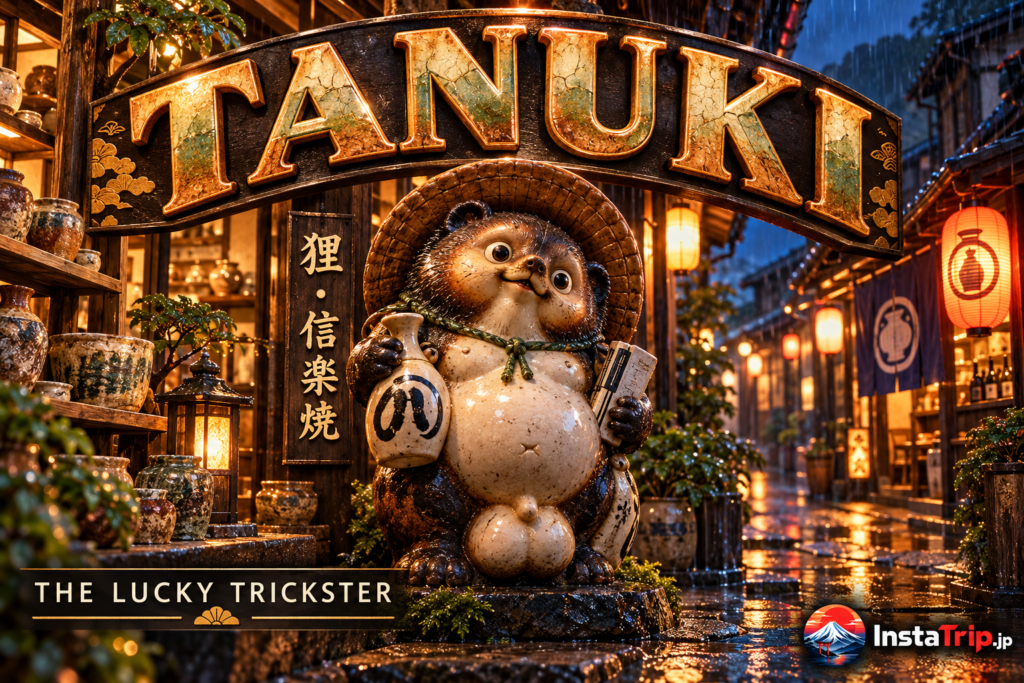
Outside a Japanese bar, the doorman may be made of clay. He wears a broad hat, holds a flask of sake, smiles at passersby—and carries a remarkably oversized pouch beneath his belly. Why would a shop put that at its entrance?
This is the Shigaraki tanuki (信楽焼の狸), one of Japan’s most recognizable good-luck figures. Behind its comic face is a layered story: a real forest animal, a shape-shifting trickster from folklore, and a ceramic invitation to walk through the door.
The wild animal and the shape-shifter
A tanuki (狸) is a Japanese raccoon dog, not a North American raccoon. Its folklore double, often called bake-danuki (化け狸), is a playful master of disguise. It may pass as a person, mislead a traveler or turn an ordinary object into a surprise. The Metropolitan Museum of Art describes an old tanuki carving disguised beneath a lotus leaf; another tale, Bunbuku Chagama (分福茶釜), imagines a tanuki and a tea kettle becoming entangled in the same impossible story.
That older trickster is close in spirit to the kitsune (狐), Japan’s shape-shifting fox. But the cheerful clay fellow at the entrance has a more specific home: Shigaraki (信楽), the pottery town in Shiga Prefecture (滋賀県).

Why is a tanuki outside a bar or sake shop?
In Shigaraki, the tanuki became a maneki-like welcome for a business: a figure of luck, hospitality and shōbai hanjō (商売繁盛), or thriving trade. Its flask (徳利, tokkuri) makes it particularly at home near an izakaya or liquor shop. The Japan National Tourism Organization notes how commonly these statues greet customers outside bars.
There is wordplay, too. Japan’s Tourism Agency explains that tanuki can be heard as ta o nuku (他を抜く), “to get ahead of others.” It is a playful commercial wish, not a literal claim that a ceramic animal can change a shop’s finances. If you already know the beckoning maneki-neko (招き猫), think of the tanuki as a different sort of greeter: less polished, more mischievous, and equipped for an evening drink.
What do its eight lucky features mean?
The familiar Shigaraki figure is read through hassō engi (八相縁起), “eight auspicious aspects.” Look closely at one statue and you can read a compact set of wishes for a good life and a well-run business. Shiga Prefecture sets out the eight meanings:
- Wide hat (笠): prepare for bad weather and unexpected trouble.
- Large eyes (大きな目): watch carefully and judge situations well.
- Friendly smile (笑顔): treat people warmly.
- Sake flask (徳利): cultivate virtue and hope for enough to eat and drink.
- Account book (通い帳): build the trust on which trade depends.
- Round belly (大きなお腹): keep your composure and act boldly when needed.
- Large money pouch (金袋): wish for financial good fortune.
- Thick tail (太いしっぽ): see things through to a good ending.
The details make it more than a shop mascot. The account book’s message, for example, is that trust matters as much as luck.

And yes—why are the testicles so large?
The conspicuous rounded form below many male tanuki statues is a deliberately exaggerated scrotum. In the Shigaraki list of eight lucky features, it is called a money pouch (金袋, kinbukuro) and represents prosperity. An official Shigaraki tourism guide even labels the feature “genitals” and links it directly to luck with money. The euphemism and the anatomy refer to the same sculpted feature.
It is meant to be funny and auspicious, rather than a realistic portrait of a wild animal. Some figures make the pouch subtle; others make it impossible to miss. Now the joke on a sake-shop doorstep is easier to understand: this tanuki promises a generous welcome and a generous fortune.
From folktale to Shigaraki clay
Shigaraki-yaki (信楽焼) belongs to one of Japan’s historic pottery regions, but the familiar shopfront tanuki should not be mistaken for an unchanged 800-year-old statue design. Shiga Prefecture traces its rise to national fame to 1951, when rows of ceramic tanuki welcomed Emperor Shōwa during a visit and the scene drew attention across Japan. The older animal tales and the modern good-luck statue meet in the same smile.
For a glimpse of the place where that smile is fired in clay, this short visual tour visits Shigaraki Station and its tanuki figures. The player is compact and starts only when you choose to watch.
Shigaraki ware and Shigaraki Station, filmed by MOVIE JAPAN.
Where to meet the tanuki
Start around Shigaraki Station (信楽駅) in Kōka City (甲賀市): the town’s ceramic tanuki make their presence known almost immediately. Browse local pottery shops, then consider the Shigaraki Ceramic Cultural Park (滋賀県立陶芸の森) for a wider view of the craft. Shigaraki Touen Tanuki Village offers giant tanuki figures, pottery shopping and hands-on activities; check each venue’s current hours before traveling.
The best way to look at the statue is slowly: hat, eyes, smile, bottle, ledger, belly, pouch, tail. By the time you reach its last detail, the supposed joke has turned into a small philosophy for opening a business.
More lucky figures and strange companions
Discover why the maneki-neko raises one paw, or follow the shape-shifting kitsune into Japanese legend.
Paid links
Browse Shigaraki-style tanuki figurines on Amazon or books about tanuki folklore on Amazon.
Map: Shigaraki Station and pottery town
Shigaraki, Kōka, Shiga Prefecture. Open Shigaraki Station in Google Maps.