
Imagine crossing a quiet bridge in rural Japan and meeting two unfamiliar girls. They tell you they have just left the grand house nearby. Days later, that household is gone. In Tōno, this is not the beginning of a horror film. It is one of the stories that made a small, elusive spirit part of Japan’s folklore.
Who is the zashiki-warashi (座敷童子)?
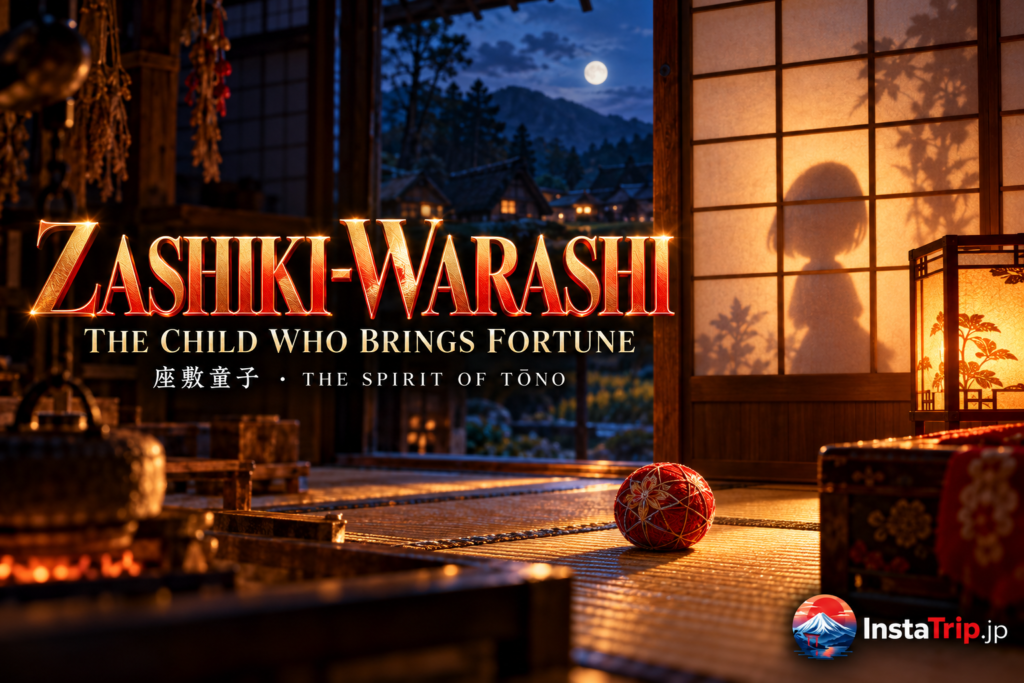
Zashiki-warashi (座敷童子) is often described as a childlike presence associated with a home. Zashiki (座敷) refers to a tatami-floored room; warashi (わらし) is a regional word for a child. Tōno’s tourism association describes a sometimes mischievous being that may appear as a boy or girl, often in an old house, and is said to bring prosperity to the family living there. Appearance and meaning vary from telling to telling: this is a living body of local stories, not a creature with one fixed set of rules. Tōno Tourism Association
People sometimes call it a yōkai (妖怪), a house spirit, or even a small household kami (家の神). In Tōno, the local interpretation can be closer to a protective spirit of the home than to a monster. That ambiguity is part of its power. It belongs to the rooms where ordinary life unfolds: a tatami floor, a sliding door, the feeling that someone else might be there. Tōno’s guide to the legend
The two girls who left the house
The most haunting account comes from Tōno Monogatari (遠野物語, The Legends of Tōno), the collection of local tales assembled by folklorist Kunio Yanagita (柳田國男) from accounts associated with Tōno storyteller Kizen Sasaki (佐々木喜善). In story 18, two girl-like household spirits were said to live in the home of Yamaguchi Magosaemon (山口孫左衛門). A villager encountered two unfamiliar girls near a bridge. When asked where they had come from, they named that house—and said they were going elsewhere.

Soon afterward, according to the story, more than twenty people of the household died after eating poisonous mushrooms. The terrible detail matters: the tale does not say that the spirits killed anyone. It links their departure with the house’s collapse, leaving its listeners to wonder whether they foresaw misfortune, carried fortune away, or merely became the image through which people remembered a tragedy. The local tourism association reproduces and explains the episode in its walk through Yamaguchi village.
In other accounts, a home with a zashiki-warashi flourishes while the spirit remains. So is seeing one good luck? In the Yamaguchi tale, seeing the two children leaving is the unsettling part. Fortune and warning are inseparable here. It is best read as folklore about the vulnerability of a household, rather than a rule that a sighting predicts anything in real life.
Why does a child spirit guard a home?
Tōno’s stories place extraordinary presences inside ordinary landscapes. Mountains, streams, barns and rooms all become places where the familiar and unfamiliar meet. A childlike guardian expresses something tender as well as eerie: the wish that a home might be protected, and the fear that its good days could disappear without warning.
That makes zashiki-warashi different from the visible objects of good fortune in our series. You can buy a maneki-neko (招き猫) or carry an omamori (お守り); the house spirit is known through stories and through the imagination of people who inhabit a place. Another surprising thread links these legends: later in Tōno Monogatari, Magosaemon’s household is also associated with a fox and a small Inari (稲荷) shrine. If that symbol interests you, explore our article on kitsune (狐). The accounts are distinct, but they show how several ideas about protection and prosperity could share one landscape.

Listen to the place where the story lives
Before looking for a ghost, listen to Tōno itself. This quiet recording features the waterwheel of Yamaguchi, the settlement associated with Sasaki’s childhood and the Tōno Monogatari landscape. The video is a soundscape of a real place, not footage of a spirit.
Where to explore the legend in Tōno (遠野)
Tōno Municipal Museum (遠野市立博物館) introduces the region’s history and folklore and displays material connected with the Yamaguchi household. The nearby Tōno Folktale Museum (とおの物語の館) offers stories and exhibits; hearing a local storyteller gives the written tales another life. For a rural setting, the Denshoen (伝承園) folklore village preserves a traditional farmhouse and presents the beliefs and daily life of the area. Check the venues’ current opening information before traveling.
You can also follow Tōno’s account of the Yamaguchi settlement (山口集落) walk to the former site of Magosaemon’s residence. The house itself no longer stands. Respect signs and private property around the historic landscape. Japan’s national tourism organization explains that Tōno is reached via the Kamaishi Line from Shin-Hanamaki, which has a Tōhoku Shinkansen connection. JNTO’s Tōno guide
Open Tōno Municipal Museum on Google Maps as a starting point for the folklore sites. The map marks the museum, not a claimed place where a spirit can be found.
The presence that cannot be kept
It would be easy to turn zashiki-warashi into a simple lucky charm. But the old Yamaguchi story leaves us with a sharper question: if good fortune lived under your roof, how would you know it was there before it was gone? Perhaps that is why the legend stays with us. It asks us to notice the life inside a house while it is still ours to cherish.
Continue exploring
Paid links
- Explore English editions of The Legends of Tōno.
- Browse illustrated books about Japanese folklore and yōkai.