
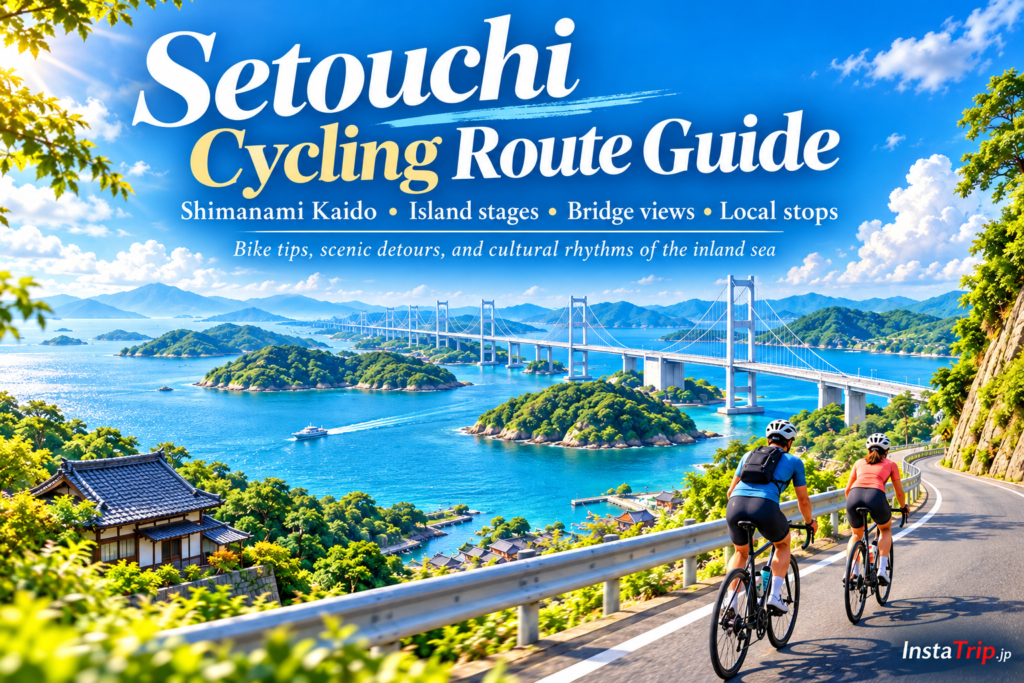
A cycling journey through Setouchi (瀬戸内) begins with a view that changes by the minute: silver-blue water below, forested islands ahead, and the great white lines of suspension bridges rising across the Inland Sea. The Shimanami Kaido (しまなみ海道) is not simply a way to travel between Honshu and Shikoku. It is a moving encounter with the Setouchi landscape, where fishing ports, citrus groves, small shrines, and contemporary art exist within a remarkably intimate seascape.
Running between Onomichi (尾道) in Hiroshima Prefecture (広島県) and Imabari (今治) in Ehime Prefecture (愛媛県), the celebrated route crosses six islands and a series of spectacular bridges. The full cycling course is roughly 70 kilometers, though the distance says little about its character. A slow traveler can spend two days lingering over temple grounds, island cafés, and waterfront views. A confident rider can complete it in a day, arriving with tired legs and an unforgettable sense of having crossed a piece of Japan under their own power.
Why the Shimanami Kaido Feels Different
Japan has exceptional cycling roads, but the Shimanami Kaido has a particular magic. It is built around connection. The route links communities that once felt separated by water, following dedicated bicycle paths over bridges designed on an astonishing scale. From the elevated approaches, cargo ships appear small beneath you, while clusters of islands seem close enough to reach by hand.
Yet the journey never feels like a purely engineered spectacle. Leave a bridge and the pace immediately softens. You may pass weathered wooden homes, vegetable plots, boats tied to narrow harbors, and roadside stands selling local fruit. Setouchi has long been shaped by maritime exchange, and cycling reveals its geography in a human-sized way. The sea is always present, but every island has its own rhythm.

The route also suits different kinds of travelers. First-time visitors can ride a manageable section and use public transportation or a ferry for the rest. Dedicated cyclists can add detours, steep island climbs, and quieter coastal roads. It depends less on athletic ambition than on how much time you want to give the landscape.
Setouchi Cycling Route Guide: Choosing Your Direction
Most travelers ride from Onomichi to Imabari, beginning amid the atmospheric slopes and temple-studded streets of Onomichi. This direction offers a memorable opening: take the short ferry across the channel to Mukaishima, then begin island-hopping almost immediately. It is a wonderful choice if you are coming from Hiroshima, Osaka, or Kyoto by train.
Imabari to Onomichi is equally rewarding and may be preferable for travelers continuing onward through western Honshu. The final descent toward Onomichi can feel especially cinematic, with the town’s hillside temples and compact waterfront gradually coming into view. Neither direction is objectively better. Check bike rental availability, luggage plans, and your wider itinerary before deciding.
A one-day crossing generally takes five to eight hours once you include breaks, photographs, meals, and wrong turns. Riders who want the route to feel like a journey rather than a challenge should plan an overnight stay on one of the islands, especially Ikuchijima or Omishima. The extra time transforms the experience. Evening brings quieter roads, softer light over the water, and a glimpse of island life after day visitors have gone.

A natural two-day rhythm
On day one, travel from Onomichi through Mukaishima and Innoshima to Ikuchijima. The terrain is mostly approachable, though bridge ramps require steady effort and there are occasional rolling sections. Ikuchijima’s Setoda area is an appealing place to pause, known for its citrus-growing landscape, relaxed waterfront, and artistic presence.
Day two can continue through the smaller islands toward Omishima, Hakatajima, and Oshima before reaching Imabari. This half of the route feels increasingly expansive, particularly on the long bridge crossings. It also offers a deeper encounter with Ehime’s island heritage, from salt traditions to sacred sites and fishing communities.
Islands Worth Stopping For
The Shimanami Kaido is best experienced with room for curiosity. Racing from bridge to bridge misses the details that make Setouchi so captivating.
On Innoshima, the Suigun Castle museum area introduces the story of the Murakami kaizoku, maritime clans who navigated and protected these strategic waters from the medieval period onward. They are sometimes loosely called pirates, but that label can obscure their more complex role as skilled seafarers, guides, and regional powers. The site adds historical depth to the sea lanes visible from the road.
Ikuchijima is famous for lemons and a bright, Mediterranean-like atmosphere, though its identity remains distinctly Japanese. In Setoda, Kosanji Temple is an extraordinary and highly personal creation, built in the 20th century by businessman Toyokichi Kanamoto in memory of his mother. Its vivid structures draw on famous religious architecture from across Japan, creating a fascinating, sometimes surprising visual world. Nearby, the Hill of Hope is a luminous marble garden whose pale surfaces frame the blue Setouchi horizon.
Omishima offers a quieter, more spiritual pause. Oyamazumi Shrine has been revered by warriors and seafarers for centuries, and its collection includes important arms and armor offered by those seeking protection at sea. Even for visitors without a special interest in military history, the shrine grounds convey the enduring bond between island communities, belief, and the water surrounding them.
Hakatajima and Oshima reward riders who take their time with coastal detours. Local salt, seafood, and small harbor scenes provide a welcome contrast to the thrill of the bridges. Near the Imabari end, the Kurushima Kaikyo Bridge is a magnificent finale – a vast chain of bridges spanning a channel known for powerful tidal currents.
Bike Rentals, Navigation, and Road Etiquette
The route is unusually welcoming for independent cyclists. Rental systems operate at major entry points and selected locations along the way, with standard bicycles and, in many cases, e-bikes. An e-bike is a sensible choice for travelers who want to explore detours without worrying about the climbs, or for anyone riding during summer heat. Traditional bikes offer a more physical connection to the journey and are perfectly suitable for the main route if you are comfortable cycling moderate distances.
Reserve ahead during spring, autumn, weekends, and Japanese holiday periods. One-way rentals can be convenient, but return locations, operating hours, and luggage rules vary, so confirm the details before setting out. Carry water, sunscreen, a light rain layer, and a phone battery pack. Convenience stores appear along much of the route, but not always exactly when you want one.
Navigation is straightforward on the main course, marked by a blue line painted along many roads. Still, do not follow it without looking up. Some of the loveliest moments happen on a short side road by the shore, while some optional detours introduce sharper climbs than expected.
Cyclists ride on the left in Japan. Keep to the designated side of the lane, obey traffic signals, use lights in tunnels or dim conditions, and be especially alert near intersections. Bridge approaches can be windy, and the path occasionally shares space with pedestrians. Courtesy is part of the pleasure here: a bell is not a substitute for slowing down, and a brief greeting goes a long way in small communities.
When to Ride the Setouchi Islands
Spring and fall offer the most comfortable conditions. April and May bring fresh green hillsides and mild temperatures, while October and November often deliver clear skies and gentler light. Cherry blossoms can be beautiful, but timing varies by island and popular travel periods bring more riders.
Summer is vibrant but demanding. The sea views are dazzling, citrus desserts are refreshing, and festivals may animate local towns, yet heat and humidity can make a full crossing strenuous. Start early, take long midday breaks, and consider dividing the route over two days. Winter is quieter and can be beautifully crisp, though wind, colder temperatures, and shorter daylight hours require more planning.
Weather deserves respect at any time of year. Rain changes the character of bridge surfaces and reduces visibility, while strong winds can make elevated crossings uncomfortable. Leave flexibility in your itinerary rather than treating the route as a fixed athletic test.
Let the Islands Set the Pace
The most memorable Setouchi ride may not be the one with the fastest finish time. It may be the unscheduled stop for a bowl of local noodles, the scent of lemons warming in the sun, or the quiet moment at a shrine gate facing the sea. The Shimanami Kaido invites you to cover distance, certainly, but it also asks you to notice what distance connects.
Ride with enough time to take the smaller road, wait for the ferry, and watch the changing water from a bridge railing. In Setouchi, the journey between islands is not the space between destinations. It is the destination itself.
A Practical Shimanami Kaido Plan
| Time available | Suggested approach | Main booking decision |
|---|---|---|
| A few hours | Choose one island or bridge section | Return the bicycle within your chosen terminal’s hours. |
| One full day | The full crossing for riders comfortable with sustained cycling | Reserve the bicycle and a realistic finish-time buffer. |
| Two days | Stop overnight around Setoda (瀬戸田) or Omishima (大三島) | Confirm that the bicycle category permits overnight hire. |
Rental Prices and Return Rules
The public Shimanami Japan system lists adult cross/city bicycles at ¥3,000 per day, electric-assist city bicycles at ¥4,000 per day and its E-bike category at ¥8,000 per day. Electric-assist city bicycles allow multiple days under the listed rules; the distinct E-bike category requires return during operating hours on the same day. Do not treat these two categories as interchangeable.
Check the official rental table and linked booking service for availability, terminal hours and price changes. The operator lends a helmet with its rentals. Budget separately for accommodation, meals, ferry connections and your onward journey.
Use the operator’s route information rather than a general car-navigation route: the cycling course and motorway lanes are different. Allow time for climbs, stops and a change in weather. For a broader island trip, see our Setouchi art islands guide.
Watch: Riding Across Tatara Bridge
This Japanese cycling channel’s ride footage follows the approach to Tatara Bridge (多々羅大橋) and the nearby park, with background music. It records a 2015 event and offers a rider’s-eye glimpse of one section, rather than a current rental or full-route guide.
Shimanami Kaido Cycling FAQ
Do I need to finish all 70 kilometers?
No. A shorter section can be a rewarding visit. Decide your start, finish and bicycle return arrangements before leaving.
Can I keep an electric bicycle overnight?
It depends on the category and provider. The public system currently distinguishes multi-day electric-assist city bicycles from same-day E-bikes.
Is the map below a turn-by-turn cycling route?
No. It locates the main places. Follow official cycling maps and road signs for the appropriate paths and bridge approaches.
What should I do with a large suitcase?
Arrange storage or a confirmed luggage service before riding. Carry only what you can manage safely on the bicycle.
Useful travel items (paid links): If needed, browse a reusable water bottle or a compact rain jacket. Use suitable items you already own.
Shimanami Kaido Map and Route Stops
Use this overview to locate the island chain. The stop links run from Onomichi toward Imabari; consult the official cycling route for bicycle access and ferry connections.