
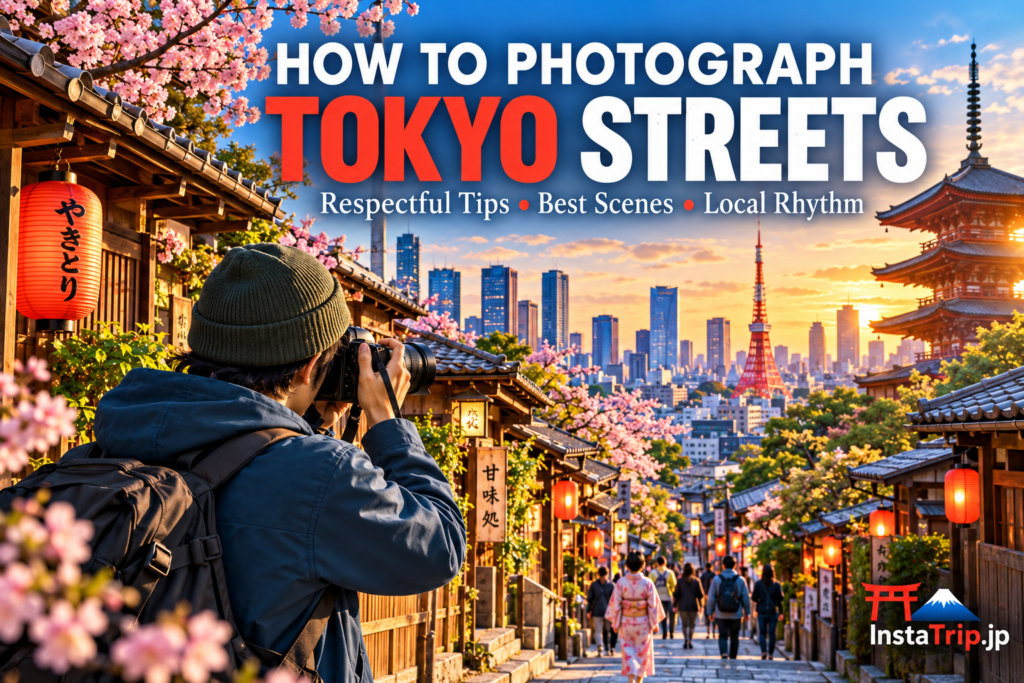
Tokyo rarely holds still. A commuter steps beneath the bright signs of Shinjuku, steam rises from a tiny ramen shop, a bicycle slips through a residential lane, and a temple roof appears beyond a web of overhead wires. To photograph Tokyo streets is to work with this constant motion while noticing the quieter details that give the city its remarkable character.
The most memorable images do not come from chasing neon alone. They come from understanding Tokyo as a city of layers: historic neighborhoods beside polished towers, private daily routines beside public spectacle, and moments of stillness inside one of the world’s most dynamic urban landscapes. A thoughtful approach will help you make stronger photographs while treating the people and places in front of your lens with care.
Read the rhythm before raising the camera
Tokyo rewards photographers who slow down. Before taking a picture, spend a few minutes watching how a street works. Notice where people pause, which direction the crowd flows, where sunlight catches a storefront, and when a train passes overhead. That brief observation often reveals a composition that feels natural rather than hurried.
In a major crossing such as Shibuya Scramble, the energy is immediate: waves of pedestrians, giant screens, taxis, umbrellas, and shifting color. Here, a wider frame can show scale, while a longer lens can isolate one person against the movement. In quieter districts, the story may be much smaller – a noren curtain moving at a doorway, potted plants arranged outside a home, or the geometry of utility poles against an evening sky.

Tokyo’s visual richness comes from contrast, but contrast should not become a cliché. A shrine gate beside apartment buildings is compelling because it reflects how sacred spaces remain part of everyday urban life, not because it is an exotic backdrop. Let the setting speak on its own terms.
Choose neighborhoods with a distinct visual language
The best places to photograph Tokyo streets depend on the mood you want to create. A single day can move from vivid electronic color to timeless temple streets, but each neighborhood deserves its own pace.
Shinjuku and Shibuya for movement and light
Shinjuku after dark is a captivating study in density. The streets around Kabukicho and the lanes near Omoide Yokocho are filled with illuminated signs, narrow storefronts, reflections, and fast-moving crowds. Rain can add another dimension, turning pavement into a mirror for red, blue, and gold light. Keep your compositions simple amid the visual intensity. One figure walking through a glowing frame is often more powerful than trying to include everything.
Shibuya brings a more open, youthful energy. Its crossings, elevated walkways, fashion, and architecture create opportunities for graphic street scenes. Early morning offers a surprising alternative to the evening rush: shutters are down, delivery workers are active, and the city feels briefly spacious.

Asakusa and Ueno for texture and continuity
Asakusa holds a different kind of drama. Around Sensō-ji, lanterns, traditional shopfronts, stone paths, and visiting worshippers create photographs rooted in atmosphere and history. Visit early if you want softer light and fewer people, but remember that this is an active spiritual site, not a stage set. Follow posted rules, avoid disrupting worship, and never block pathways or entrances while looking for a shot.
Nearby Ueno offers a more everyday rhythm, especially around its market streets, parks, and rail lines. It is a rewarding place for images that connect people with the practical beauty of Tokyo life: umbrellas gathered outside a station, vendors preparing for the day, or seasonal color moving through the park.
Yanaka, Kagurazaka, and Koenji for quieter stories
For photographers drawn to intimate scenes, Tokyo’s smaller streets can be magnificent. Yanaka retains a low-rise, nostalgic atmosphere, with old wooden homes, modest temples, cats, craft shops, and narrow lanes that invite patience. Kagurazaka combines stone slopes, traditional details, French-influenced cafes, and refined evening light. Koenji brings vintage shops, music culture, murals, and a more playful local energy.
These areas are not simply “hidden gems.” They are neighborhoods where people live and work. Photograph the character of the street without turning residents into scenery. That distinction matters.
Work with Tokyo’s changing light
Light changes the emotional temperature of Tokyo more dramatically than almost any camera setting. In the hour after sunrise, broad avenues and station entrances can feel calm and cinematic. Soft light reaches alleyways, delivery carts roll into place, and the city begins to gather momentum.
Midday is often challenging, especially between tall buildings where shadows become harsh. Instead of forcing wide scenes, look for strong patterns: silhouettes beneath elevated tracks, reflections in glass, graphic crosswalks, or the contrast between bright vending machines and shaded corners. Tokyo is full of surfaces that respond beautifully to direct light.
Blue hour is especially rewarding. The brief transition after sunset allows sky detail to remain visible while signs, windows, and headlights start to glow. If you are photographing handheld, raise your ISO rather than relying on an excessively slow shutter speed. A little grain can suit Tokyo’s nocturnal atmosphere; a blurred subject rarely does, unless that motion is intentional.
Rain is not a reason to put the camera away. Clear umbrellas, wet asphalt, and reflected neon are among the city’s most recognizable visual elements. Use a lens hood or protective cover, watch for puddles near curbs, and wait for a lone figure to enter the frame. A rainy evening can transform an ordinary street into a vivid, reflective scene.
Photograph Tokyo streets with cultural awareness
Street photography is as much about judgment as timing. Tokyo is highly photogenic, but public visibility does not mean every person wants to be photographed closely. Avoid treating people as anonymous props, particularly in quiet residential areas, small businesses, or moments that appear personal.
When a person is clearly the subject of your image, consider whether the photograph preserves their dignity. A candid image from a respectful distance may work in a busy public setting, while a close portrait is better approached with a smile, a gesture toward your camera, and a clear request. If communication is difficult, politeness is still easily understood. If someone declines or seems uncomfortable, move on without argument.
Be especially careful around schools, temples, shrines, and private homes. Do not photograph where signs prohibit it, do not use flash in sensitive spaces, and do not step into a road, doorway, or narrow passage just to improve a composition. Tokyo’s streets function with extraordinary order because millions of small interactions are considerate. A photographer should become part of that rhythm, not interrupt it.
Tripods can also be intrusive in crowded areas. They are useful for deliberate night scenes in an appropriate open location, but handheld photography is usually more flexible and less disruptive. Travel light when possible. A compact camera or a single versatile lens can help you respond quickly and remain aware of your surroundings.
Build photographs around small human details
Tokyo’s grand scenes are unforgettable, but its everyday details often stay with viewers longer. Look for hands exchanging coins at a food stall, a salaryman framed by a station window, schoolchildren’s bright umbrellas moving in a line, or a chef preparing a storefront before opening. These are not trophies to collect. They are glimpses of the city’s living texture.
Try working with layers. Frame a subject through a train window, beneath a sign, beyond a bicycle basket, or between the curtains of a tiny restaurant. Tokyo naturally offers depth through doorways, mirrors, lanes, wires, and elevated tracks. Let foreground elements partially obscure the view when they add a sense of place.
Color can become a visual thread as well. The orange-red of torii gates, the blue glow of convenience stores, green railway signals, and the muted earth tones of older neighborhoods can each guide a series of photographs. Rather than editing every image into the same dramatic style, allow different areas of Tokyo to retain their own color and mood.
Leave space for the unexpected
Planning helps, but some of Tokyo’s finest street photographs arrive between destinations. You may find an elderly shopkeeper watering flowers, a festival banner catching the wind, a delivery rider crossing a beam of light, or a quiet lane suddenly filled with the sound of a passing train. Keep your camera accessible, but do not let the search for images prevent you from experiencing the city.
Return to one area more than once if you can. The same street near Tokyo Skytree can feel entirely different at dawn, during a summer shower, or beneath winter twilight. Familiarity changes the photographs you make because you stop chasing the obvious view and start noticing the city’s subtle variations.
Tokyo does not need to be exaggerated to look extraordinary. Walk with curiosity, wait with patience, and photograph with respect. The result will be more than a record of where you went: it will carry something of the city’s captivating rhythm home with you.