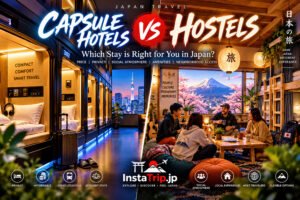

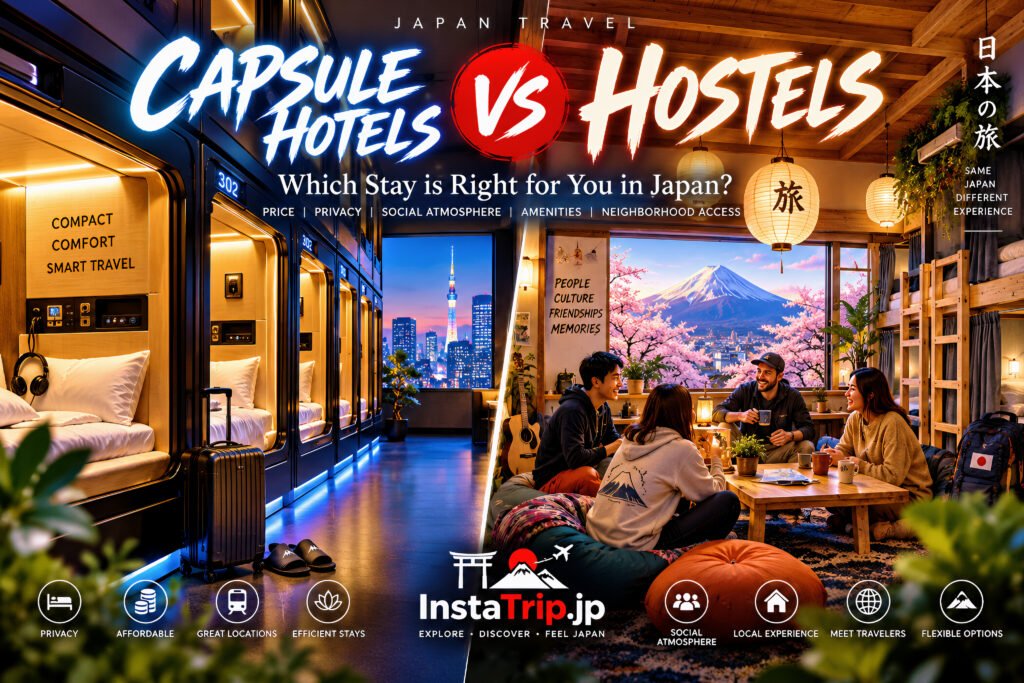
The choice between capsule hotels versus hostels can shape the rhythm of a Japan trip more than many travelers expect. One night might end beneath the electric glow of Shinjuku, tucked into a quiet personal pod after a late bowl of ramen. Another might begin over coffee in a lively hostel lounge, trading Kyoto recommendations with travelers headed for the same morning train. Both can be affordable, memorable ways to stay in Japan, but they offer very different kinds of freedom.
Japan has elevated compact accommodation into an experience of its own. Capsule hotels reflect the country’s enduring fascination with efficient design, personal order, and thoughtful use of urban space. Hostels, meanwhile, bring a more communal energy to cities and smaller destinations alike. The better choice depends less on which is objectively superior and more on how you want your days and evenings to feel.
Capsule Hotels Versus Hostels: The Essential Difference
A capsule hotel gives each guest an enclosed sleeping compartment, usually large enough to sit up in but not stand in. Inside, there is commonly a mattress, bedding, light, outlet, ventilation, and sometimes a small screen or control panel. Bathrooms, lockers, lounges, and bathing facilities are shared, though the sleeping space itself feels distinctly more private than a dorm bed.

A hostel is built around shared social space. Dorm rooms may have bunk beds for four, six, eight, or more guests, while many properties also offer private rooms. Common kitchens, lounges, terraces, and bars are often central to the experience. In Japan, the strongest hostels frequently combine practical facilities with a local sense of place: a restored machiya townhouse in Kyoto, a creative base near Tokyo’s art-filled neighborhoods, or a relaxed retreat near the coast in Kamakura.
The distinction is simple. Capsule hotels prioritize a compact individual retreat. Hostels prioritize connection, flexibility, and shared atmosphere.
Choose a Capsule Hotel When Sleep and Privacy Matter Most
For solo travelers who want their own defined space without booking a conventional hotel room, a capsule hotel can be an excellent fit. The pod provides a reassuring boundary at the end of a full day, particularly in Tokyo or Osaka, where the sensory intensity of stations, shopping streets, and nightlife can make a calm place to reset feel especially valuable.
Capsules are often more comfortable than first-time visitors imagine. Quality varies, but many modern properties provide crisp bedding, dedicated lockers, clean shower rooms, and polished communal areas. Some have large public baths or saunas, creating an unexpectedly restorative ritual after hours spent walking through Asakusa, Ueno, or the luminous streets around Dotonbori.
They are also well suited to short stays. If you are arriving late, catching an early shinkansen, or spending one or two nights in a major city before continuing to Hakone, Hiroshima, or Fukuoka, the efficient check-in and central locations can be a real advantage. A capsule hotel near a train hub can turn a logistical night into a small urban adventure.
There are trade-offs. Capsules may feel restrictive for anyone who is claustrophobic, traveling with large luggage, or hoping to unpack and linger in their room. Sound can travel through the sleeping floor, even where quiet rules are carefully observed. Many traditional capsule hotels have gender-separated floors or facilities, and some have age, tattoo, or access policies that travelers should check before booking. These rules are not uniform, so details matter.
Choose a Hostel When You Want Japan to Feel More Social
A hostel is often the better choice for travelers who want spontaneous conversation, local tips, or a companion for a museum visit, food crawl, or day trip. Japan can be wonderfully easy to navigate, but it can also feel beautifully self-contained. A hostel lounge creates a natural place to share discoveries without forcing the experience.
This matters particularly for solo travelers staying several nights. A good hostel can become a temporary neighborhood base: someone recommends a tiny kissaten coffee shop, another guest suggests the best time to photograph Tokyo Skytree, and the staff points you toward a nearby sento, market, or seasonal festival. These encounters are never guaranteed, but hostels make them more likely.
Hostels also tend to work better for friends, couples, and travelers carrying more gear. Private rooms can offer considerable value, while dorms often have more room around the bed than a capsule. Kitchens are useful for longer stays, especially if you want to balance restaurant meals with a simple breakfast or snacks picked up from a local supermarket.
The compromise is obvious: shared rooms bring less privacy and less control. Even an impeccably run hostel cannot eliminate the realities of different schedules, rustling bags, early alarms, and occasional snoring. Earplugs and an eye mask are wise additions. Travelers seeking a hushed, hotel-like evening may find the sociability charming for one night and tiring by the third.
Price Is Not Always the Deciding Factor
It is tempting to assume capsule hotels are always cheaper than hostels, but Japan’s accommodation market is more nuanced. Prices shift with season, city, weekends, events, and how close you are to a major station. A capsule in central Tokyo can cost more than a dorm bed in a less central neighborhood, while a stylish boutique hostel in Kyoto during cherry blossom season may rival a business hotel.
Instead of comparing the nightly number alone, consider what is included. A capsule hotel may offer toiletries, pajamas, towels, bathing facilities, and a more polished sleep setup. A hostel may include a kitchen, social events, laundry facilities, luggage storage, or a private room option that makes sense when split between two people.
Location deserves equal attention. Saving a small amount on a bed can lose its appeal if you spend an hour each way on crowded trains. Staying near the atmosphere you came to experience – old lanes in Kyoto, the port energy of Yokohama, the temple district of Asakusa, or the nightlife of Shinjuku – can make a short visit feel far richer.
The Japanese Etiquette Behind a Comfortable Stay
Whether you choose a capsule hotel or hostel, shared-space etiquette helps everyone enjoy the experience. Japan’s accommodation culture often places a high value on quiet consideration, especially late at night. Keep phone calls out of sleeping areas, set alarms to vibrate when possible, and organize your bag before lights-out rather than at 5 a.m.
If the property has a public bath, follow posted guidance closely. Wash thoroughly at the shower station before entering the bath, keep towels out of the water, and avoid treating the area like a swimming pool. These customs are straightforward, and observing them with care makes the experience more comfortable for all guests.
It is also worth remembering that compact spaces are intentional, not a deficiency. In a capsule hotel, the small scale can feel almost cocoon-like when embraced as part of the design. In a hostel, the shared table and communal kitchen are invitations to participate respectfully in a temporary community.
A Practical Decision for Different Japan Itineraries
A capsule hotel usually suits the independent traveler on a fast-moving city itinerary. Choose one if you value a defined sleeping space, plan to be out exploring most of the day, and want a central overnight stop with more privacy than a dorm. It can be especially compelling for a first night in Tokyo, a late arrival in Osaka, or a brief stop between destinations.
A hostel generally suits travelers who want to slow down, meet people, cook occasionally, or stay in one area long enough to develop a routine. It is often the stronger option for backpackers, friend groups, longer stays, and anyone who enjoys the human texture of travel as much as the itinerary itself.
There is no rule against mixing both. Spend a few nights in a social hostel while discovering Kyoto’s temples, craft shops, and evening streets, then book a capsule in Tokyo before an early departure. The contrast can reveal two sides of contemporary Japan: the communal warmth of shared discovery and the captivating precision of personal space.
Choose the accommodation that supports the trip you actually want to have. After all, the best nights in Japan are not defined by the size of the room, but by how ready you feel to step back into the city, the mountains, or the next fascinating corner of the country when morning arrives.
![[商品価格に関しましては、リンクが作成された時点と現時点で情報が変更されている場合がございます。]](https://hbb.afl.rakuten.co.jp/hgb/574e3107.38c21b6e.574e3108.03167e3d/?me_id=1402903&item_id=10000190&pc=https%3A%2F%2Fthumbnail.image.rakuten.co.jp%2F%400_mall%2Ff131067-taito%2Fcabinet%2Fhenrei%2Ftravel%2F8000-002-t03.jpg%3F_ex%3D128x128&s=128x128&t=picttext "[商品価格に関しましては、リンクが作成された時点と現時点で情報が変更されている場合がございます。]")