
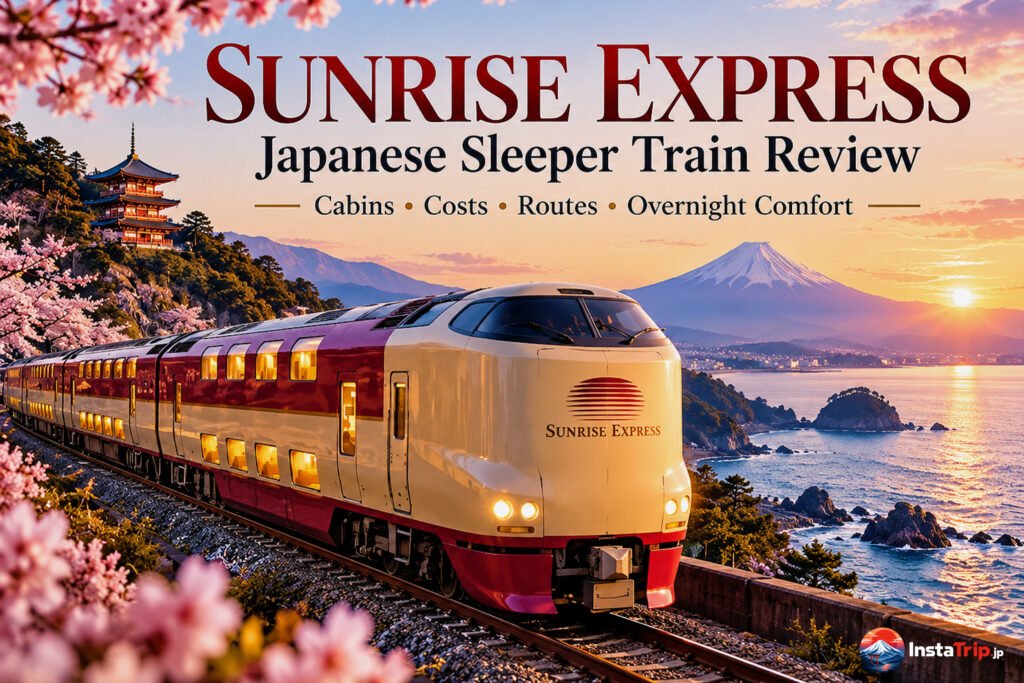
At Tokyo Station, the platforms begin to quiet just as the Sunrise Express prepares to leave. This Japanese sleeper train review is not about racing across the country at shinkansen speed. It is about trading a hotel night for the gentle rhythm of rail travel, falling asleep beneath city lights, and waking as Japan’s landscapes shift beyond the window.
The Sunrise Seto (サンライズ瀬戸) and Sunrise Izumo (サンライズ出雲) are Japan’s last regularly scheduled overnight sleeper trains, and that alone gives the experience a special character. Their salmon-pink and bronze exterior may feel wonderfully retro beside the sleek shinkansen, but the journey itself remains a practical and captivating way to reach the Seto Inland Sea or the spiritual landscapes of Shimane.
Japanese Sleeper Train Review: What Makes Sunrise Special
The Sunrise Express is actually two trains traveling together from Tokyo through the night. Near Okayama, usually before dawn, they separate. The Sunrise Seto continues toward Takamatsu in Kagawa Prefecture, a gateway to the islands and art-filled coast of the Seto Inland Sea. The Sunrise Izumo heads toward Izumoshi, close to Izumo Taisha, one of Japan’s most significant Shinto shrines.

That split gives the train a rare sense of occasion. While many Japanese rail journeys are defined by efficiency, the Sunrise is defined by transition. Tokyo’s electric glow gives way to sleeping suburbs, dark mountain silhouettes, and then a pale, quiet morning in western Japan. For travelers who value atmosphere as much as arrival time, this is the point.
It is also an experience shaped by scarcity. Japan once had a broader network of overnight trains, but high-speed rail and domestic flights changed the economics of long-distance travel. The Sunrise survives because it offers something neither can fully replace: an unhurried night aboard a moving piece of Japanese railway culture.
The Cabins: Compact, Private, and Surprisingly Comfortable
The best way to experience the Sunrise is in a private compartment. These rooms are small, thoughtfully arranged, and unmistakably Japanese in their efficient use of space. Most have a bed, a small shelf or desk area, reading light, climate controls, and a window positioned for watching the night pass by.
A Solo room is the most compact private choice, designed for one person and ideal for travelers who prioritize privacy over space. A Single room offers a little more room to settle in, while Single Twin and Sunrise Twin compartments suit couples, friends, or parents traveling with a child. The upper-level cabins are particularly memorable, raising your view above the platform as the train glides out of Tokyo.
The trade-off is clear: these are not spacious hotel rooms on rails. Luggage space is limited, corridors are narrow, and a tall traveler may find the bed snug. Yet the compactness is part of the charm. Everything has a place, from hooks and shelves to foldaway fittings, creating a private retreat that feels purposeful rather than cramped.
For a lower-cost alternative, the train also has Nobi Nobi seating. This is a shared, carpeted sleeping area where passengers lie down in assigned spaces rather than using conventional seats. It is less private and can feel more exposed, but it is a distinctive option for flexible travelers, especially those using a Japan Rail Pass. Bring an eye mask, earplugs, and a small travel pillow if you choose it.
Sleep Quality: Better Than You Might Expect
Sleep on the Sunrise is not identical to sleep in a quiet hotel. The train sways, wheels hum through the night, and station stops occasionally break the stillness. Light sleepers may wake more than once, particularly if their cabin is near a door or service area.
But many travelers find the motion deeply calming. Once the train leaves the greater Tokyo area, the sound becomes a steady backdrop rather than a disruption. There is something quietly magnificent about opening your eyes at dawn, lifting the blind, and finding rice fields, misty hills, or the industrial edges of Okayama sliding past.
Food, Showers, and the Onboard Reality
The Sunrise is not a luxury cruise train, and expectations should be set accordingly. There is no full dining car or breakfast service, so buy dinner, snacks, and drinks before boarding. Tokyo Station offers abundant choices, from beautifully packed bento boxes to bakery items, tea, beer, and late-night convenience-store staples.
Eating a bento in your cabin after departure is one of the journey’s simple pleasures. Choose something easy to manage in a small space, and avoid relying on onboard vending options for a full meal. By morning, a coffee and pastry saved from the night before can be enough until you arrive.
Shower rooms are available, but they are limited. Shower cards are sold from onboard vending machines, and they can sell out early. If a shower matters to you, board promptly and check availability soon after departure. The facilities are functional and clean rather than indulgent, which fits the train’s practical character.
Shared restrooms and wash areas are also well maintained, although the experience depends on fellow passengers and the time of night. As with any overnight train, packing a compact toiletry kit, comfortable sleepwear, and clothes for the next morning makes a meaningful difference.
Is the Sunrise Express Worth the Cost?
It depends on what you are comparing it with. A shinkansen can take you from Tokyo to Okayama in a few hours, while a domestic flight may be quicker for some longer routes. If your only goal is to arrive as fast or as cheaply as possible, the Sunrise is not automatically the best choice.
Its value comes from combining transportation, a night of accommodation, and a memorable travel experience. Private rooms require a regular rail fare and limited express charge, plus an additional accommodation charge. Prices vary by cabin type and can change, so it is wise to check current JR information before planning around a specific budget.
Japan Rail Pass holders should pay close attention to the details. The pass can cover the basic rail journey and limited express portion where valid, but private rooms generally require an additional accommodation fee. Nobi Nobi spaces have historically been the most pass-friendly option, though reservations remain essential and policies can change.
For couples sharing a twin room, or travelers who would otherwise book a Tokyo hotel and take an early train west, the math can feel more favorable. For solo travelers in a private compartment, it is often a splurge. That splurge is justified when the journey itself is part of your Japan story.
Booking the Train: The Hardest Part of the Adventure
The Sunrise Express is popular with Japanese rail enthusiasts, couples, independent travelers, and visitors seeking one of Japan’s most unusual overnight experiences. Private cabins can disappear quickly, especially on weekends, holidays, and during spring and autumn travel seasons.
Reservations generally open one month before departure, with sales beginning in Japan time. If the train is central to your itinerary, build flexibility into your plans. Consider traveling midweek, staying open to either the Seto or Izumo route, and having a daytime rail alternative in mind.
Do not book nonrefundable hotels or activities at the far end of the route until you have confirmed your berth. This is one of those rare Japanese travel experiences where demand can outweigh even careful planning.
Which Route Should You Choose?
Choose the Sunrise Seto if you want to arrive in Takamatsu and continue toward the Seto Inland Sea. From there, the region opens into a compelling world of island ferries, contemporary art, coastal scenery, and the refined food culture of Kagawa, known for its udon.
Choose the Sunrise Izumo if your journey is leading toward Shimane’s quieter, more ancient atmosphere. Izumo Taisha, the Sea of Japan coastline, and the historic castle town of Matsue offer a powerful contrast to Tokyo’s dynamic urban energy. Arriving by sleeper train gives this part of Japan an especially cinematic beginning.
The Seto route is often easier to connect with a wider western Japan itinerary. The Izumo route feels more remote and contemplative. Neither is better in absolute terms. Your choice comes down to whether you are drawn toward island horizons or sacred landscapes.
A Night That Changes the Shape of an Itinerary
The Sunrise Express asks you to slow down. It does not offer perfect silence, endless space, or the polished luxury of a high-end hotel. What it offers is rarer: the chance to inhabit the distance between two parts of Japan.
Board with a good bento, a light bag, and room in your schedule for a little uncertainty. By the time morning light reaches the window, the train will have done more than carry you west. It will have turned an ordinary transfer into one of the most memorable nights of your journey.
|
![[商品価格に関しましては、リンクが作成された時点と現時点で情報が変更されている場合がございます。]](https://hbb.afl.rakuten.co.jp/hgb/0489ec49.ec8e1d52.0489ec4a.0edbe10a/?me_id=1213310&item_id=21349458&pc=https%3A%2F%2Fthumbnail.image.rakuten.co.jp%2F%400_mall%2Fbook%2Fcabinet%2F4940%2F9784802214940_1_4.jpg%3F_ex%3D128x128&s=128x128&t=picttext "[商品価格に関しましては、リンクが作成された時点と現時点で情報が変更されている場合がございます。]")