
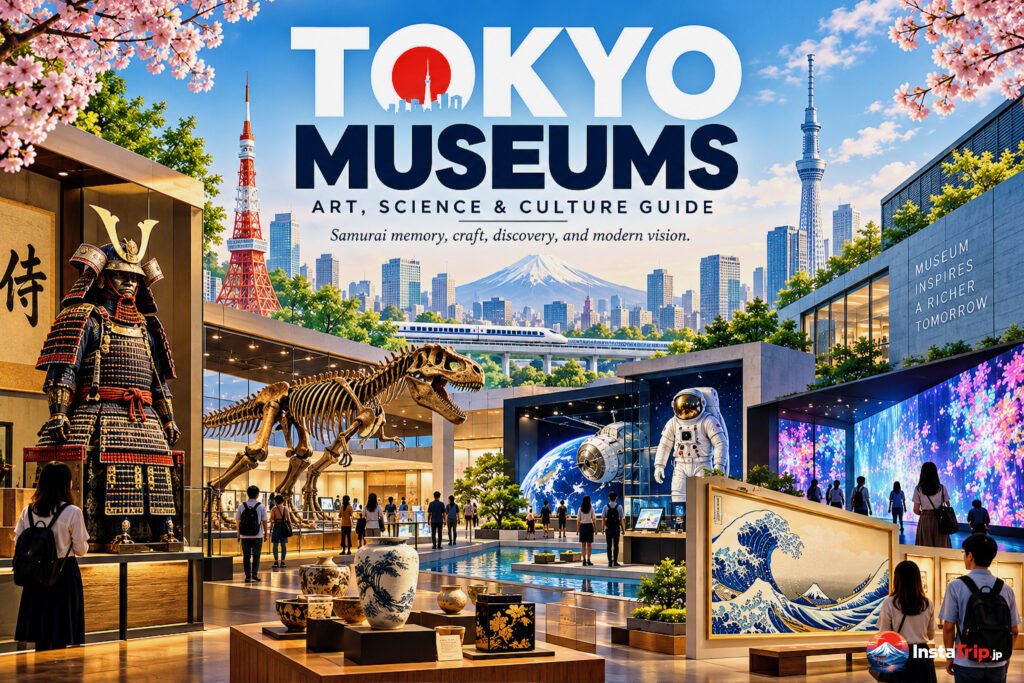
A quiet gallery of Buddhist sculpture, a glowing digital universe, a woodblock wave known around the world, and a tiny object perfected by a master craftsperson can all belong to the same Tokyo afternoon. Tokyo museums are not a single category of attraction. They are a vivid way to encounter the city’s many identities: the former shogunal capital, the center of modern Japan, a global art destination, and a place where everyday design receives extraordinary attention.
For travelers, the challenge is not finding a museum. It is choosing the right lens. Tokyo’s cultural institutions are spread across distinct neighborhoods, and each visit can change the rhythm of a day. A morning among ancient treasures in Ueno feels very different from an evening of contemporary installations in Roppongi or an immersive digital artwork in Azabudai Hills.
Tokyo museums: choose a story, not just a building
The most rewarding museum days begin with a question. Are you curious about Japan before Tokyo became a modern metropolis? Do you want to understand ukiyo-e, architecture, fashion, animation, or the ideas shaping contemporary art? A focused choice makes the experience more memorable than rushing through several major collections.

Ueno is the natural starting point for art and history. Its spacious park setting brings together institutions that can easily fill an entire day, especially in spring, when cherry blossoms add another layer of atmosphere. Roppongi, by contrast, places art within Tokyo’s vertical, fast-moving urban landscape. The two areas reveal an essential contrast in the city: deep continuity and restless reinvention.
Allow time for the museum itself, not only the works inside it. Tokyo’s galleries often make careful use of gardens, natural light, courtyards, cafés, and views across the skyline. These pauses are part of the cultural experience, reflecting a sensitivity to season, material, and setting that appears across Japanese art and architecture.
Begin with Japan’s great visual traditions
Tokyo National Museum: a foundation for Japanese art
In Ueno Park, Tokyo National Museum is an exceptional first stop for anyone hoping to place Japan’s art, ritual, and craftsmanship in context. Its collections range across archaeological objects, Buddhist images, samurai arms and armor, lacquerware, ceramics, textiles, calligraphy, and painting. Rather than presenting history as distant or static, the museum shows how materials carried meaning: the sheen of lacquer, the deliberate irregularity of a tea bowl, the disciplined line of a sword fitting.
It is an ambitious museum, and trying to see every gallery can flatten the experience. Choose two or three areas that genuinely interest you, then give them time. The Japanese Gallery offers a broad introduction, while the Gallery of Horyuji Treasures creates a more contemplative encounter with ancient Buddhist art. Seasonal displays also mean that repeat visits can feel different.
For visitors new to Japanese art, look beyond famous objects and notice the relationship between function and beauty. A writing box, kimono, incense container, or food vessel was often made for use, yet designed with a level of imagination that turns daily life into an art form.
Nezu Museum: art in the calm between city streets
Near Omotesando, the Nezu Museum offers a strikingly different scale. Its collection of premodern Japanese and East Asian art is significant, but the experience is shaped equally by its architecture and garden. The building’s long, low lines and sheltered approach create a sense of retreat from one of Tokyo’s most fashionable districts.
This is an ideal museum for travelers drawn to tea culture, ceramics, calligraphy, and the quiet power of individual objects. The garden path, with its stone lanterns, ponds, and small teahouses, encourages a slower pace. It is particularly captivating after rain or during the changing colors of early autumn. Because special exhibitions rotate, the number of works on view may be modest, but that intimacy is part of its appeal.
The Sumida Hokusai Museum: meet an artist beyond the wave
Katsushika Hokusai’s The Great Wave has become an international image, but the Sumida Hokusai Museum invites visitors to see the artist as far more than the creator of one famous print. Located in the area where Hokusai spent much of his life, the museum traces his astonishingly productive career through prints, drawings, illustrated books, and changing artistic identities.
The museum is especially rewarding for those interested in Edo-period Tokyo, then called Edo. Hokusai observed actors, laborers, merchants, landscapes, and passing weather with remarkable energy. His work captures a city alive with commerce and spectacle, while his landscapes reveal a profound fascination with Mount Fuji and the natural world. Pairing the museum with a walk along the Sumida River makes the historical connection feel immediate.
See contemporary Tokyo in motion
Mori Art Museum: global ideas above Roppongi
High in Roppongi Hills, Mori Art Museum brings a changing program of contemporary art into one of Tokyo’s most dramatic urban settings. Its exhibitions often connect artists from Japan and around the world through themes such as cities, ecology, identity, technology, and social change. This is not necessarily the place to seek a permanent overview of Japanese art. It is where Tokyo’s role in current cultural conversations becomes visible.
The museum works particularly well in the late afternoon. After looking at challenging, imaginative work, the surrounding city lights offer their own kind of installation. Exhibition themes vary widely, so check what is on before building your day around it. A show may feel deeply personal, visually spectacular, or intellectually demanding – and sometimes all three.
The National Art Center, Tokyo: a gallery without a collection
Also in Roppongi, The National Art Center, Tokyo is instantly recognizable for its sweeping glass façade and fluid interior. Unlike a conventional museum, it does not maintain a permanent collection. Its identity comes from large-scale temporary exhibitions, which can range from major retrospectives to design and fashion displays.
That model makes it an excellent choice for repeat visitors and for travelers with a particular artist or movement in mind. It also means the experience depends entirely on the current program. Even when an exhibition is not your priority, the building is worth appreciating as an example of contemporary Japanese architecture shaped around movement, transparency, and public space.
teamLab Borderless: digital art as a changing environment
At teamLab Borderless in Azabudai Hills, digital art leaves the frame altogether. Projected flowers drift across walls, light responds to bodies in motion, and rooms transform as visitors move through them. The experience is vibrant, playful, and highly photogenic, but it is more interesting when approached as an experiment in perception rather than simply a backdrop for pictures.
The collective behind teamLab often explores the idea that artworks can exist without fixed boundaries, interacting with people and with one another. That makes the visit feel less like viewing a sequence of exhibits and more like entering a constantly changing environment. Timed entry is commonly required, and popular periods can be busy, so an early or later slot may offer a more spacious experience.
Follow your own fascination
Tokyo rewards specific interests. Animation lovers may find the Ghibli Museum in Mitaka deeply moving for its hand-drawn detail, imaginative architecture, and playful devotion to the creative process. Its limited entry system requires advance planning, but the museum offers a rare chance to encounter animation as an art of patience, observation, and wonder.
For science and emerging technology, Miraikan in Odaiba brings questions about space, robotics, climate, and the human future into a hands-on setting. Families often enjoy it, yet its exhibitions can also appeal to adults who want a clearer sense of Japan’s scientific ambitions. In Ginza, smaller galleries and design spaces can be a welcome counterpoint to larger institutions, especially for travelers interested in contemporary craft, graphics, and fashion.
The best choice depends on your energy as much as your interests. A dense historical collection can be absorbing but demanding. An immersive exhibition may feel exhilarating, but less useful for understanding a long artistic tradition. Combine one major museum with a neighborhood walk, a temple visit, or an unhurried meal rather than turning culture into a checklist.
Make a museum day feel like Tokyo
Check opening days, special exhibition schedules, and ticket policies shortly before visiting. Major museums may close on particular weekdays, while popular timed-entry experiences and small specialty museums can sell out. Tokyo is wonderfully efficient, but a little planning protects the sense of spontaneity once you arrive.
A practical rhythm is to visit a museum soon after opening, take lunch in its neighborhood, then let the surrounding streets extend the story. From Ueno, continue toward Yanaka’s older lanes or Ameyoko’s lively market energy. From Nezu, wander into Omotesando and Aoyama. From Roppongi, stay through dusk, when the district’s architecture and illuminated towers feel almost cinematic.
Bring a small notebook, or use your phone to record one work that stays with you and one question it raises. The gesture is simple, but it changes how you look. Tokyo’s museums are full of celebrated masterpieces; their deeper gift is the invitation to notice the city with greater attention long after you have stepped back onto the street.